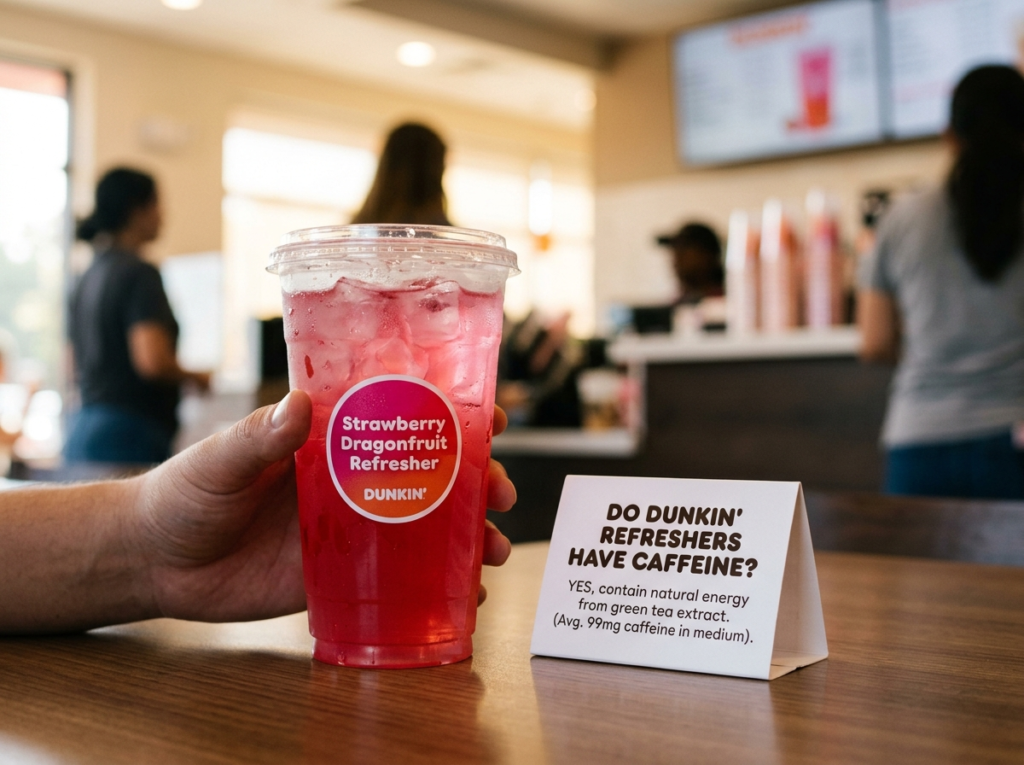
A single medium Dunkin Refresher packs roughly 99 mg of caffeine — that’s about the same as a full cup of regular brewed coffee. Surprised? Most people are. Dunkin Refreshers look like fruity, lightweight coolers. They taste like a tropical vacation. And because they don’t smell or taste like coffee, a lot of folks assume they’re caffeine-free.
They’re not.
If you’ve been sipping on these colorful drinks thinking you’re avoiding caffeine, or if you’re just curious about what’s actually in your cup, you’re in the right place. Let’s break down exactly how much caffeine Dunkin Refreshers contain, where that caffeine comes from, and whether these drinks are actually a healthy choice.
What Exactly Are Dunkin Refreshers?
Dunkin Refreshers are fruity, iced beverages that Dunkin’ introduced as a lighter alternative to traditional coffee and espresso drinks. They’re vibrant, sweet, and designed for people who want an energy lift without the bitter taste of coffee.
Think of them as the middle ground between a juice drink and an energy beverage. You get the fruit-forward flavor profile of something like a smoothie or iced tea, but with a real caffeine kick hiding underneath.
Each Refresher starts with a green tea extract base, which is blended with fruit concentrate, B vitamins, and flavoring. The drink is served over ice and often finished with a bright, eye-catching color that matches its flavor.
The key thing to understand here? That green tea extract isn’t just there for show. It’s the primary source of caffeine in every single Dunkin Refresher. And green tea extract is no joke — it delivers a legitimate energy boost, just without the roasted coffee taste.
Dunkin Refreshers Caffeine Content — The Full Breakdown
Let’s get straight to the numbers, because that’s probably why you’re here.
The caffeine in Dunkin Refreshers varies based on the size you order. Dunkin’ offers these drinks in their standard cup sizes — Small, Medium, and Large. If you’re not sure how those sizes translate to ounces, you might want to check out this guide on Dunkin cup sizes for clarity.
Here’s what the caffeine content looks like across sizes:
Small (16 oz): approximately 66 mg of caffeine
Medium (24 oz): approximately 99 mg of caffeine
Large (32 oz): approximately 132 mg of caffeine
These numbers apply across all the standard Dunkin Refresher flavors. The caffeine source — green tea extract — stays consistent regardless of whether you choose Peach Passion Fruit, Strawberry Dragonfruit, or any seasonal option. The flavor changes, but the caffeine base doesn’t.
Now, let’s put those numbers in perspective. A medium Dunkin hot coffee contains around 210 mg of caffeine. So a medium Refresher gives you roughly half the caffeine of a regular coffee. That makes Refreshers a solid pick if you want a moderate energy boost without going full throttle.
Compared to something like a Monster Energy drink, which typically has around 160 mg of caffeine per can, a medium Dunkin Refresher is noticeably lighter. And compared to a Starbucks Refresher, which has around 35-45 mg of caffeine per grande, Dunkin’s version actually packs more of a punch.
That last comparison tends to shock people. Many assume Starbucks and Dunkin Refreshers are basically the same drink with different branding. They’re not. Dunkin Refreshers contain significantly more caffeine per serving than their Starbucks counterpart. If you’re switching between the two brands, keep that difference in mind.
Where Does the Caffeine in Dunkin Refreshers Come From?
Here’s where things get interesting, and where a lot of confusion starts.
Dunkin Refreshers don’t contain coffee. Not a drop. There’s no espresso shot hiding in there, no cold brew mixed in. The caffeine comes entirely from green tea extract.
Green tea extract is a concentrated form of — you guessed it — green tea. It retains the caffeine naturally found in tea leaves, along with other compounds like L-theanine and antioxidants. The extract is processed in a way that removes most of the tea flavor, which is why your Refresher tastes like peach or strawberry rather than a cup of green tea.
This is actually a smart move from Dunkin’. Green tea caffeine tends to hit differently than coffee caffeine. Many people report a smoother, more gradual energy curve with green tea-based caffeine. You don’t get that sharp spike followed by a crash that coffee sometimes causes. L-theanine, which naturally occurs alongside caffeine in green tea, has a calming effect that can take the jittery edge off.
So when someone says “Dunkin Refreshers give me energy but don’t make me anxious,” there’s real science behind that feeling. The caffeine is real, but the delivery system is just… gentler.
That said, caffeine is caffeine. Your body processes it the same way regardless of the source. If you’re sensitive to caffeine, 99 mg from a medium Refresher will still affect you. Don’t let the fruity taste fool you into thinking otherwise.
Dunkin Refreshers Ingredients — What’s Actually in Your Cup?
Beyond caffeine, what else are you drinking? Let’s look at the Dunkin Refreshers ingredients a bit more closely.
The ingredient list for a typical Dunkin Refresher includes water, sugar, green tea extract, fruit juice concentrate (specific to the flavor), natural and artificial flavors, citric acid, and B vitamins. Some variations also contain coconut milk when ordered as a “Coconut Refresher.”
The sugar situation is worth paying attention to. A medium Dunkin Refresher contains around 46 grams of sugar. That’s roughly 11.5 teaspoons. For context, the American Heart Association recommends no more than 25 grams of added sugar per day for women and 36 grams for men. One medium Refresher can exceed that daily limit on its own.
The B vitamins added to the drink — typically B3 (niacin), B6, and B12 — are a nice touch. These vitamins play a role in energy metabolism and are commonly found in energy drinks. They don’t provide energy on their own the way caffeine does, but they support the body’s natural energy-producing processes.
If you’re ordering the Coconut Refresher version, you’re also getting coconut milk mixed in, which adds some fat, a slightly creamier texture, and a few extra calories. The coconut milk version tends to run about 30-50 calories higher than the standard version, depending on the size.
One thing you won’t find in Dunkin Refreshers? Artificial sweeteners. Unlike some sugar-free Dunkin options, the Refreshers use real sugar. That’s a plus for people who avoid artificial sweeteners, but a downside if you’re watching your sugar intake.
Dunkin Refreshers Flavors — What’s on the Menu?
Dunkin’ rotates its Refresher flavors periodically, but a few have become permanent staples. Here’s what you’ll typically find:
Peach Passion Fruit has been one of the most popular choices since Refreshers launched. It’s sweet, tangy, and has a tropical flavor that works well over ice. The color is a warm golden-orange, and it’s probably the most “juice-like” tasting option.
Strawberry Dragonfruit leans into the berry side. It’s slightly less sweet than the Peach Passion Fruit and has that pink-magenta color that makes it incredibly Instagram-friendly. The dragonfruit adds a subtle exotic note, though most of the flavor is carried by the strawberry.
Dunkin’ occasionally introduces limited-time flavors tied to seasons or promotions. Past appearances have included Mango Pineapple and Blueberry Pomegranate variations. These seasonal flavors keep the same green tea extract caffeine base, so the caffeine content stays consistent even when the flavor changes.
Each flavor is available as a standard Refresher (made with the flavored concentrate and green tea energy) or as a Coconut Refresher (blended with coconut milk for a creamier finish). The coconut version softens the tartness a bit and gives the drink a more smoothie-like quality.
If you’re the type of person who usually goes for non-coffee drinks when visiting coffee shops, Dunkin Refreshers fit squarely into that category. They deliver caffeine without any coffee flavor whatsoever.
Are Dunkin Refreshers Healthy?
This is the question that sparks the most debate, and honestly, the answer depends on what “healthy” means to you.
The pros: Dunkin Refreshers contain green tea extract, which brings along antioxidants. They have B vitamins. They’re lower in caffeine than most coffee drinks, which could be a benefit if you’re trying to moderate your intake. They don’t contain any fat in the standard (non-coconut) version. And they’re free from coffee’s acidity, which matters if you deal with acid reflux or stomach sensitivity.
The cons: The sugar content is high — really high. As mentioned, a medium has about 46 grams. That alone makes it hard to call this a “healthy” drink by any nutritional standard. The calorie count for a medium ranges from about 140-200 calories depending on the flavor and whether you add coconut milk. Those calories come almost entirely from sugar.
Here’s an honest comparison. A medium Dunkin Refresher has roughly the same sugar content as a can of Coca-Cola. You probably wouldn’t call Coke a health drink, right? The green tea extract and B vitamins in a Refresher are genuinely beneficial additions, but they don’t cancel out the sugar load.
A practical tip: If you want to enjoy Dunkin Refreshers without going overboard on sugar, order a small instead of a large. That drops the sugar to around 31 grams — still not low, but significantly better. You can also ask for less sweetener if your local Dunkin’ allows customization on Refresher drinks. Some locations will accommodate this; others won’t, since Refreshers come from a pre-mixed concentrate.
If your main concern is calories and you’re exploring lighter options across different coffee shops, low calorie Starbucks drinks might give you some useful ideas you can apply to your Dunkin orders too.
The bottom line? Dunkin Refreshers aren’t health drinks, but they’re not the worst thing you could order either. Treat them like what they are — a sweet, caffeinated treat — and enjoy them in moderation.
Dunkin Refreshers vs. Other Caffeinated Drinks
Understanding how Dunkin Refreshers stack up against other popular caffeinated beverages can help you make smarter choices based on your caffeine tolerance and daily goals.
Dunkin Refresher (Medium) — ~99 mg caffeine
That’s your baseline. Now let’s see how it compares.
A medium Dunkin iced coffee delivers about 297 mg of caffeine. That’s three times more than a Refresher of the same size. So if you’re switching from iced coffee to a Refresher, you’re cutting your caffeine intake dramatically. That could be a good or bad thing depending on your energy needs.
A Starbucks Pink Drink (grande) — which is basically Starbucks’ version of a fruity Refresher with coconut milk — contains around 45 mg of caffeine. Roughly half of what a medium Dunkin Refresher has.
A standard Red Bull can (8.4 oz) contains 80 mg of caffeine. So a medium Dunkin Refresher actually gives you more caffeine than a Red Bull, which surprises most people.
A can of Pepsi has about 38 mg. A Coke Zero sits around 34 mg. Both are well below what you’d get from any size Dunkin Refresher.
And then there are drinks with zero caffeine — like Sprite or Fanta — which are in a completely different category.
The point? Dunkin Refreshers sit in a moderate caffeine zone. They’re not as intense as coffee or most energy drinks, but they pack noticeably more caffeine than sodas and even some competing Refresher-style beverages.
Who Should (and Shouldn’t) Drink Dunkin Refreshers?
Not every drink is right for every person. Here’s a realistic look at who benefits most from Dunkin Refreshers and who might want to think twice.
Great choice for: People who dislike the taste of coffee but still want a caffeine boost. If you can’t stand the bitterness of coffee but need something to keep you alert during a long afternoon, a Refresher fills that gap nicely. It’s also a good pick for anyone transitioning away from high-caffeine energy drinks and looking for something with a softer kick.
Worth being cautious about if: You’re pregnant or breastfeeding. The American College of Obstetricians and Gynecologists recommends limiting caffeine to 200 mg per day during pregnancy. A large Refresher at 132 mg takes up a significant chunk of that allowance, and you’d need to account for any other caffeine sources in your day.
Probably not ideal for: Kids and young teenagers. The American Academy of Pediatrics discourages caffeine for children under 12 and recommends no more than 100 mg per day for adolescents aged 12-18. A medium Refresher is right at that upper limit, and because it tastes like a fruit drink, kids might not realize they’re consuming caffeine at all. That’s a real concern.
Also think twice if: You’re highly caffeine-sensitive. Some people feel jittery, anxious, or have trouble sleeping after even small doses of caffeine. If that’s you, 66-132 mg from a Refresher could easily trigger those effects. The fact that it comes from green tea extract might soften the impact slightly, but individual sensitivity varies widely.
Tips for Ordering Dunkin Refreshers Smarter
A few practical tricks can help you get the most enjoyment from your Refresher while keeping things balanced.
Know your size. Going from a small to a large doubles your caffeine and sugar intake. If you’re having a Refresher as a casual afternoon pick-me-up, a small is often enough. Save the large for those days when you genuinely need the extra boost.
Time it right. Because Dunkin Refreshers contain a moderate amount of caffeine, drinking one after 3-4 PM could interfere with your sleep if you’re sensitive. Caffeine has a half-life of about 5-6 hours, meaning half of it is still in your system that much later. A medium Refresher at 4 PM means roughly 50 mg of caffeine still active in your body at 9-10 PM.
Try the coconut version strategically. Adding coconut milk increases calories and fat, but it also slows down sugar absorption slightly. That means a more gradual energy release and less of a blood sugar spike. If you’re going to have a Refresher anyway, the coconut version might actually be the smarter nutritional play — despite the extra calories.
Don’t double up unknowingly. If you’re having a Refresher alongside other caffeinated drinks throughout the day, keep a rough count. Pair a Refresher with a couple cups of coffee and you could easily push past 400 mg of caffeine — the FDA’s recommended daily maximum for most healthy adults. Track it loosely, especially if you also drink energy drinks that last for hours in the same day.
How Dunkin Refreshers Compare to Starbucks Refreshers
This matchup comes up constantly, so it’s worth addressing directly.
Both Dunkin and Starbucks use green tea extract as their caffeine source for Refreshers. Both offer fruit-forward flavors. Both serve them over ice. On the surface, they seem nearly identical.
The differences become clear when you look at the details. Dunkin Refreshers contain significantly more caffeine per serving. A medium Dunkin Refresher has around 99 mg, while a grande Starbucks Refresher comes in around 35-45 mg. That’s more than double the caffeine at Dunkin for a similarly sized drink.
Flavor-wise, Starbucks currently offers more variety in their Refresher lineup, with options like Mango Dragonfruit, Strawberry Açaí, and Pineapple Passionfruit. Dunkin keeps its options tighter, usually sticking to two or three core flavors plus seasonal rotations.
On the sugar front, both brands load their Refreshers with sweetness. Starbucks Refreshers contain about 45 grams of sugar in a grande, which is actually comparable to Dunkin’s numbers. Neither brand wins a health award here.
Price tends to favor Dunkin slightly — their Refreshers are typically $1-2 cheaper than Starbucks equivalents, though pricing varies by location.
The real deciding factor often comes down to caffeine preference. If you want more energy from your Refresher, Dunkin wins. If you want less caffeine and more flavor variety, Starbucks might be your pick. For an even broader look at what Dunkin does well across their full drink menu, the best Dunkin Donuts drinks guide covers a lot of ground.
FAQ
Do Dunkin Refreshers have more caffeine than coffee?
No. Dunkin Refreshers have less caffeine than Dunkin’s regular brewed coffee. A medium Refresher contains about 99 mg of caffeine, while a medium hot coffee has roughly 210 mg. You’d need to drink about two medium Refreshers to match one medium coffee’s caffeine level.
Can I drink Dunkin Refreshers if I’m caffeine-sensitive?
You can, but proceed carefully. Even though Refreshers have moderate caffeine (66-132 mg depending on size), that’s still enough to cause jitteriness, increased heart rate, or sleep disruption in caffeine-sensitive individuals. Start with a small size and see how your body responds before sizing up.
Are Dunkin Refreshers vegan?
The standard Dunkin Refreshers (without coconut milk) are generally considered vegan-friendly. They don’t contain dairy, eggs, or animal-derived ingredients. The Coconut Refresher version uses coconut milk, which is also plant-based, so both options work for a vegan diet. That said, Dunkin doesn’t officially certify their Refreshers as vegan, so cross-contamination in preparation is always possible.
Do Dunkin Refreshers have artificial colors?
Dunkin Refreshers get their color primarily from fruit juice concentrates and natural colorants. The specific coloring agents can vary by flavor. If you have sensitivities to certain food dyes, it’s worth checking the ingredient list for your specific flavor at your local Dunkin’ or on their official website.
How long does the caffeine from a Dunkin Refresher last?
Caffeine typically reaches peak levels in your bloodstream within 30-60 minutes of consumption and has a half-life of about 5-6 hours. So the caffeine from a medium Dunkin Refresher (99 mg) would be about half-gone after 5-6 hours. Most people feel the energizing effects for 3-5 hours, though this varies based on individual metabolism, body weight, and caffeine tolerance.
Final Thoughts
Dunkin Refreshers are one of those drinks that catch people off guard. They look like fruit punch, taste like a tropical treat, and seem completely innocent. But there’s legitimate caffeine working behind the scenes — enough to rival a Red Bull and outpace every soda on the market.
That’s not necessarily a bad thing. If you know what you’re getting, you can use Refreshers strategically. Need a mid-afternoon boost without coffee breath? A small Refresher does the job. Want something flavorful on a hot day that also keeps you alert? A medium Peach Passion Fruit with coconut milk is hard to beat.
Just don’t treat them like juice. They aren’t. Know the caffeine numbers, keep an eye on the sugar content, and order the size that matches your actual needs — not your thirst. Your body (and your sleep schedule) will thank you for it.