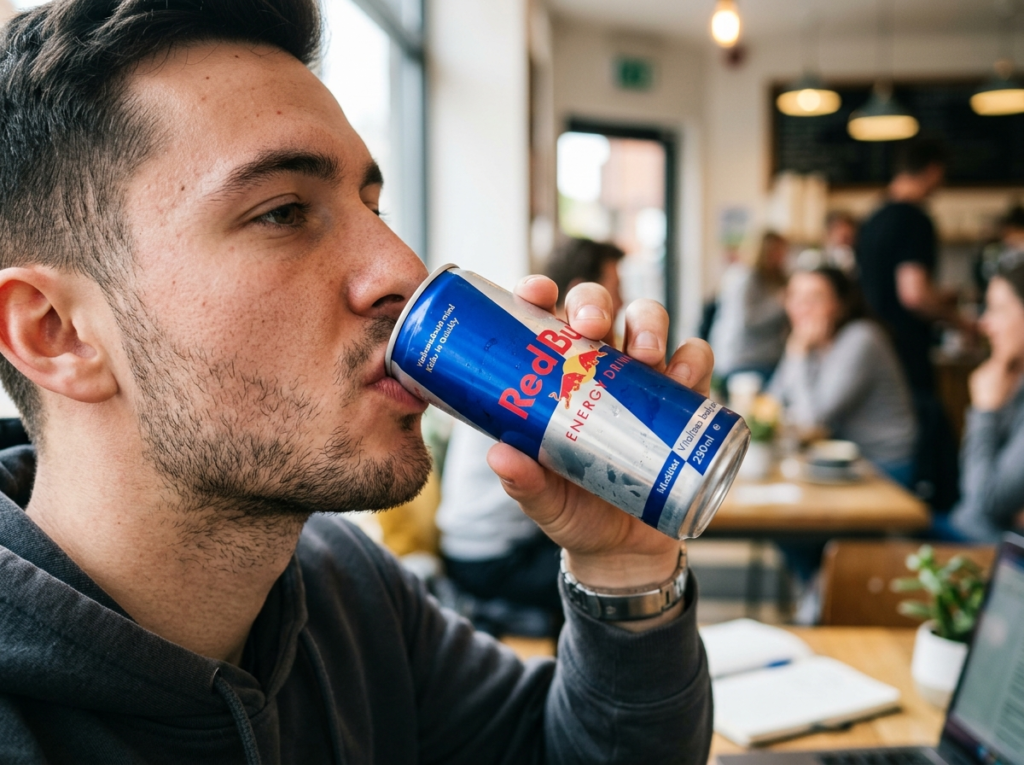
You just cracked open a can of Red Bull before a late-night study session, a gym workout, or a long drive. The clock’s ticking. You’re waiting for that boost. And the question in your head is simple — how long does Red Bull take to kick in?
The short answer? You’ll start feeling it within 10 to 15 minutes. But that’s just the beginning of the story. The caffeine and sugar in Red Bull follow a specific absorption timeline inside your body, and understanding that timeline can help you time your intake perfectly — whether you’re prepping for a presentation or pushing through a workout.
Let’s break it all down, minute by minute.
What Happens After You Drink Red Bull? The Real Timeline
Your body doesn’t process Red Bull all at once. It goes through stages. Think of it like a wave — it builds, peaks, and eventually fades. Here’s a realistic, science-backed look at what happens from the moment you take your first sip.
The First 10 Minutes: Caffeine Enters Your Bloodstream
The second Red Bull hits your stomach, your body gets to work. Caffeine is water-soluble, which means your stomach and small intestine absorb it pretty quickly. Within roughly 10 minutes, caffeine starts entering your bloodstream.
At this point, you probably won’t feel a dramatic change. But behind the scenes, your heart rate may begin to rise slightly, and your body is already gearing up. The sugar (about 27 grams in a standard 8.4 oz can) starts getting absorbed too, giving your blood glucose a quick bump.
15 to 45 Minutes: The Energy Wave Hits
This is the window where Red Bull really kicks in. Most people feel noticeably more alert and focused around the 15 to 20 minute mark. Your caffeine blood levels are climbing steadily, and that tired feeling starts fading.
By about 30 to 45 minutes after drinking, caffeine reaches its peak concentration in your blood. This is when you feel the strongest effects — sharper focus, more energy, and that familiar “I can handle anything” feeling. If you’re using Red Bull to power through something demanding, this is your golden window.
The taurine and B-vitamins in the formula are also playing their supporting roles during this phase, though their individual impact is much harder to isolate compared to caffeine and sugar.
1 to 2 Hours: Peak Performance Zone
Between 1 and 2 hours after drinking, you’re riding the peak of Red Bull’s effects. Your body has fully absorbed the caffeine (about 80 mg in a standard can), and you’re operating at your most alert state.
This is worth knowing if you’re trying to time your Red Bull before something specific. Got a workout at 6 PM? Drinking Red Bull around 5:15 or 5:30 PM will line up your peak energy with your training window.
3 to 4 Hours: The Gradual Comedown
Caffeine has what scientists call a half-life of about 5 to 6 hours in most healthy adults. That means roughly 5 hours after drinking Red Bull, about half the caffeine is still in your system. But the noticeable “energy boost” feeling typically starts fading around the 3 to 4 hour mark.
If you had the sugared version, you might also experience a mild sugar dip during this window. Your blood glucose spiked earlier, and now insulin has brought it back down — sometimes a little too aggressively. That’s what people call the “sugar crash,” and it’s real, though not everyone experiences it the same way.
If you’re curious about how this compares to other energy drinks, you might want to check out how long Monster Energy lasts — the timeline is surprisingly different because of the higher caffeine content.
Why Does Red Bull Kick In Faster for Some People?
You’ve probably noticed this — your friend drinks the same can and feels wired in 5 minutes, while you’re still waiting after 20. That’s not imagination. Several real factors affect Red Bull absorption time and how fast you feel it working.
Your Stomach Contents Matter — A Lot
This one is huge. Drink Red Bull on an empty stomach, and caffeine absorbs significantly faster. Your stomach has nothing else to process, so it rushes the caffeine straight to your small intestine and into your bloodstream. You could feel the effects in as little as 5 to 10 minutes.
Drink it right after a heavy meal? That same caffeine has to wait in line behind all the food your stomach is breaking down. Absorption slows down, and the Red Bull onset time could stretch to 30 minutes or more. The effect might also feel less intense because caffeine enters your blood more gradually instead of in one quick rush.
Pro Tip: If you need Red Bull to work fast, drink it on a mostly empty stomach or at least 30 minutes before eating. If you want a smoother, less jittery experience, have it with or after food.
Body Weight and Metabolism
A person weighing 130 pounds will typically feel 80 mg of caffeine more intensely than someone weighing 200 pounds. It’s simple math — the same dose distributes across less body mass, creating a higher concentration in the blood.
Your metabolic rate plays a part too. People with faster metabolisms process caffeine more quickly, which means a faster onset but also a shorter duration. Smokers, interestingly, metabolize caffeine nearly twice as fast as non-smokers due to how certain liver enzymes behave. Hormonal birth control, on the other hand, can slow caffeine metabolism significantly.
Your Caffeine Tolerance
If you drink Red Bull (or coffee, or any caffeinated drink) regularly, your body builds tolerance. Your adenosine receptors — the ones caffeine blocks to make you feel awake — actually multiply over time. So the same 80 mg dose that used to light you up might barely register after months of daily use.
Someone who rarely consumes caffeine will feel Red Bull kick in faster and stronger than a daily coffee drinker. That’s just how tolerance works.
Genetics Play a Silent Role
This one’s fascinating. Your genes influence how quickly your liver breaks down caffeine. People with a particular variant of the CYP1A2 gene are “fast metabolizers” — they process caffeine quickly, feel it fast, and clear it fast. Others are “slow metabolizers” who feel effects for much longer, sometimes uncomfortably so.
You can’t control your genetics, obviously. But if you’ve always felt like caffeine affects you differently than most people around you, there’s a real biological reason behind it.
Red Bull vs. Coffee: Which Kicks In Faster?
This is a question that comes up constantly. And the honest answer is — they kick in at roughly the same speed, because the active ingredient (caffeine) is the same molecule regardless of the source. Your body doesn’t know whether caffeine came from a Red Bull can or a coffee cup.
The difference lies in how much caffeine you’re getting and what else comes with it.
A standard 8.4 oz Red Bull contains about 80 mg of caffeine. A typical 8 oz cup of brewed coffee contains roughly 95 mg. So cup for cup, coffee actually delivers a slightly bigger caffeine punch. If you’re comparing a Starbucks drink ranked by caffeine content, you’ll find some options that blow Red Bull out of the water.
Where Red Bull differs is the combination of ingredients. You’re getting caffeine plus taurine, B-vitamins, and a hefty dose of sugar (unless you choose sugar-free). Some people report that this combination creates a “smoother” energy boost compared to coffee, which can feel more intense but also more jittery. That said, scientific evidence specifically proving taurine enhances caffeine’s effects is still limited.
The sugar in Red Bull does give you a quicker spike in energy compared to black coffee, because your body absorbs simple sugars very rapidly. But that spike comes with a trade-off — the potential sugar crash later.
How to Make Red Bull Kick In Faster
Sometimes you don’t have 20 minutes to wait. Maybe you need that energy now. While you can’t magically speed up your liver, there are a few practical things that influence how fast Red Bull works.
Drink it on an empty or near-empty stomach. We talked about this earlier, but it’s the single most effective way to speed up absorption. Caffeine that doesn’t have to compete with food gets into your blood much faster.
Drink it cold. This isn’t about temperature affecting absorption speed directly. It’s about the fact that most people drink cold beverages faster than warm ones. You’ll consume the entire can more quickly, which means all the caffeine enters your system sooner rather than being sipped over 30 minutes.
Don’t sip — drink with purpose. If you nurse a Red Bull over an hour, you’re spreading out the caffeine intake so gradually that you might never feel a strong “kick.” You’ll get a mild, extended alertness instead of a noticeable boost. Neither approach is wrong — it depends on what you’re after.
Stay hydrated. Dehydration slows down virtually every process in your body, including digestion and absorption. Drinking some water alongside your Red Bull isn’t going to dilute the caffeine — it’ll actually help your body process everything more efficiently.
How Long Does the Energy from Red Bull Actually Last?
Understanding when Red Bull kicks in is only half the picture. You also want to know how long that energy sticks around.
For most people, the noticeable effects of a single 8.4 oz Red Bull last somewhere between 3 to 5 hours. The peak happens within the first 1 to 2 hours, and then there’s a gradual decline.
But remember that caffeine half-life we mentioned — 5 to 6 hours? That means even after you stop feeling energized, caffeine is still in your system and can still affect your sleep. If you drink Red Bull at 4 PM, you’ll still have about 40 mg of caffeine floating around at 9 or 10 PM.
This is why most sleep researchers recommend cutting off all caffeine at least 6 hours before bedtime. If you plan to sleep at 11 PM, your last Red Bull should be no later than 5 PM.
For a deeper look at the full duration timeline, we’ve got a dedicated piece on how long Red Bull lasts that goes into much more detail.
Does Red Bull Sugar-Free Kick In Differently?
Yes and no. The caffeine content is identical — 80 mg in both the regular and sugar-free versions. So the caffeine-related onset time is basically the same.
The difference is what happens with energy beyond caffeine. Regular Red Bull gives you a rapid blood sugar spike on top of the caffeine boost. For the first 30 to 60 minutes, you’re riding both the caffeine wave and the sugar wave. That combination often makes regular Red Bull feel like it kicks in faster and harder.
Sugar-free Red Bull skips that glucose spike entirely. The energy you feel comes purely from caffeine and the supporting ingredients. Many people describe it as a “cleaner” energy boost — less of a rush, less of a crash. But it might also feel slightly less dramatic initially.
If you’re watching your calorie intake, sugar-free is the obvious choice. But if you want the fastest, most noticeable kick? The sugared version typically delivers a more immediate sensation, even though the caffeine itself works at the same speed.
What About Double-Dosing? Will Two Cans Kick In Faster?
Here’s something people don’t always think through. Drinking two Red Bulls doesn’t make the caffeine absorb faster. What it does is double your dose to 160 mg, which means the effects are stronger, not quicker. Your body still takes the same 10 to 15 minutes to start absorbing caffeine — it just absorbs more of it.
And 160 mg is getting close to a level where side effects become more likely for many people — jitteriness, rapid heartbeat, anxiety, digestive discomfort. The FDA suggests keeping total daily caffeine intake under 400 mg for healthy adults, and two Red Bulls puts you at 160 mg in a single sitting.
If you’re looking for more caffeine per serving, you might want to explore options like which energy drink has the most caffeine — though more isn’t always better. Compare that with the caffeine in Monster Energy and you’ll see the numbers vary quite a bit across brands.
⚠️ Warning: If you have any heart conditions, anxiety disorders, or caffeine sensitivity, always consult your doctor before consuming energy drinks. This article is for informational purposes and isn’t medical advice.
Timing Your Red Bull for Specific Activities
Now let’s get practical. You know Red Bull takes about 10 to 15 minutes to start working and peaks at 30 to 60 minutes. How do you use that information?
Before a Workout
Drink your Red Bull about 20 to 30 minutes before you start exercising. By the time you’ve warmed up, caffeine will be approaching peak levels. You’ll feel the biggest boost during the most intense part of your session.
Before an Exam or Presentation
Timing is a little different here because you need sustained focus, not a short burst. Drink Red Bull about 30 to 45 minutes before the event begins. This puts you right in the peak zone when you need it most, with effects lasting well through a typical 1 to 2 hour exam or meeting.
During a Long Drive
For road trips, the strategy changes. Don’t drink the whole can at the beginning. Instead, start with half the can about 30 minutes before you expect to feel drowsy. Save the other half for 2 to 3 hours later. This extends the alertness window instead of creating one spike followed by a fade.
Late-Night Study Sessions
Be careful here. Red Bull can absolutely help you power through a few more hours of studying. But if you drink it too late, the caffeine will wreck your sleep quality, and poor sleep destroys memory consolidation — which defeats the entire purpose of studying. Try to limit your Red Bull use to at least 6 hours before you plan to sleep, even if that means stopping earlier than you’d like.
What If You Don’t Feel Anything After Drinking Red Bull?
It happens. You drink a can, wait 30 minutes, and… nothing. A few reasons could explain this.
High caffeine tolerance is the most common culprit. If you’re regularly consuming 300+ mg of caffeine daily through coffee, tea, or other energy drinks, a single 80 mg Red Bull might not produce a noticeable effect. Your receptors are already so accustomed to caffeine that 80 mg barely moves the needle.
You ate a large meal recently. Food slows absorption to the point where caffeine trickles in so gradually that you never get that distinct “kick.” You might still get a mild lift, but it won’t feel dramatic.
You’re sleep-deprived beyond what caffeine can fix. Caffeine blocks adenosine receptors, but it doesn’t eliminate the adenosine itself. If you’ve been awake for 24+ hours, the adenosine buildup in your brain is so massive that 80 mg of caffeine can only block a fraction of it. You’ll still feel tired, just slightly less so.
You might be a fast metabolizer. Some people’s livers break down caffeine so quickly that it barely has time to accumulate enough to feel strong. If this sounds like you, a slightly higher dose might be necessary — but be cautious and don’t jump to extreme amounts.
If Red Bull doesn’t seem to do much for you and you’re looking for caffeine-free ways to stay refreshed, you might enjoy exploring non-coffee drinks at Starbucks that still offer a pick-me-up without the heavy caffeine load.
Red Bull Onset Time Compared to Other Popular Drinks
It helps to put Red Bull’s kick-in time in perspective alongside other beverages you might reach for.
Coffee kicks in at roughly the same speed as Red Bull — 10 to 15 minutes — but delivers slightly more caffeine per serving. The effects tend to feel sharper because there’s no sugar buffer (assuming you drink it black). If you’re curious about caffeine amounts across different coffee drinks, the caffeine in a tablespoon of coffee gives you a useful reference point.
Monster Energy (16 oz) packs about 160 mg of caffeine — double what Red Bull offers in a standard can. It takes a similar 10 to 15 minutes to start working, but the peak is noticeably higher. You can read more about whether Monster Energy is bad for you to understand the full trade-offs.
Soda (Coke, Pepsi) contains much less caffeine — around 34 to 46 mg per 12 oz can. The onset time is similar, but the effect is much milder. Most people don’t drink soda for an energy boost, and for good reason. Check the caffeine in Pepsi if you’re curious about the exact numbers.
Tea generally falls between soda and Red Bull in terms of caffeine content, kicking in at the same 10 to 15 minute window. The presence of L-theanine in tea tends to create a calmer alertness compared to the more stimulating effect of Red Bull.
FAQ
How long does Red Bull take to kick in on an empty stomach?
On an empty stomach, you’ll typically start feeling Red Bull’s effects within 5 to 10 minutes. Without food slowing down absorption, caffeine moves through your stomach and into your small intestine faster. Peak effects still arrive around 30 to 45 minutes, but the initial onset is noticeably quicker compared to drinking it after a meal.
Can I drink Red Bull 30 minutes before a workout?
Absolutely — 30 minutes before a workout is actually the ideal timing. By the time you’ve changed, warmed up, and started your main sets, caffeine will be near peak levels in your bloodstream. Research consistently shows that caffeine consumed 30 to 60 minutes before exercise improves both endurance and perceived energy levels.
Does Red Bull work faster than coffee?
Not really. Both deliver caffeine to your bloodstream at roughly the same rate because it’s the same molecule being absorbed through the same pathway. The difference is that Red Bull’s added sugar can create a quicker subjective feeling of energy due to the blood glucose spike. But the caffeine itself follows an identical absorption timeline whether it comes from Red Bull, coffee, or any other source.
Why does Red Bull not work for me anymore?
The most likely explanation is caffeine tolerance. Regular caffeine consumption causes your brain to produce more adenosine receptors, which means you need more caffeine to achieve the same blocking effect. If Red Bull used to work well but doesn’t anymore, your tolerance has increased. A caffeine “reset” — reducing or eliminating caffeine for 7 to 14 days — can restore sensitivity.
Is it bad to drink Red Bull every day?
A single 8.4 oz Red Bull daily (80 mg caffeine, 27 g sugar) falls within safe caffeine limits for most healthy adults. The bigger concern for daily consumption is the sugar content. Over time, 27 grams of added sugar daily adds up. Opting for the sugar-free version eliminates that concern while keeping the caffeine benefit. If you have any underlying health conditions, speak with your doctor about regular energy drink consumption.
Your Move
So here’s the quick takeaway: Red Bull starts working within 10 to 15 minutes, hits peak performance around 30 to 60 minutes, and the noticeable energy boost lasts about 3 to 5 hours. Everything from your body weight to your last meal to your genetic makeup affects exactly where you fall within those ranges.
The smartest thing you can do? Time your Red Bull strategically. Don’t just crack one open and hope for the best. Think about when you actually need peak alertness, count back 20 to 30 minutes, and drink it then. You’ll get far more value from that single can than someone who drinks it randomly.
And if Red Bull isn’t giving you enough of a boost anymore, before doubling your dose, try taking a caffeine break for a week or two. Your tolerance will reset, and that familiar kick will come right back — often stronger than you remember.