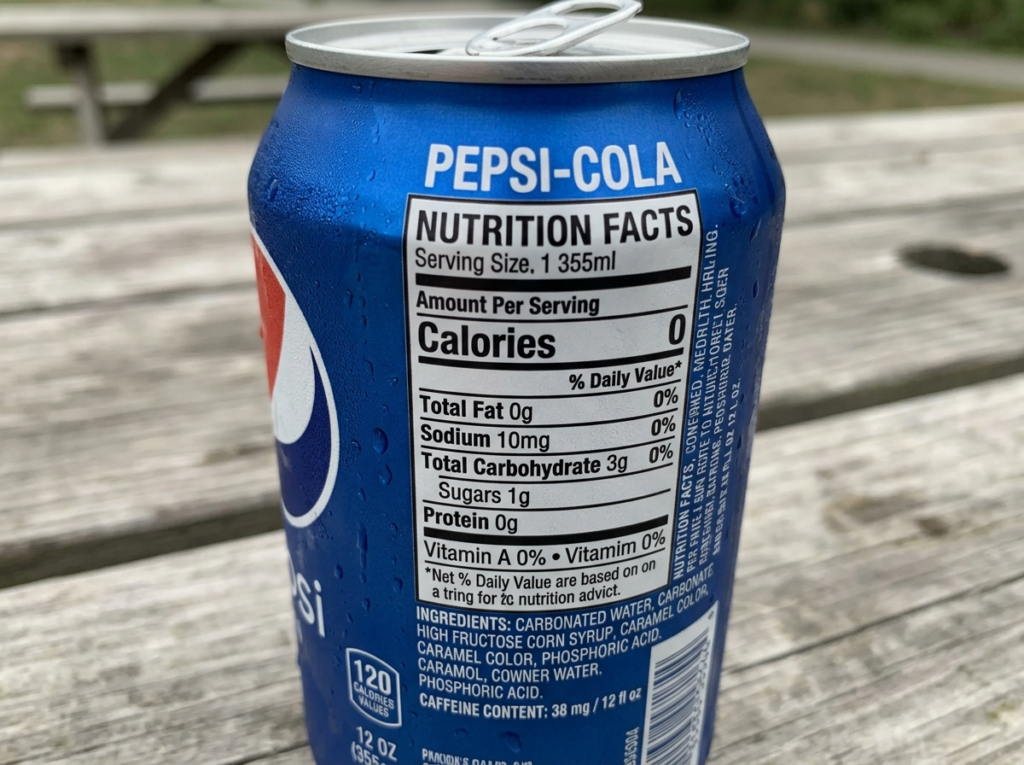
A standard 12 oz can of Pepsi packs about 38 mg of caffeine — and that number surprises a lot of people. Some think it’s way more, others assume it’s basically zero. The truth sits somewhere that most folks don’t expect.
Whether you’re watching your caffeine intake for health reasons, trying to figure out if Pepsi will keep you up at night, or you’re just curious how it stacks up against Coke, coffee, or energy drinks — you’re in the right spot. Let’s break down the Pepsi caffeine content mg by mg, compare it across different Pepsi variants, and put it side by side with other popular drinks so you know exactly what you’re sipping on.
How Much Caffeine Is Actually in a Regular Pepsi?
Let’s start with the straight answer. A regular 12 oz (355 ml) can of Pepsi contains approximately 38 mg of caffeine. That’s according to PepsiCo’s own nutritional data.
Now, 38 mg might not mean much on its own, so here’s some context. The FDA recommends a daily caffeine limit of about 400 mg for healthy adults. That means you’d need to drink roughly 10 cans of Pepsi to hit that ceiling — which, let’s be honest, brings up bigger concerns than just caffeine (hello, sugar).
For a 20 oz bottle — the kind you’d grab from a gas station cooler — you’re looking at about 63 mg of caffeine. And if you’re sharing a 2-liter with the family at dinner, the entire bottle contains around 192 mg. Your actual intake depends on how much you pour into that cup.
Quick fact: Pepsi has slightly less caffeine per ounce than most people guess. It works out to about 3.17 mg per fluid ounce. That’s less than coffee, less than most energy drinks, and even a touch less than Coca-Cola.
Pepsi Caffeine Content Across Every Variant
Not all Pepsi products carry the same caffeine punch. PepsiCo makes several variants, and the caffeine levels shift between them — sometimes in ways you wouldn’t predict.
Regular Pepsi
The classic. 38 mg per 12 oz can. It’s the baseline everyone uses for comparison. Nothing fancy here, just your standard cola caffeine level.
Diet Pepsi Caffeine
Here’s one that catches people off guard. A 12 oz can of Diet Pepsi has about 35 mg of caffeine — slightly less than regular Pepsi. The difference is small (just 3 mg), but it’s there. If you switched to Diet Pepsi thinking you’d dodge caffeine, you haven’t really changed much on that front. You’ve cut sugar and calories, sure, but the caffeine is nearly identical.
Pepsi Zero Sugar Caffeine
This one’s interesting. Pepsi Zero Sugar (formerly known as Pepsi Max in some markets) contains 69 mg of caffeine per 12 oz can. That’s almost double what you get in regular Pepsi.
Why the jump? PepsiCo designed Pepsi Zero Sugar to appeal to people who wanted a bolder, more intense cola experience without the calories. Extra caffeine contributes to that sharper taste profile. So if you’ve been drinking Pepsi Zero Sugar assuming it has the same caffeine as regular Pepsi — it doesn’t. Not even close.
Pepsi Wild Cherry
Wild Cherry Pepsi carries about 38 mg per 12 oz — the same as regular Pepsi. The cherry flavoring doesn’t add or subtract any caffeine.
Caffeine Free Pepsi
Exactly what the name says. Zero caffeine. PepsiCo makes this specifically for people who want the cola taste without any stimulant effect. It’s a solid pick if you’re drinking soda in the evening and don’t want it messing with your sleep. The taste is remarkably close to regular Pepsi — most people can’t tell the difference in a blind test.
Pepsi Real Sugar (Throwback)
This version uses real cane sugar instead of high fructose corn syrup, but the caffeine stays at 38 mg per 12 oz. Same as regular Pepsi.
Pepsi vs Coke Caffeine: The Cola Showdown
This is probably the most searched comparison in the entire soda world, and it makes sense. If you’re choosing between the two biggest colas on the planet, you might want to know which one gives you more of a buzz.
Here’s the breakdown for a standard 12 oz can:
- Pepsi: 38 mg
- Coca-Cola Classic: 34 mg
- Diet Pepsi: 35 mg
- Diet Coke: 46 mg
- Pepsi Zero Sugar: 69 mg
- Coke Zero Sugar: 34 mg
A few things jump out here. Regular Pepsi actually has more caffeine than regular Coke — about 4 mg more. It’s a tiny difference, and you’d never feel it in real life, but Pepsi takes that round.
The real surprise? Diet Coke has more caffeine than regular Coke. At 46 mg per can, it beats both regular Pepsi and regular Coke. A lot of people don’t realize that diet versions of sodas don’t always mirror the caffeine content of their regular counterparts. If you’re curious about how Coke Zero’s caffeine stacks up, it’s worth a separate look — it actually sits at the same level as regular Coke, which is lower than most people assume.
And then there’s the big gap: Pepsi Zero Sugar (69 mg) absolutely dwarfs Coke Zero (34 mg). If you pick your zero-calorie cola based on caffeine kick, Pepsi Zero wins by a mile.
How Does Pepsi Compare to Coffee and Energy Drinks?
Comparing Pepsi to coffee is like comparing a gentle breeze to a gust of wind. They’re in completely different leagues.
An 8 oz cup of brewed coffee delivers roughly 80–100 mg of caffeine. A 12 oz serving from most coffee shops? That jumps to 120–150 mg or higher. A Starbucks Grande brewed coffee packs a staggering 310 mg. One cup of Starbucks coffee has more caffeine than eight cans of Pepsi.
Energy drinks are another world entirely. A 16 oz Monster Energy contains about 160 mg of caffeine, and some of the more intense energy drinks on the market go well beyond 200 mg per can. If you want to see which energy drink has the most caffeine, some of those numbers will make Pepsi’s 38 mg look like a rounding error.
Even tea outpaces Pepsi in many cases. An 8 oz cup of black tea has about 47 mg of caffeine — more than a full 12 oz can of Pepsi.
So what does this mean practically? If you’re sensitive to caffeine or trying to cut back, Pepsi is actually one of the lower-caffeine options among caffeinated drinks. It’s not caffeine-free, but it’s not going to hit you the way a double espresso or a Monster would.
Why Does Pepsi Even Have Caffeine?
You might wonder why soda companies add caffeine at all. Is it there to get you hooked? Is it a flavor thing? The answer is a bit of both — but mostly flavor.
Caffeine has a naturally bitter taste that plays an important role in balancing the sweetness of cola. Without it, cola would taste noticeably flatter and more one-dimensionally sweet. PepsiCo and Coca-Cola have both said publicly that caffeine is used primarily as a flavoring agent.
That said, let’s be real — caffeine is also mildly addictive. It creates a subtle physical dependence over time, which doesn’t hurt repeat purchases. The FDA classified caffeine as a “generally recognized as safe” (GRAS) food additive back in 1958, and it’s been a standard cola ingredient for well over a century.
Did you know? The original Pepsi-Cola formula from the 1890s contained pepsin (a digestive enzyme) and kola nuts — which are a natural source of caffeine. The caffeine was there from day one.
How Much Is Too Much? Pepsi and Your Daily Caffeine Budget
If you drink one or two cans of Pepsi a day, caffeine probably isn’t your concern. At 38 mg per can, even three cans only gets you to 114 mg — well under the 400 mg daily recommendation for adults.
But here’s the thing most people forget: Pepsi probably isn’t your only caffeine source. You might have a morning coffee (95 mg), an afternoon tea (47 mg), maybe a piece of dark chocolate (12 mg), and then a Pepsi with dinner (38 mg). Those numbers add up to about 192 mg — still safe, but it shows how caffeine sneaks in from multiple directions.
A few groups should pay closer attention:
Pregnant women are generally advised to keep caffeine under 200 mg per day (per the American College of Obstetricians and Gynecologists). At that limit, five cans of Pepsi would max you out — though the sugar content is a separate concern your doctor would likely flag first.
Kids and teenagers metabolize caffeine differently than adults. The American Academy of Pediatrics recommends no more than 100 mg per day for adolescents (ages 12–18) and discourages caffeine for younger children entirely. Two to three cans of Pepsi would approach that limit for a teen.
People with anxiety disorders, heart arrhythmias, or certain medications may also need to be more careful. Even Pepsi’s modest caffeine content can be relevant if your doctor has told you to avoid stimulants.
Pepsi vs Other Sodas: Where Does It Land?
Cola isn’t the only soda with caffeine. Some non-cola sodas also contain it, while others — like Sprite and Fanta — are completely caffeine-free.
Here’s how Pepsi compares to some other popular sodas (per 12 oz serving):
- Pepsi: 38 mg
- Coca-Cola: 34 mg
- Mountain Dew: 54 mg
- Dr Pepper: 41 mg
- Diet Coke: 46 mg
- Pepsi Zero Sugar: 69 mg
- Sprite: 0 mg
- Fanta: 0 mg
- Root Beer (most brands): 0 mg
- 7UP: 0 mg
Pepsi sits comfortably in the middle of the pack among caffeinated sodas. Mountain Dew — also a PepsiCo product — has notably more caffeine. And if you’ve ever wondered about caffeine in root beer, the answer for most major brands is zero, which makes it a solid option for late-night sipping.
Does Pepsi’s Caffeine Affect Your Sleep?
This depends on your personal sensitivity and when you drink it.
Caffeine has a half-life of about 5–6 hours in most adults. That means if you drink a Pepsi at 6 PM, roughly 19 mg of caffeine is still circulating in your system around midnight. For most people, that small amount won’t cause noticeable sleep disruption.
But “most people” isn’t everyone. Some people are slow caffeine metabolizers — their bodies take significantly longer to process it. Genetics play a role here, specifically a gene called CYP1A2. If you’re someone who feels wired after a single cup of tea, even Pepsi’s 38 mg could bother you in the evening.
Pro Tip: If you enjoy cola flavor but want to avoid any sleep interference, switch to Caffeine Free Pepsi for your evening drinks. Same taste, zero stimulant effect. Problem solved.
Pepsi Caffeine Compared to Popular Coffee Shop Drinks
Sometimes it helps to compare Pepsi not just to plain coffee, but to the specific drinks people actually order. Here’s where things get eye-opening.
A Starbucks Vanilla Frappuccino (Grande, 16 oz) has about 95 mg of caffeine — roughly 2.5 cans of Pepsi worth. Even a seemingly innocent Vanilla Frappuccino from the bottled version packs more caffeine than you’d expect. And if you’re a Starbucks Refreshers fan, those fruity drinks contain green coffee extract and carry about 35–45 mg of caffeine per serving — surprisingly close to a can of Pepsi.
The point here isn’t to scare you away from anything. It’s to show you that Pepsi, in the grand scheme of caffeinated beverages, is on the milder end. If you can handle a Starbucks drink without issues, a Pepsi isn’t going to cause you caffeine problems.
What About Pepsi in Fountain Drinks and Restaurants?
Here’s something worth knowing: the caffeine content you see on a can is measured under controlled conditions. Fountain drinks at restaurants and fast food joints aren’t always perfectly consistent.
Fountain machines mix syrup with carbonated water at a set ratio, but that ratio can vary slightly depending on how the machine is calibrated. Your 20 oz fountain Pepsi at a movie theater might have slightly more or slightly less caffeine than a 20 oz bottle from a store.
The difference is usually small — maybe 5–10% either direction — but it’s worth mentioning for anyone who tracks their caffeine intake closely. The bigger variable at restaurants is cup size. A “large” soda at many fast food chains is 30–32 oz. That means you could be looking at 95–100 mg of caffeine from a single large Pepsi — still moderate, but getting into a range that matters.
Should You Switch to Pepsi if You Want Less Caffeine?
That depends on what you’re switching from.
If you’re coming from coffee and want to reduce caffeine, switching to Pepsi would dramatically cut your intake. One 12 oz Pepsi vs. one 12 oz coffee — you’re going from ~140 mg down to 38 mg. That’s a 73% reduction.
If you’re switching from energy drinks, the drop is even steeper. A Monster Energy has roughly four times the caffeine of a Pepsi can.
But if you’re trying to reduce caffeine overall, soda might not be the best replacement because of the sugar and calorie issue. A 12 oz Pepsi has 41 grams of sugar — that’s about 10 teaspoons. You might solve one problem and create another.
A smarter approach for many people is to gradually reduce caffeine across all sources. Maybe switch your second coffee of the day to a Starbucks drink with lower caffeine, cut your soda intake to one can, and skip caffeine entirely after 2 PM.
Pepsi Caffeine for Kids: What Parents Should Know
Kids and soda is a conversation most parents have had — or should have. The caffeine in Pepsi is relatively low, but kids weigh less than adults, so the same 38 mg hits differently.
For a 50-pound child, 38 mg of caffeine is roughly equivalent to what 80+ mg would feel like for a 170-pound adult. That’s about the strength of a cup of coffee, proportionally speaking.
The Canadian government recommends these daily caffeine limits for children:
- Ages 4–6: 45 mg max
- Ages 7–9: 62.5 mg max
- Ages 10–12: 85 mg max
So even one can of Pepsi gets a young child close to their daily limit. Two cans puts them over. This isn’t about fear-mongering — plenty of kids drink soda occasionally and are perfectly fine. But it’s good information to have, especially if your kid is also eating chocolate or drinking iced tea in the same day.
FAQ
Is there more caffeine in Pepsi or Coke?
Regular Pepsi has slightly more — 38 mg vs. 34 mg per 12 oz can. The 4 mg difference is minimal, and you won’t feel it. But if you look at diet versions, the comparison flips: Diet Coke (46 mg) beats Diet Pepsi (35 mg) by a noticeable margin.
How much caffeine is in Pepsi Zero Sugar?
Pepsi Zero Sugar contains 69 mg of caffeine per 12 oz can, which is nearly double the caffeine in regular Pepsi. It’s one of the highest-caffeine mainstream colas available, so keep that in mind if you’re trying to limit your intake.
Can I drink Pepsi before bed?
You can, but it’s not ideal if you’re caffeine-sensitive. The 38 mg in a regular Pepsi is mild, and many people drink it in the evening without sleep issues. If you notice it affects you, try switching to Caffeine Free Pepsi — it tastes virtually the same and won’t interfere with your rest.
Does Diet Pepsi have less caffeine than regular Pepsi?
Yes, but just barely. Diet Pepsi has about 35 mg per 12 oz, compared to 38 mg in regular. That 3 mg difference is negligible. The real benefit of Diet Pepsi over regular is the absence of sugar and calories, not a meaningful caffeine reduction.
Is 38 mg of caffeine a lot?
Not by any standard measure. It’s less than half the caffeine in a typical cup of coffee, less than a cup of black tea, and about one-quarter of what you’d get in a 16 oz energy drink. For most adults, 38 mg is a very mild amount of caffeine.
Final Thoughts
Pepsi’s caffeine sits at a pretty modest 38 mg per 12 oz can — enough to notice if you’re paying attention, but not enough to worry about for most people. The variant that deserves a second look is Pepsi Zero Sugar at 69 mg, which plays in a different league entirely.
Your smartest move? Know your own caffeine sensitivity, keep a rough mental tally of what you consume across all sources during the day, and choose your variant accordingly. If you love the taste but want zero caffeine, Caffeine Free Pepsi exists for exactly that reason. And if you’re the type who tracks every milligram, now you’ve got the real numbers to work with — no guessing needed.