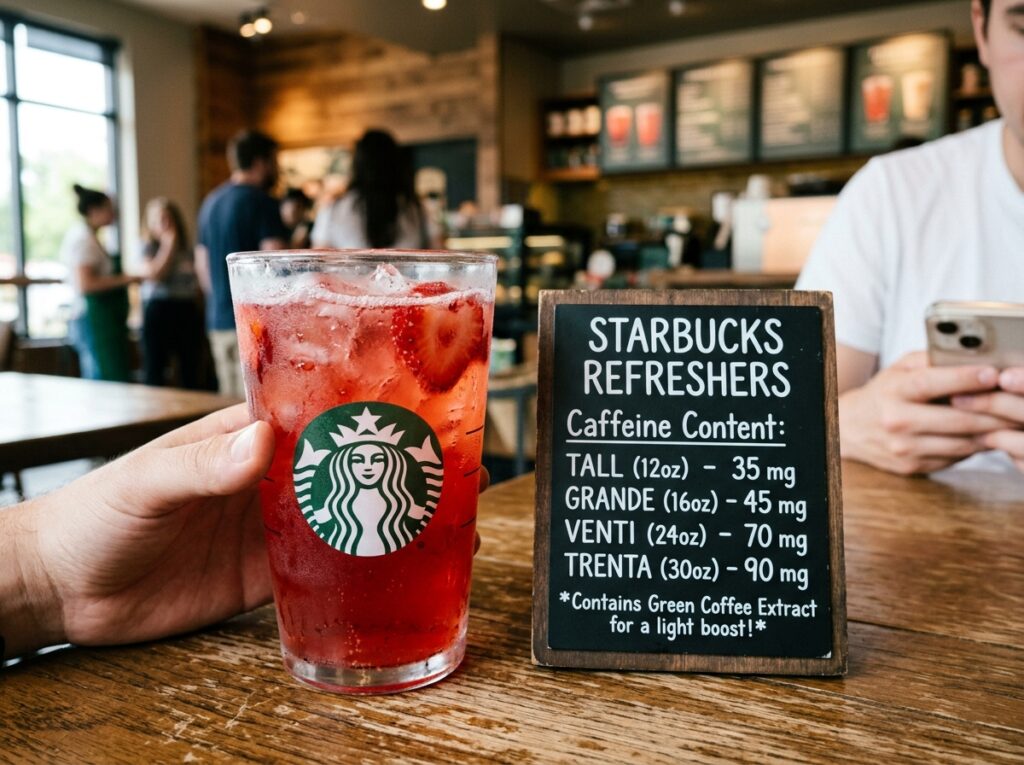
A tall Starbucks Refresher looks innocent enough — fruity, colorful, served over ice. But there’s caffeine hiding in that pretty cup. Not a ton, not zero, but enough to matter if you’re watching your intake or ordering one for your kid.
Starbucks Refresher caffeine content catches a lot of people off guard. Most assume these drinks are caffeine-free because they taste nothing like coffee. The truth? Every single Refresher on the Starbucks menu contains caffeine from green coffee extract, and the amount changes depending on which size you order and which flavor you pick.
If you’ve ever stood in that Starbucks line wondering whether your Strawberry Açaí Refresher will keep you up at night, or if a Mango Dragonfruit is a safe pick for your afternoon break, you’re in the right place. Let’s break down exactly how much caffeine sits inside each Refresher, how it compares to other drinks, and what that means for your daily routine.
What Makes Starbucks Refreshers Caffeinated?
Here’s where things get interesting. Starbucks Refreshers don’t get their caffeine from brewed coffee or espresso. The caffeine source is green coffee extract — basically unroasted coffee beans that have been processed into an extract.
Green coffee extract keeps the caffeine but skips the roasty, bitter flavor you associate with regular coffee. That’s why a Refresher can taste like strawberries and tropical fruit while still giving you a mild energy lift. The extract blends into the fruity base so smoothly that you’d never guess there’s any coffee connection at all.
Starbucks uses this extract across its entire Refresher line. So whether you’re sipping a Dragon Drink, a Paradise Drink, or a plain Strawberry Açaí Refresher, green coffee extract is doing the caffeine work behind the scenes.
Quick Fact: Green coffee extract contains chlorogenic acid, an antioxidant that partially breaks down during roasting. So your Refresher actually delivers some antioxidants that a regular cup of coffee doesn’t — at least not in the same concentration.
Starbucks Refresher Caffeine Content by Size
The caffeine in your Refresher scales up predictably with size. Starbucks offers four sizes, and the caffeine difference between a Tall and a Trenta is significant.
Here’s the general caffeine range for most Starbucks Refreshers:
- Tall (12 oz): 35–45 mg of caffeine
- Grande (16 oz): 45–55 mg of caffeine
- Venti (24 oz): 55–70 mg of caffeine
- Trenta (30 oz): 70–90 mg of caffeine
These numbers shift slightly by flavor because each base concentrate has a marginally different formulation. But the ballpark stays consistent. A Grande Refresher delivers roughly the same caffeine as a can of Coca-Cola — enough to feel a subtle pick-me-up, but nowhere close to an espresso shot’s 75 mg or a Grande Pike Place’s 310 mg.
If you’re someone who’s curious about how caffeine levels stack up across the entire Starbucks menu, the Refreshers sit comfortably on the lower end of the spectrum.
Does Strawberry Açaí Refresher Have Caffeine?
Yes, the Strawberry Açaí Refresher has caffeine. This is probably the single most-asked question about Starbucks Refreshers, and the answer surprises a lot of people.
A Grande Strawberry Açaí Refresher contains about 45 mg of caffeine. That caffeine comes entirely from the green coffee extract in the drink’s base — not from the strawberries, not from the açaí, and definitely not from the freeze-dried strawberry pieces floating on top.
Here’s the flavor-specific breakdown for a Grande (16 oz):
Strawberry Açaí Refresher — ~45 mg caffeine
Mango Dragonfruit Refresher — ~45 mg caffeine
Dragon Drink (Mango Dragonfruit with coconut milk) — ~45 mg caffeine
Pink Drink (Strawberry Açaí with coconut milk) — ~45 mg caffeine
Paradise Drink (Pineapple Passionfruit with coconut milk) — ~45 mg caffeine
Pineapple Passionfruit Refresher — ~45 mg caffeine
Notice a pattern? At the same size, most Refreshers land very close to each other in caffeine content. The difference between flavors is minimal — usually only 5 mg or less. What changes the number more dramatically is your cup size, not your flavor choice.
Pro Tip: If you’re ordering the lemonade version of any Refresher (like Strawberry Açaí Lemonade), the caffeine stays about the same. Lemonade doesn’t add or subtract caffeine. It just replaces some of the water in the drink with lemonade.
The Pink Drink specifically has its own caffeine profile worth checking if that’s your go-to order. The coconut milk swap doesn’t meaningfully change the caffeine level compared to the standard Refresher base.
How Starbucks Refreshers Compare to Other Caffeinated Drinks
Putting 45 mg of caffeine into perspective helps. Numbers in isolation don’t mean much unless you know what they feel like compared to what you normally drink.
A Grande Starbucks Refresher (45 mg) sits between a can of Coca-Cola (34 mg) and a single shot of Starbucks espresso (75 mg). It’s roughly one-seventh the caffeine of a Grande brewed coffee from Starbucks, which packs a hefty 310 mg.
Compared to energy drinks, a Refresher is quite mild. A standard 16 oz Monster Energy contains about 160 mg of caffeine — more than three times what your Grande Refresher delivers. If you’ve ever looked into Monster Energy’s caffeine content, you know the gap is huge.
Even a Vanilla Frappuccino carries more caffeine than a Refresher of the same size, since Frappuccinos use coffee or crème base depending on the flavor.
What about other refresher-style drinks outside Starbucks? Dunkin Refreshers also contain caffeine, sourced from green tea extract rather than green coffee extract. The caffeine levels between the two brands are surprisingly similar, though the flavor profiles and ingredient lists differ quite a bit.
So where does this leave you? If you want something lighter than coffee but don’t want a completely caffeine-free drink, a Refresher hits that middle ground pretty well. It won’t wire you the way a double espresso does, but it’s not a zero-caffeine choice either.
Starbucks Tea for Cold and Flu: The Medicine Ball Connection
While we’re talking about Starbucks drinks with unexpected caffeine, let’s talk about one that people often search for alongside Refreshers — the Medicine Ball Starbucks drink.
Officially called the “Honey Citrus Mint Tea” on the Starbucks menu, the Medicine Ball became hugely popular as a Starbucks tea for cold symptoms. People swear by it during cold and flu season, and some order it specifically when they’re feeling under the weather.
The drink combines Jade Citrus Mint green tea and Peach Tranquility herbal tea, steamed together with lemonade and honey. It’s warm, soothing, and has a gentle sweetness that feels comforting when you’re dealing with a sore throat or congestion.
Here’s the caffeine angle: a Grande Medicine Ball contains about 16–25 mg of caffeine. That’s less than a Refresher. The caffeine comes from the green tea portion — the Peach Tranquility tea is herbal and caffeine-free, so it dilutes the overall caffeine content.
Did you know? The Medicine Ball wasn’t originally on the Starbucks menu. It started as a customer-created drink that went viral on social media. Starbucks officially added it to the menu in 2017 after baristas across the country kept getting requests for it.
A few things to keep in mind about the Medicine Ball:
The honey and lemon in the drink can genuinely soothe a scratchy throat — that’s not just placebo. Honey has mild antibacterial properties and has been shown in studies to be as effective as some over-the-counter cough suppressants for nighttime cough relief (a finding backed by research published in the journal Pediatrics). Lemon provides vitamin C, though in modest amounts.
That said, this is a comfort drink, not medicine. If you’re running a high fever or dealing with something serious, see your doctor. A warm tea from Starbucks isn’t a substitute for proper medical care. But as a feel-good option on a cold day when you’re sniffly and tired? It’s genuinely pleasant.
If you’re exploring non-coffee drinks at Starbucks — whether because you’re sick, caffeine-sensitive, or just not a coffee person — the Medicine Ball and the Refreshers both fit that category in different ways. One’s warm and tea-based, the other’s cold and fruity.
Who Should Watch Their Refresher Caffeine Intake?
For most adults, the caffeine in a Starbucks Refresher is pretty manageable. The FDA considers 400 mg of caffeine per day safe for most healthy adults, and a Grande Refresher uses up only about 11% of that limit.
But “most adults” doesn’t mean everyone. A few groups should pay closer attention.
Pregnant individuals are generally advised to keep caffeine under 200 mg per day (per the American College of Obstetricians and Gynecologists). A single Refresher fits within that limit, but it still counts toward your daily total. If you’re also having tea, chocolate, or any other caffeine source, those milligrams add up.
Kids and teenagers metabolize caffeine differently than adults. The American Academy of Pediatrics discourages caffeine consumption for children under 12 and recommends that teens limit intake to 100 mg per day. A Tall Refresher with 35 mg might seem harmless, but if your 10-year-old is also eating chocolate and drinking a soda, the cumulative intake might be higher than you’d want.
People with caffeine sensitivity know their bodies react strongly even to small amounts. If one cup of green tea makes you jittery, a Refresher could do the same. The caffeine amount might be low objectively, but “low” is relative to your personal tolerance.
Anyone on certain medications — particularly some heart medications, anxiety medications, or stimulants — should check with their doctor about caffeine from any source, including Refreshers.
⚠️ Important: This isn’t medical advice. If you have specific health conditions or concerns about caffeine, talk to your healthcare provider. They can give you personalized guidance based on your situation.
Can You Get a Caffeine-Free Refresher at Starbucks?
Short answer: not really. There’s no version of a Starbucks Refresher that’s completely caffeine-free because the green coffee extract is baked into every Refresher base. You can’t ask the barista to leave it out — it’s pre-mixed into the concentrate they pour from.
Your best options if you want something that looks and tastes similar but has zero caffeine? Try these approaches:
Order a Blended Strawberry Lemonade or another fruit-based blended drink. These skip the Refresher base entirely and use fruit juice, ice, and sometimes crème base instead. They’re not identical in taste, but they scratch the same itch — cold, fruity, and refreshing.
Ask for an iced herbal tea with fruit juice or lemonade. Passion Tango Herbal Tea is naturally caffeine-free and has a berry-hibiscus flavor that’s close to the Refresher vibe. Add some lemonade to it, and you’ve got a solid caffeine-free alternative.
Some customers also customize by ordering just the lemonade or juice components without the Refresher base, though your barista’s ability to accommodate this depends on how the store handles custom orders.
If you’re exploring the broader world of low-calorie Starbucks drinks, many of those options happen to be lower in caffeine too — so you can optimize for both if that matters to you.
Does the Lemonade or Coconut Milk Version Change the Caffeine?
People ask this a lot, so let’s clear it up. When you order a Refresher with lemonade (like a Strawberry Açaí Lemonade) or with coconut milk (like a Pink Drink), the caffeine content stays roughly the same.
Here’s why: the caffeinated part is the Refresher base concentrate. Whether the rest of the cup is filled with water, lemonade, or coconut milk, the same amount of concentrate goes in. The barista pours the same proportion of base regardless of what liquid fills the rest.
There might be an extremely slight dilution difference — coconut milk is denser than water, which could theoretically affect how the drink is portioned — but in practice, the caffeine difference is negligible. We’re talking maybe 2–3 mg at most, which you’d never notice.
So pick your version based on taste preference, not caffeine anxiety. Want it creamier? Go coconut milk. Want it tangier? Go lemonade. Want it lightest? Stick with the original water version. Your caffeine exposure stays in the same neighborhood regardless.
Best Times to Drink a Starbucks Refresher
Because the caffeine content is relatively modest, Refreshers are more versatile than coffee when it comes to timing. But “modest” doesn’t mean “irrelevant.”
Morning through early afternoon is the sweet spot. You get a gentle lift without the intensity of coffee, and the caffeine clears your system well before bedtime. For most people, caffeine’s half-life is about 5–6 hours, meaning half the caffeine from a 2 PM Refresher is still circulating at 7–8 PM.
Mid-afternoon is where it gets personal. If you’re not caffeine-sensitive and you sleep like a rock, a 3 PM Grande Refresher with its 45 mg probably won’t affect your sleep. But if you’re someone who lies awake after an afternoon tea, those same 45 mg could be a problem.
Evening is generally not ideal for anyone trying to protect their sleep quality. Even though 45 mg seems small, caffeine affects sleep architecture in ways you might not consciously feel. You might fall asleep fine but spend less time in deep sleep, leaving you less rested than expected.
Pro Tip: If you want that fruity Refresher taste in the evening, ask for the Passion Tango Iced Tea with lemonade instead. Zero caffeine, similar fruit-forward flavor profile, and no sleep disruption.
How to Order Smarter: Controlling Your Caffeine with Refreshers
You have more control over your Refresher’s caffeine than you might think. Here are some practical strategies.
Size down. This is the most obvious lever. A Tall Refresher has roughly half the caffeine of a Venti. If you’re ordering out of habit and always default to Venti, try a Grande for a week and see if you notice any difference in your energy levels. You probably won’t — and you’ll cut your caffeine by about 15–20 mg.
Ask for light ice. Wait — doesn’t less ice mean more drink, which means more caffeine? Yes, slightly. But more importantly, the drink lasts longer, so you might not order a second one. If your two-Refresher-a-day habit becomes a one-Refresher habit, that’s a net caffeine reduction.
Don’t double up unknowingly. A Refresher plus a coffee in the same afternoon can push your total caffeine higher than you realize. Track it loosely for a day or two if you’re curious. You might find your “light caffeine day” is actually 200+ mg when you add everything up.
If caffeine content across different brands interests you, it’s worth knowing how other popular drinks compare. Even some sodas people assume are caffeine-free actually aren’t, while others like Sprite truly contain zero.
Seasonal and Limited-Edition Refreshers: Do They Have Different Caffeine?
Starbucks rolls out seasonal and limited-time Refresher flavors regularly. Every summer seems to bring at least one new option, and customers always wonder if the caffeine changes.
The short answer is that seasonal Refreshers use the same type of green coffee extract base as the permanent menu items. The caffeine content stays in that familiar 35–45 mg range for a Grande. What changes is the fruit flavoring, the inclusions (like freeze-dried fruit pieces or popping pearls), and sometimes the color.
Starbucks doesn’t typically publish separate caffeine data for limited-time offerings, but because the base is consistent, you can safely estimate using the standard Refresher numbers. If a seasonal flavor used a dramatically different base, Starbucks would be required to disclose that — and they haven’t indicated any such changes for recent limited-edition drops.
FAQ Section
How much caffeine is in a Starbucks Refresher compared to coffee?
A Grande Starbucks Refresher contains about 45 mg of caffeine, while a Grande brewed coffee (Pike Place Roast) has approximately 310 mg. That makes the Refresher roughly one-seventh the caffeine of a standard Starbucks coffee. The difference is massive, which is why Refreshers appeal to people who want flavor and a mild lift without the full caffeine load of brewed coffee.
Does the Strawberry Açaí Refresher have caffeine?
Yes. A Grande Strawberry Açaí Refresher contains approximately 45 mg of caffeine from green coffee extract. This applies to the standard water-based version, the lemonade version, and the Pink Drink version (made with coconut milk). The caffeine amount stays roughly the same across all three variations.
Is the Medicine Ball at Starbucks good for a cold?
The Medicine Ball (officially called Honey Citrus Mint Tea) combines green tea, herbal tea, honey, and lemonade. The warm liquid and honey can soothe a sore throat, and honey has mild antibacterial properties supported by some clinical research. It contains about 16–25 mg of caffeine from the green tea component. It’s a comforting drink, but it’s not a replacement for medical treatment if you’re genuinely ill.
Can kids drink Starbucks Refreshers?
Starbucks Refreshers contain caffeine (35–45 mg for a Tall), so they’re not caffeine-free kids’ drinks. The American Academy of Pediatrics recommends no caffeine for children under 12. For teenagers, the recommended limit is 100 mg per day. A single Tall Refresher falls within that teen limit, but parents should consider total daily caffeine from all sources, including chocolate and soda.
Are Starbucks Refreshers healthier than energy drinks?
Refreshers are lower in caffeine (45 mg per Grande vs. 160 mg in a 16 oz Monster Energy) and don’t contain ingredients like taurine or guarana that are common in energy drinks. A standard Refresher has about 90 calories and 20 grams of sugar in a Grande, which isn’t “health food” territory but is notably less intense than most energy drinks. Neither is a health drink, but the Refresher is the lighter option by most measures.
Your Next Starbucks Order, Decoded
Now you know what’s actually in that colorful cup. Starbucks Refresher caffeine content sits in a mild-but-real range — enough to give you a gentle energy nudge, but low enough that it won’t replace your morning coffee. The green coffee extract in every Refresher base is doing the work, delivering roughly 45 mg of caffeine in a Grande regardless of whether you’re drinking Strawberry Açaí, Mango Dragonfruit, or whatever seasonal flavor is on the board this month.
If you’re caffeine-conscious, size is your biggest control lever. Stick with a Tall if you want to minimize. Go Trenta if you genuinely don’t mind the extra milligrams. And if you want zero caffeine but still want that fruity Starbucks experience, Passion Tango Iced Tea with lemonade is your friend.
Next time you’re in line, you won’t have to guess. You’ll know exactly what you’re ordering — and exactly how it fits into your day.