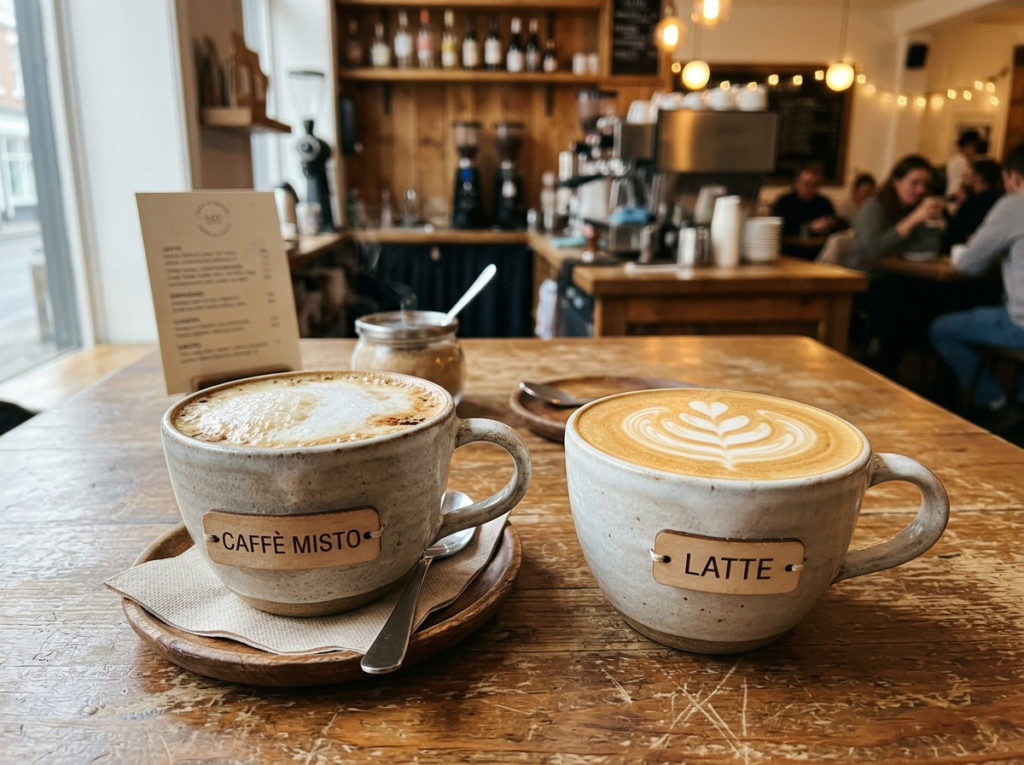
You’re standing in line at Starbucks, staring at the menu, and two drinks sound almost identical — a Caffè Misto and a Latte. Both have coffee. Both have milk. So what’s the deal? Why are they priced differently, and more importantly, why do they taste nothing alike?
This confusion is way more common than you’d think. Most people either pick one randomly or just default to a latte because it sounds familiar. But here’s the thing — choosing the right one can change your entire morning coffee experience. The difference between a Caffè Misto and a latte comes down to how the coffee is made and how the milk is prepared. And that small distinction creates two very different drinks in terms of flavor, strength, texture, and even calories.
Let’s break it all down so the next time you walk up to that counter, you know exactly what to order — and why.
What Exactly Is a Caffè Misto?
A Caffè Misto is Starbucks’ version of a classic French drink called “café au lait.” The name itself is Italian — “misto” means “mixed” — and the drink is exactly that: brewed coffee mixed with steamed milk, split right down the middle in a 1:1 ratio.
So if you order a grande (16 oz), you’re getting roughly 8 ounces of freshly brewed drip coffee and 8 ounces of steamed milk. That’s it. No espresso involved at all.
The Starbucks Misto ingredients are refreshingly simple. You’ve got their standard Pike Place roast (or whatever featured dark roast they’re pouring that day), steamed 2% milk, and a light layer of foam on top. No syrups, no extras — unless you ask for them.
What makes the Misto special is its simplicity. It tastes like real coffee — that bold, rounded, familiar flavor you get from a drip brew — but the steamed milk softens it, makes it smoother, and adds a touch of creaminess without drowning out the coffee itself.
Quick fact: You can actually swap the default brewed coffee for any roast Starbucks has available that day. If the blonde roast is being brewed, ask for it. It’ll give your Misto a lighter, slightly sweeter profile.
What Exactly Is a Latte?
A latte — short for “caffè latte,” which literally means “milk coffee” in Italian — is an espresso-based drink. And that’s the single most important difference between these two.
Instead of brewed drip coffee, a latte starts with espresso shots. A grande latte at Starbucks gets two shots of espresso (about 2 ounces total), and then the rest of the cup is filled with steamed milk and topped with a thin layer of microfoam.
So think about what’s happening here: in a 16 oz grande latte, roughly 14 ounces of that drink is milk. The espresso is concentrated and strong, but there isn’t a lot of it. That’s why lattes taste so creamy and milk-forward. You get hints of the espresso — that slightly roasty, caramel-sweet undertone — but it’s wrapped in velvety steamed milk.
This is also why lattes are the most popular canvas for flavor customizations. Vanilla lattes, caramel lattes, pumpkin spice lattes — they all work because the mild, milky base lets syrups and sauces or syrups shine without competing too hard with the coffee flavor.
Misto vs Latte: The Key Differences That Actually Matter
Alright, so both drinks have coffee and milk. But the kind of coffee, the ratio of milk, and the way they’re prepared create two completely different experiences. Let’s walk through what separates them.
The Coffee Base
This is where everything starts. A Misto uses brewed drip coffee — the same stuff that comes out of those big batch brewers behind the counter. A latte uses espresso, which is made by forcing pressurized hot water through finely-ground coffee beans.
Why does this matter? Brewed coffee and espresso taste fundamentally different. Brewed coffee has a broader, more nuanced flavor. You pick up on more of the bean’s origin characteristics — floral notes, fruity undertones, nuttiness. Espresso is more concentrated and punchy. It’s bolder, slightly more bitter, and has that characteristic crema richness.
A Misto puts brewed coffee front and center because half the drink is literally coffee. A latte, on the other hand, uses just a small amount of concentrated espresso that gets diluted by a large volume of steamed milk.
The Milk Ratio
Here’s a number that surprises most people: a grande latte has nearly twice as much milk as a grande Misto.
In a Misto, the ratio is 50/50 — half coffee, half steamed milk. In a latte, it’s closer to 85-90% steamed milk with just two shots (about 2 oz) of espresso. That’s a massive difference in milk volume, and you can absolutely taste it.
The Taste Experience
And this brings us to what people really want to know — the misto vs latte taste difference.
A Misto tastes like coffee with milk. The brewed coffee flavor is dominant. You taste the roast, the body, the warmth of a proper cup of coffee, but the steamed milk rounds off any harsh edges and adds a creamy smoothness. If you’re someone who loves the taste of coffee and just wants it a little gentler, the Misto is your drink.
A latte tastes like milk with coffee. It’s creamy, smooth, and mild. The espresso gives it depth and warmth, but milk is the star. If you want something that feels indulgent and gentle — almost dessert-like when you add a flavor shot — a latte hits that spot.
Neither one is better. They’re just… different moods.
Caffeine Content
Here’s one that catches people off guard. A grande Misto actually has more caffeine than a grande latte.
A grande Misto made with Pike Place roast contains roughly 310 mg of caffeine because brewed drip coffee is naturally higher in caffeine per ounce than espresso. A grande latte with two espresso shots has about 150 mg.
So if you’re ordering a morning drink specifically to wake up, the Misto packs more than double the caffeine punch. If you’re curious about how caffeine stacks up across different drinks, check out this guide to Starbucks drinks ranked by caffeine — some of the numbers are genuinely surprising.
Calories and Nutrition
Because a latte has significantly more milk, it also has more calories. A grande latte with 2% milk runs about 190 calories. A grande Misto with 2% milk comes in around 110 calories.
That 80-calorie gap widens even further if you switch to whole milk or add syrups. For anyone watching their calorie intake, the Misto is the leaner option right out of the gate. And if you want to go even lighter, you can order either drink with almond milk, oat milk, or nonfat milk. If you’re looking for more low-calorie Starbucks drink ideas, there are plenty of options beyond these two.
Misto Price at Starbucks: Which One’s Easier on Your Wallet?
Let’s talk money, because this is actually one of the biggest practical reasons people choose a Misto over a latte.
A grande Caffè Misto at Starbucks typically costs between $4.25 and $4.75, depending on your location. A grande latte usually runs $5.25 to $5.95. That’s roughly a dollar difference per drink.
Why the price gap? Espresso drinks cost more to make. Pulling espresso shots takes a dedicated machine, more precise grinding, and more time per drink. Drip coffee is brewed in batches — it’s already sitting there, ready to pour. So the labor and equipment costs are lower, and that savings passes through to the menu price.
If you’re a daily coffee buyer, that dollar difference adds up fast. Over a five-day work week, you’re saving about $5. Over a year? That’s roughly $260 — basically enough to buy a decent home espresso machine.
Pro Tip: If you want to save even more, order a regular drip coffee and ask for steamed milk on the side. Some locations will do this at a slightly lower price than a Misto, though your mileage may vary depending on the store.
How to Order a Caffè Misto (and Make It Your Own)
Knowing how to order a Caffè Misto the right way can seriously upgrade your experience. The base drink is simple, but Starbucks gives you a lot of room to customize.
Here’s your basic order: just say “I’d like a [size] Caffè Misto.” That’s literally it. You’ll get the featured brewed coffee of the day with steamed 2% milk, half and half.
But if you want to tweak it, here are some ideas that actually work well:
Change the roast. Ask what brewed coffees they have available. If they’re pouring a blonde roast alongside the dark, you can request that instead. Blonde roasts give the Misto a lighter, slightly sweeter flavor without adding any sugar.
Switch the milk. Oat milk makes a Misto taste almost like a completely different drink — it adds a natural sweetness and heavier body. Almond milk keeps it light. Coconut milk adds a subtle tropical note that works surprisingly well with darker roasts.
Add a flavor. One pump of vanilla or two pumps of brown sugar syrup can turn a plain Misto into something that rivals a flavored latte — at a lower price point and with fewer calories.
Go half-caf. If you want the Misto experience but don’t need 310 mg of caffeine, ask for half-caf brewed coffee. Some stores can accommodate this easily, especially if they have decaf brewed alongside regular.
Make it iced. You can order an Iced Caffè Misto, but heads up — not all baristas are familiar with this since it’s not a standard iced menu item. Just ask for iced coffee with cold milk or steamed milk poured over ice.
When Should You Order a Misto vs a Latte?
This isn’t about which drink is “better.” It’s about matching the drink to your mood, your goals, and what you actually want out of that cup.
Go with the Misto if:
You genuinely enjoy the taste of coffee and want it to be the dominant flavor. You want more caffeine to power through your morning. You’re watching your calories or trying to keep your order simple and clean. You want a solid, no-fuss coffee drink that costs less than a latte.
Go with the Latte if:
You prefer a creamier, milk-forward drink where the coffee flavor stays in the background. You like adding flavored syrups and want a base that plays nicely with them. You enjoy the texture of well-steamed milk and microfoam. You appreciate the specific flavor profile of espresso — that concentrated, slightly sweet intensity.
There’s also a third option that people forget about. If you like the idea of a latte but want it stronger, you can always add an extra espresso shot to your latte. And if you love the Misto but want it creamier, just ask for extra steamed milk. Both drinks are flexible enough to meet you wherever you are.
Can You Make a Caffè Misto at Home?
Absolutely — and it’s one of the easiest café-style drinks to replicate in your own kitchen. You don’t need an espresso machine, which is a big win for the Misto.
Here’s how to do it:
Brew a strong cup of coffee using whatever method you prefer — drip machine, French press, pour-over, or even an AeroPress. You want it slightly stronger than usual because the milk will dilute it. While the coffee brews, heat your milk. If you have a milk frother (even a cheap handheld one), use it to steam and froth the milk until it’s hot and has a nice layer of foam. Pour the brewed coffee into your mug until it’s half full, then pour the steamed milk on top. Spoon a bit of foam over the surface.
That’s your homemade Caffè Misto. Total prep time: about 5 minutes. Total cost: pennies.
A latte at home is trickier because you need actual espresso. A Moka pot or AeroPress can get you close, but for true espresso, you need a machine with at least 9 bars of pressure. If you’re considering investing in one, this comparison of DeLonghi vs Breville espresso machines might help you decide.
How the Misto Compares to Other Coffee Drinks
The Misto sits in an interesting spot on the coffee drink spectrum. It’s not as plain as a black drip coffee, not as milk-heavy as a latte, and nothing like a cappuccino’s foam-heavy structure.
A cappuccino uses espresso (like a latte) but has a much thicker layer of foam — it’s roughly equal thirds of espresso, steamed milk, and foam. If you want to understand that comparison better, here’s a breakdown of cappuccino vs coffee and their caffeine differences.
A flat white is closer to a latte but uses ristretto shots (shorter, sweeter espresso pulls) and has less foam, creating a more velvety texture.
An Americano is espresso diluted with hot water — no milk at all unless you add it. It’s closer in strength to a Misto but completely different in flavor because of the espresso base.
The Misto’s closest relative outside of Starbucks is the French café au lait, which is exactly the same concept — brewed coffee, hot milk, simple and honest. In fact, if you ever order a “café au lait” at a non-Starbucks coffee shop, that’s exactly what you’re getting. Starbucks just gave it a fancier Italian name.
What About Non-Coffee Drinkers?
If you’ve been reading this and thinking, “I don’t even like coffee that much,” don’t worry — neither the Misto nor the latte might be your best bet. Starbucks has a surprisingly wide range of drinks that don’t involve coffee or espresso at all.
From refreshers to tea lattes to blended drinks, there’s a lot to explore. Here’s a solid list of non-coffee drinks at Starbucks that are worth checking out. Some of them still have caffeine (from tea or other sources), and some are completely caffeine-free.
And if you’re specifically looking for something with lower or no caffeine, you might also be curious about how much caffeine is in a Starbucks Refresher — it’s a popular alternative that a lot of people don’t realize still contains green coffee extract.
FAQ
Is a Caffè Misto just a latte with drip coffee?
Sort of, but not exactly. The idea is similar — coffee plus steamed milk — but the type of coffee changes everything. A Misto uses brewed drip coffee in a 1:1 ratio with milk, while a latte uses concentrated espresso with a much higher proportion of milk. The flavor, caffeine content, calorie count, and price are all different because of this distinction.
Does a Caffè Misto have more caffeine than a latte?
Yes, significantly more. A grande Misto has about 310 mg of caffeine compared to roughly 150 mg in a grande latte. Brewed drip coffee naturally contains more caffeine per ounce than espresso, and since half the Misto is brewed coffee (about 8 oz), the caffeine adds up fast.
Can I order a Caffè Misto iced at Starbucks?
You can, but it’s not a standard menu item. Ask for iced coffee with steamed milk or cold milk added. Some baristas will know exactly what you mean if you say “iced Caffè Misto,” while others might need you to explain it. Either way, they can make it happen.
Why is a Misto cheaper than a latte at Starbucks?
The cost difference comes down to ingredients and preparation. Drip coffee is brewed in large batches and costs less per serving to produce. Espresso requires a dedicated machine, individual shot-pulling, and more barista time. The Misto also uses less milk than a latte, which further reduces the cost.
What’s the best milk to use in a Caffè Misto?
It depends on your preference. The default is 2% milk, which gives a good balance of creaminess and lightness. Oat milk is a popular upgrade — it adds natural sweetness and a fuller body. Almond milk keeps it light and slightly nutty. Whole milk makes it rich and indulgent. There’s no wrong answer here.
Your Next Order, Sorted
Here’s what it boils down to. A Caffè Misto is brewed coffee with steamed milk — it’s bolder, higher in caffeine, lighter in calories, and easier on your wallet. A latte is espresso with a lot of steamed milk — it’s creamier, smoother, milder, and a better base for flavored syrups.
Neither one wins across the board. Your pick depends on what you’re craving that day. And honestly? The best move might be to try both back-to-back on your next two visits. Order a Misto on Monday, a latte on Tuesday, and let your taste buds make the final call.
Now you know exactly what you’re asking for when you step up to that counter. So go order with confidence — and maybe save that extra dollar for a pastry.