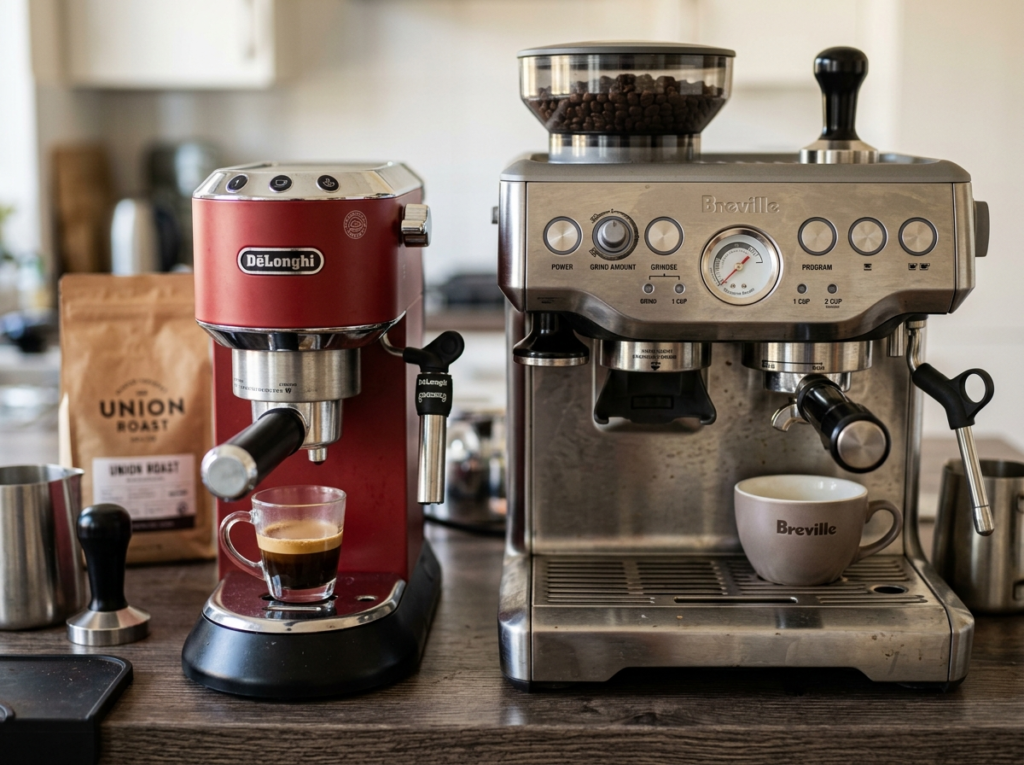
The average American spends over $2,000 a year on coffee from cafés. That’s roughly the cost of a really good espresso machine — one that could pay for itself within twelve months. And when people finally decide to make the switch to home espresso, two brands almost always end up in the final round: De’Longhi and Breville.
Both are respected. Both make solid machines. But they’re built with different philosophies, and they appeal to different kinds of coffee drinkers. If you’ve been going back and forth reading Breville vs De’Longhi reviews trying to figure out which is better, you’re not alone. This is probably the most common espresso machine comparison people search for — and for good reason.
Let’s break it down honestly. No fluff, no hype. Just the stuff that actually matters when you’re spending your hard-earned money.
A Quick Look at Both Brands
Before we get into specifics, it helps to understand where these two companies come from, because their origins say a lot about their machines.
De’Longhi is an Italian brand that’s been around since 1902. Yes, over a century. They started with small industrial parts and eventually moved into home appliances. Coffee is deeply woven into Italian culture, and De’Longhi reflects that. Their machines tend to prioritize simplicity, reliability, and the kind of espresso you’d get in a small café in Milan — strong, consistent, and unpretentious.
Breville (known as Sage in some parts of Europe) is an Australian company founded in 1932. They’ve always leaned into innovation and technology. Their kitchen appliances are known for giving users a lot of control. Their espresso machines reflect this too — they’re designed for people who want to understand and tweak every variable in their shot.
So right away, you can see the split. De’Longhi says, “Let us handle the complexity.” Breville says, “Here are the tools — you drive.”
Neither approach is wrong. It just depends on who you are as a coffee drinker.
Build Quality and Design — What You’re Actually Getting
Let’s talk about what these machines feel like when you unbox them and set them on your counter.
Breville machines, especially the popular Barista Express and the higher-end Barista Pro and Barista Touch, feel premium. They use a lot of brushed stainless steel. The portafilters have a solid weight to them. The dials click with precision. You look at a Breville and you think, “This looks like it belongs in a specialty coffee shop.” The footprint is larger on most models, so you’ll want to make sure you’ve got the counter space.
De’Longhi machines come in a wider range of designs. The Dedica line is famously slim — only about 6 inches wide — making it a go-to for small kitchens. The La Specialista line is bulkier but still elegant in a European way. And their super-automatic machines like the Magnifica and Dinamica lines have a more utilitarian look, because they’re built around convenience, not showmanship.
Quick fact: The De’Longhi Dedica EC685 is one of the slimmest semi-automatic espresso machines you can buy. If kitchen space is tight, that’s worth knowing.
Build quality on both brands is solid in their mid-range and upper models. Where you’ll notice differences is in the entry-level tier. De’Longhi’s budget machines sometimes use more plastic components, which isn’t necessarily bad for durability but can feel less premium in hand. Breville’s entry-level options, like the Bambino, still maintain a good material standard, though the feature set is naturally more limited.
Espresso Quality — The Thing That Actually Matters
Okay, let’s get to the heart of this best espresso machine comparison. How does the coffee taste?
Both brands can produce excellent espresso. But they get there differently.
Breville’s approach is to give you the tools and let you dial things in. The Barista Express, for example, comes with a built-in conical burr grinder with about 30 grind settings. You control the dose, the tamp, and the extraction time. When you get it right — and there’s a bit of a learning curve — the results are genuinely impressive. Rich crema, balanced flavor, and the kind of shot you’d pay $4.50 for at a good café.
The Breville Barista Pro takes this further with a faster heat-up time (about 3 seconds thanks to its ThermoJet system) and a digital temperature control display. The Dual Boiler model, their flagship, lets you brew and steam milk simultaneously without any temperature drop — something serious home baristas care about deeply.
De’Longhi’s approach depends on which line you choose. Their semi-automatics like the La Specialista give you grind control and tamping assistance (some models have a built-in smart tamper), but the process feels more guided. You’re making decisions, but the machine is holding your hand a bit. And honestly? For most people, that produces more consistent results more quickly.
Their super-automatic machines — the Magnifica S, Dinamica, and Eletta — take it to another level of convenience. You press a button. The machine grinds the beans, tamps, brews, and even cleans itself. The espresso is good. Not quite as nuanced as what a skilled person can pull on a Breville Dual Boiler, but perfectly enjoyable for daily drinking. And the consistency is hard to beat because the machine removes human error from the equation.
Pro Tip: If you’re someone who drinks espresso-based drinks daily and doesn’t want to spend 5–10 minutes per drink, a De’Longhi super-automatic might genuinely change your morning routine. If you enjoy the ritual and the craft, Breville’s semi-automatics will feel more rewarding.
The Grinder Situation
This is a detail that a lot of Breville vs De’Longhi reviews gloss over, and it shouldn’t be ignored.
Breville integrates grinders into many of their espresso machines, and they’re legitimately good for built-in grinders. The conical burr grinder in the Barista Express line gives you enough range to find the right grind for espresso. It’s not going to match a standalone $300 grinder, but it’s very capable for its class.
De’Longhi also includes grinders in several models. The La Specialista Arte, for instance, has a sensor grinding system that adjusts based on the type of bean. Their super-automatics all have built-in grinders with adjustable settings, usually between 5 and 13 levels depending on the model.
Here’s the honest truth: Breville’s grinders generally offer more fine-tuning. If you’re the kind of person who notices the difference between grind setting 7 and grind setting 9, you’ll appreciate that. De’Longhi’s grinders are reliable and produce consistent results, but the adjustment range isn’t as granular on most models.
If you already own a quality standalone grinder — something like a Baratza Sette or a 1Zpresso hand grinder — you might prefer a machine without a built-in grinder and just use yours. Both brands offer options without grinders at lower price points.
Milk Frothing and Steam Performance
If you drink straight espresso, skip this section. But if you’re a latte or cappuccino person — and statistically, most home espresso drinkers are — this matters a lot.
Breville equips most of their machines with traditional steam wands. The Barista Express has a standard wand that takes a little practice to master. The Barista Pro and Barista Touch have improved steam wands that heat up faster and produce better microfoam. The Dual Boiler is in a class of its own here — the dedicated steam boiler means you get powerful, consistent steam that can produce latte art-quality milk. If you’ve been wanting to learn latte art at home, Breville gives you the tools to actually do it.
De’Longhi takes a mixed approach. Some of their machines have manual steam wands similar to Breville’s. But many De’Longhi models — especially in the super-automatic range — use an automatic milk frothing system. You pour milk into a carafe or container, press a button, and the machine froths and dispenses it into your cup. The Dinamica Plus and Eletta Explore even let you customize foam density through an app or on-machine settings.
The automatic systems are incredibly convenient. You get good foam with zero technique required. But if you’re a purist who wants silky, velvety microfoam with that perfect texture for pouring rosettas, you’ll find the manual steam wands on Breville machines more capable, assuming you take the time to learn.
If you’re curious about the difference a great espresso makes in milk drinks compared to regular coffee, you might enjoy reading about cappuccino vs coffee and their caffeine differences. It puts things in perspective.
Price Ranges — What Does Your Budget Get You?
Let’s talk money, because this is usually where decisions get made.
De’Longhi’s range is broader. You can get into a De’Longhi espresso machine for around $100–$150 with models like the Stilosa or the ECP3420. These are basic, no-frills machines — no grinder, simple steam wand, 15 bars of pump pressure. They make decent espresso for beginners. Move up to the $300–$500 range and you’re looking at the Dedica, La Specialista Arte, or the Magnifica S super-automatic. The sweet spot for most people falls here. Go above $700, and you’re into the Dinamica Plus, Eletta, and the La Specialista Maestro — machines with advanced features, touchscreens, and app connectivity.
Breville’s range starts a bit higher. The Bambino comes in around $300, and it’s a solid entry point with fast heat-up and good steam for its price. The Barista Express sits around $600–$700 and remains one of the most popular home espresso machines sold anywhere. The Barista Pro runs about $800–$900. And the Dual Boiler pushes past $1,500.
Here’s how I think about it: at the under $300 mark, De’Longhi gives you more options. At the $500–$800 mark, both brands are competitive, and it comes down to whether you want semi-automatic control (Breville) or super-automatic convenience (De’Longhi). Above $1,000, Breville’s Dual Boiler competes with De’Longhi’s top-tier super-automatics, but they’re solving completely different problems.
⚠️ Warning: Don’t forget to budget for accessories. A good tamper, a knock box, descaling solution, and quality beans all add up. If you buy a Breville Barista Express, you’re more or less set out of the box. Some De’Longhi models require you to purchase a tamper or dosing tools separately.
Ease of Use and Learning Curve
This is where the two brands diverge sharply, and it’s something that a lot of people underestimate when making their decision.
De’Longhi super-automatics are about as easy as espresso machines get. You fill the bean hopper, fill the water tank, press a button, and you get espresso. Some models let you save drink preferences, adjust strength and volume, and even schedule descaling reminders. The learning curve is basically flat. If you can operate a Keurig, you can operate a De’Longhi Magnifica. (Speaking of machine maintenance, if you’ve dealt with troubleshooting common issues on other coffee machines, you know how much ease of use matters.)
De’Longhi’s semi-automatics like the La Specialista series add a bit more involvement but still guide you through the process. The smart tamping station, for example, applies consistent pressure so you don’t have to worry about technique.
Breville semi-automatics require more learning. You need to understand grind size, dose, distribution, tamping pressure, and extraction timing. The first week or two with a Breville Barista Express can be frustrating if you’re new to espresso. You’ll pull some sour shots and some bitter ones before you find your groove. But once you do, the control feels empowering rather than overwhelming.
Breville does make things easier in some ways. The Barista Touch has a touchscreen with guided workflows. The Bambino Plus has automatic milk texturing. But even these models assume you have some baseline interest in the process.
Did you know? Most barista training programs teach students on semi-automatic machines similar in design to Breville’s lineup. So if you learn on a Breville, you’re building real espresso skills that transfer to any machine.
Cleaning and Maintenance
Nobody talks about this enough, but cleaning is a huge part of owning an espresso machine. Neglect it, and your $700 machine will taste like a $7 one within months.
De’Longhi super-automatics have automatic rinsing cycles. Every time you turn the machine on or off, it runs water through the brew group. Many models have removable brew groups that you can rinse under the tap. The descaling process is guided — the machine tells you when it’s time and walks you through the steps. Honestly, maintenance on a De’Longhi super-automatic is about as painless as it gets.
Breville semi-automatics require more hands-on maintenance. You’ll need to backflush the machine regularly (Breville includes cleaning tablets for this). The grinder needs occasional cleaning. The steam wand should be wiped and purged after every use. The drip tray fills up faster than you’d expect. And descaling is something you’ll want to do every couple of months depending on your water hardness. If you own a Breville, you’ll want to get familiar with the proper descaling process — it makes a real difference in both machine longevity and taste.
Neither brand is particularly difficult to maintain. But if you’re honest with yourself about whether you’ll actually clean your machine regularly, that should factor into your decision. Super-automatics handle more of it for you.
Durability and Longevity
Both brands make machines that last. But how long they last depends partly on the model and partly on how well you care for them.
De’Longhi machines tend to have a reputation for reliability over long periods. Their super-automatics, while complex internally, are designed for high-volume daily use. It’s common to see people reporting 5–8 years of daily use from a Magnifica or Dinamica with proper descaling. The simpler models like the Dedica can last even longer because there’s less that can go wrong.
Breville machines also hold up well, particularly the mid-range and higher models. The Barista Express commonly lasts 5–7 years. The Dual Boiler, with its commercial-grade components, can go even longer. Where Breville sometimes gets criticism is with specific parts — the solenoid valve, for instance, is a known point of eventual failure on older models. Replacement parts are available, and Breville’s customer service is generally responsive, but it’s worth knowing.
Both brands offer warranties. Breville typically provides a 1–2 year warranty depending on the model. De’Longhi offers similar coverage. For either brand, buying from an authorized retailer matters — it affects your warranty coverage.
Which One Should YOU Pick?
Alright, here’s where it gets personal. Because the best espresso machine comparison isn’t about specs on paper — it’s about your life, your habits, and what you actually want from your morning coffee.
Choose De’Longhi if:
You want convenience above all else. You drink multiple espresso-based drinks a day and don’t want the process to eat into your morning. You live with someone who also drinks coffee but doesn’t want to learn barista skills. You have a smaller kitchen and need a compact option. You prefer a machine that handles most of the decision-making. Or you’re looking for the best value under $500.
Choose Breville if:
You enjoy the process of making espresso almost as much as drinking it. You want to learn and improve over time. You care about having manual control over every variable. You’re interested in latte art. You don’t mind spending a few extra minutes per drink. Or you want a machine that feels like a hobby, not just an appliance.
There’s no universal winner here. A De’Longhi Magnifica S at $450 can make someone incredibly happy for years. A Breville Barista Express at $650 can make someone equally happy. They’re just different kinds of happy.
Popular Model-to-Model Matchups
Let’s put a few specific models head-to-head since that’s what people often search for.
De’Longhi Dedica EC685 vs Breville Bambino: Both are compact, entry-friendly machines around $300. The Dedica is slimmer and has a traditional portafilter feel. The Bambino heats up in 3 seconds (seriously) and has better steam for milk drinks. If you drink mostly straight espresso, the Dedica works great. If you’re making lattes, the Bambino’s steam performance edges it out.
De’Longhi La Specialista Arte vs Breville Barista Express: This is the real battle. Both are around $500–$700, both include grinders, and both target the “serious but not obsessive” home barista. The La Specialista holds your hand more — smart tamping, guided dosing. The Barista Express gives you more freedom and a more traditional workflow. Espresso quality from both is excellent. Your choice comes down to how much you want to be involved in the process.
De’Longhi Dinamica Plus vs Breville Barista Touch: Both have touchscreens, both are premium. But they’re fundamentally different machines. The Dinamica Plus is a super-automatic — one touch and done. The Barista Touch is a semi-automatic with a pretty interface. The Dinamica Plus is about convenience; the Barista Touch is about guided craftsmanship.
If you’re also exploring what machine setups look like at the highest end, check out our look at the most expensive espresso machines to see where these brands fit in the broader market.
What About Nespresso?
Quick detour. Some people researching De’Longhi vs Breville end up looking at Nespresso machines too, since both brands manufacture Nespresso-compatible machines. That’s a different conversation entirely. Nespresso uses pods, which limits your bean choices and produces a different style of espresso. If you’re considering that route, our Nespresso Vertuo vs Original comparison covers the pod machine side of things.
Also, understanding how much caffeine your Nespresso pods contain can help you decide if that path even suits your needs.
FAQ
Is De’Longhi or Breville better for beginners?
De’Longhi is generally easier for beginners, especially their super-automatic line. Machines like the Magnifica S require almost no learning curve — you press a button and get espresso. Breville’s semi-automatics, while well-designed, require you to learn grinding, dosing, and tamping. If you’ve never made espresso before and don’t want a steep learning curve, De’Longhi is the safer bet. If you’re excited to learn, Breville will teach you faster because it demands more from you.
Do Breville espresso machines make better espresso than De’Longhi?
Not categorically, no. A skilled user on a Breville Dual Boiler can pull a more nuanced shot than most De’Longhi super-automatics. But a De’Longhi La Specialista in the right hands produces espresso that’s just as enjoyable. The difference is more about control and ceiling. Breville gives you a higher potential ceiling if you invest the time. De’Longhi gives you a higher floor — meaning even without much skill, you’ll get a consistently good result.
How often do I need to descale these machines?
Both brands recommend descaling every 2–3 months with regular use, though it depends on your water hardness. De’Longhi super-automatics will alert you when it’s time. Breville machines also have descale indicators on many models. Using filtered water extends the interval and protects internal components. Don’t skip this step — mineral buildup is the number one cause of premature machine failure for both brands.
Can I use any coffee beans in De’Longhi and Breville machines?
Yes, both brands work with any standard espresso beans. You’ll get the best results with freshly roasted beans — ideally used within 2–4 weeks of the roast date. Avoid oily dark roasts in super-automatic machines, though. The oils can clog the grinder and brew unit over time. Medium to medium-dark roasts tend to work best for both brands’ built-in grinders.
Which brand has better customer support?
Both have decent support, but experiences vary. Breville tends to get higher marks for responsive email and phone support in the US and Australia. De’Longhi’s support is reliable but can be slower in some regions. Both have authorized service centers for repairs. One thing to consider: Breville’s machines are often easier to find replacement parts for online, which matters if your machine is out of warranty.
Your Espresso, Your Call
Here’s what it comes down to. De’Longhi and Breville both make machines that can deliver genuinely great espresso at home. They’re not competing to be the same thing — they’re competing to be the best version of their own thing. De’Longhi wants your morning to be effortless. Breville wants your morning to be an experience.
Think about what your typical Tuesday morning looks like. Are you rushing out the door, needing coffee in under two minutes? Or do you have 10 minutes to grind, tamp, pull a shot, and steam some milk while a podcast plays in the background? That question will tell you more than any spec sheet ever will.
Whichever you choose, you’re making a solid investment. And you’ll probably wonder why you didn’t stop paying $5 a cup sooner.