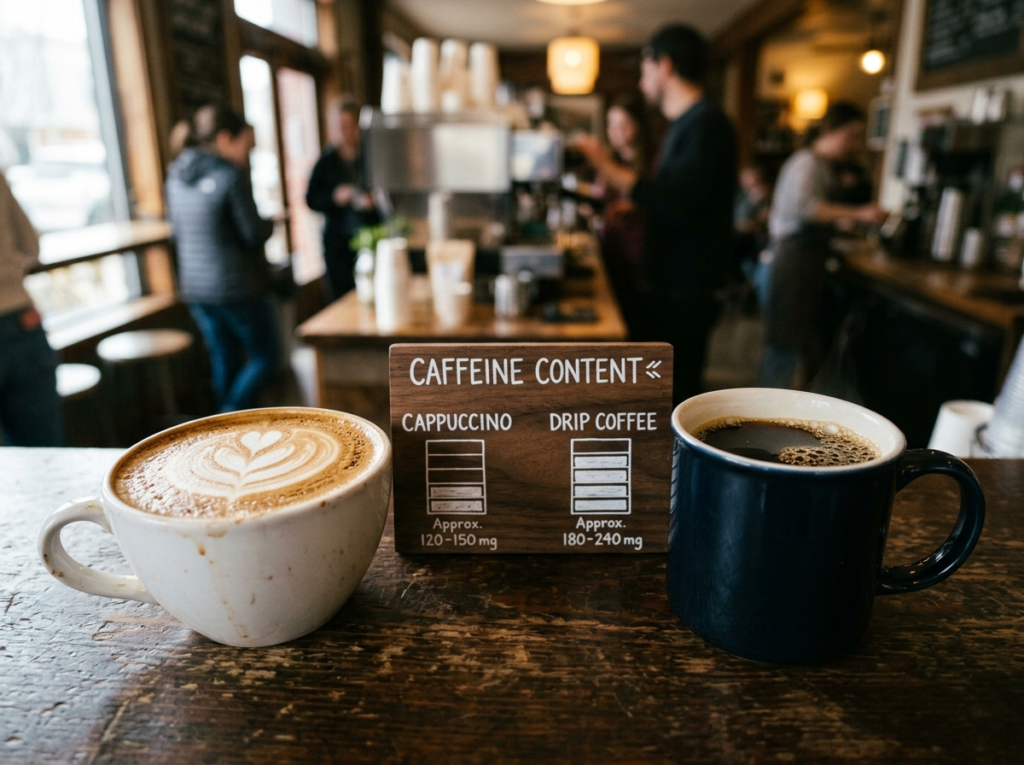
A single shot of espresso, the heart of every cappuccino, contains roughly 63 mg of caffeine — yet an average 8-oz cup of drip coffee packs around 95 mg. That simple stat surprises most people. You’d think the bold, concentrated taste of a cappuccino would mean more caffeine, right? Not exactly.
The cappuccino vs coffee caffeine debate isn’t as straightforward as it seems. Your drink size, the brewing method, the type of beans — they all play a role. And if you’re trying to manage your daily caffeine intake or just pick the right drink for your morning routine, understanding these differences actually matters.
Let’s break it all down — no fluff, just the stuff you actually need to know.
What Exactly Is a Cappuccino? (And How Is It Different From Coffee?)
Before we talk caffeine numbers, let’s make sure we’re comparing the right things. Because “coffee” is a broad term. It can mean drip coffee, pour-over, French press, cold brew, or even instant coffee. A cappuccino, on the other hand, is a very specific drink.
A traditional cappuccino is made with one or two shots of espresso, topped with equal parts steamed milk and milk foam. The ratio is typically one-third espresso, one-third steamed milk, and one-third foam. That’s it. The drink usually comes in a 5 to 6-oz cup in its classic Italian form, though most American coffee shops serve it in 8 to 16-oz sizes.
Regular drip coffee? That’s just hot water passing through ground coffee beans via a filter. No milk, no foam — just brewed coffee. The process is slower than espresso extraction, and it uses more water and more ground coffee per serving.
This difference in preparation is exactly why the caffeine content between the two isn’t what most people expect.
Cappuccino vs Coffee Caffeine Content: The Real Numbers
Let’s put actual numbers on the table.
A standard cappuccino made with a single shot of espresso contains about 63 mg of caffeine. If your barista pulls a double shot (which is common at places like Starbucks), you’re looking at roughly 126 mg of caffeine.
An 8-oz cup of regular drip coffee contains approximately 80 to 100 mg of caffeine, with the average sitting around 95 mg. A large 16-oz cup? That jumps to about 190 mg.
So here’s the thing most people get wrong: ounce for ounce, espresso has more caffeine than drip coffee. A single ounce of espresso gives you about 63 mg, while a single ounce of drip coffee gives you roughly 12 mg. But nobody drinks 8 ounces of straight espresso. You drink it in tiny 1 to 2-oz servings, which means the total caffeine per cup ends up being lower than a regular mug of drip coffee.
Quick Fact: A Starbucks Grande (16-oz) Pike Place brewed coffee has about 310 mg of caffeine. A Grande cappuccino at Starbucks? Around 150 mg. That’s less than half. If you’re curious about how different Starbucks drinks stack up, check out this breakdown of Starbucks drinks ranked by caffeine.
The milk in a cappuccino doesn’t add any caffeine either. It’s just there for texture and flavor. So the caffeine in your cappuccino comes entirely from the espresso shot(s).
Why Does Drip Coffee Have More Caffeine Than a Cappuccino?
It comes down to three things: water contact time, coffee-to-water ratio, and serving size.
Water contact time matters a lot. Drip coffee brewing takes anywhere from 3 to 5 minutes. During that time, hot water slowly passes through the coffee grounds, extracting caffeine along the way. Espresso, by contrast, forces hot water through finely-ground coffee in just 25 to 30 seconds. Less time means less total caffeine gets extracted per brewing cycle — even though the concentration per ounce is higher.
The coffee-to-water ratio also plays a role. A typical drip coffee maker uses about 14 to 18 grams of ground coffee for every 8-oz cup. An espresso shot uses about 7 to 9 grams for a 1-oz serving. So drip coffee uses roughly twice the amount of ground coffee per cup, which naturally pulls more caffeine into your mug.
Serving size is the final piece. You drink drip coffee in 8, 12, or 16-oz servings. A cappuccino, even a large one, might have two espresso shots at most. The math just doesn’t favor the cappuccino when it comes to total caffeine per drink.
Think of it like this: espresso is a concentrated shot of flavor and caffeine, like a shot of whiskey. Drip coffee is more like a pint of beer. The pint has more alcohol overall, even though the whiskey is stronger per sip.
Espresso vs Cappuccino Caffeine: Is There Any Difference?
This one’s easy. A cappuccino is espresso — just with milk and foam added. The caffeine in a cappuccino comes 100% from the espresso shot inside it. Steamed milk and foam contribute zero caffeine.
So if your cappuccino has a single shot of espresso, it has the same caffeine as a single espresso — about 63 mg. If it has a double shot, you get about 126 mg. The milk changes the taste and texture, but the caffeine stays the same.
Where it gets tricky is that different coffee shops use different standards. At Starbucks, for example, a Tall cappuccino (12 oz) gets one shot, a Grande (16 oz) gets two shots, and a Venti (20 oz) gets two or three shots. At smaller independent cafés, the standard might be a single shot regardless of size — they just add more milk.
Pro Tip: If you want more caffeine from your cappuccino without ordering a larger size, just ask for an extra shot. Most coffee shops will add one for about $0.50 to $1.00. That one extra shot bumps your caffeine by roughly 63 mg.
If you’re someone who uses a home espresso setup, keeping your machine clean and well-maintained actually affects extraction consistency — and that means consistent caffeine levels too. Here’s a useful guide on how to descale a Breville espresso machine if you’re brewing at home.
How Much Caffeine in a Cappuccino at Popular Coffee Chains?
Numbers vary from one chain to the next because they use different espresso blends, grind sizes, and shot counts. Here’s what you can expect at some of the most popular spots:
Starbucks Cappuccino:
A Tall (12 oz) has about 75 mg. A Grande (16 oz) has roughly 150 mg. A Venti (20 oz) comes in at around 150 to 225 mg, depending on whether they pull two or three shots.
Dunkin’ Cappuccino:
Dunkin’ tends to use slightly different espresso blends. A small cappuccino there has about 118 mg of caffeine. Their large? Around 252 mg. Dunkin’ often uses more espresso per drink than you’d expect. If you’re a Dunkin’ regular, you might also want to look at this complete guide to Dunkin’ cup sizes so you know exactly what you’re getting.
McDonald’s (McCafé) Cappuccino:
A small McCafé cappuccino has about 71 mg of caffeine. A medium sits around 142 mg. These numbers are slightly lower because McDonald’s uses a lighter espresso roast.
Independent / Specialty Cafés:
Your local specialty shop probably uses higher-quality, single-origin beans. Caffeine content can vary widely — anywhere from 60 to 130 mg per cappuccino depending on the beans, the roast, and how many shots they pull.
The takeaway? Don’t assume all cappuccinos are equal. The caffeine in your cappuccino depends heavily on where you buy it.
Does the Type of Coffee Bean Affect Caffeine?
Absolutely. And this is something most cappuccino vs coffee caffeine comparisons completely skip over.
There are two main species of coffee beans used commercially: Arabica and Robusta. Arabica beans are smoother, more complex in flavor, and account for about 60-70% of global coffee production. Robusta beans are bolder, more bitter, and contain almost twice the caffeine of Arabica.
A cup of drip coffee made with Robusta beans can have up to 200 mg of caffeine per 8-oz cup. The same cup made with Arabica? Closer to 80-95 mg.
Most specialty coffee shops — and most cappuccinos — use Arabica beans. So if you’re drinking a cappuccino from a quality café, your caffeine per shot might be slightly lower than a gas station drip coffee that uses a Robusta blend.
Some coffee enthusiasts are even exploring low-caffeine varieties like Arabica Laurina, which naturally contains about half the caffeine of regular Arabica. If you’re caffeine-sensitive but love the taste of espresso drinks, that’s worth looking into.
Roast level matters too, though the difference is smaller than most people think. Light roasts actually retain slightly more caffeine than dark roasts because the roasting process breaks down caffeine molecules. But the difference per cup is only about 5-10 mg, so it’s not a major factor.
Which Drink Should You Pick Based on Your Caffeine Goals?
Your ideal pick depends on what you’re trying to get out of your coffee.
If you want maximum caffeine to power through a long morning, a large drip coffee is your friend. A 16-oz cup gives you around 190 mg of caffeine, and you can sip it slowly over an hour. Cold brew is another strong option — it often contains 200+ mg per 16-oz serving because of its long steeping time.
If you want a moderate caffeine boost with a richer experience, a cappuccino with a double shot is a great middle ground. You get about 126 mg of caffeine, plus the creamy texture of steamed milk. It’s enough to wake you up without sending your heart into overdrive.
If you’re sensitive to caffeine or trying to cut back, a single-shot cappuccino gives you just 63 mg. That’s less than a cup of black tea (which averages 47 mg for an 8-oz serving) — wait, actually it’s more than tea. But it’s still significantly lower than a full mug of drip coffee. Pair it with lunch, and you won’t be staring at the ceiling at midnight.
If you’re watching calories too, keep in mind that drip coffee (black) has essentially zero calories. A cappuccino made with whole milk has about 80-120 calories depending on size. Using skim milk or oat milk brings that down. And if you’re looking for lighter café options in general, this list of low-calorie Starbucks drinks has some solid picks.
How Your Brewing Method Changes the Caffeine Game
Not all “coffee” is created equal. The way you brew it can swing caffeine content by 50 mg or more per cup. Here’s how different methods compare to a standard cappuccino:
Drip Coffee (Auto Drip Maker): 80–100 mg per 8 oz. This is the baseline most people compare to. Longer brew time means more caffeine extracted.
French Press: 80–108 mg per 8 oz. The immersion method and metal filter let more oils and compounds through, including a slightly higher caffeine extraction in some cases.
Pour-Over: 80–95 mg per 8 oz. Very similar to drip, but you have more control over water temperature and flow rate.
Cold Brew: 150–240 mg per 8 oz. Cold brew uses a high coffee-to-water ratio and steeps for 12–24 hours. The result is a caffeine powerhouse that can have double the caffeine of hot drip coffee. You can learn more about how caffeine works in different drinks by reading about how much caffeine is in a tablespoon of ground coffee.
AeroPress: 50–70 mg per serving. Shorter brew time and smaller serving size keep caffeine moderate.
Nespresso Pods: 55–85 mg per capsule, depending on the blend. If you use a Nespresso machine for your cappuccinos, this Nespresso caffeine content guide gives you exact numbers for each pod.
The point is, “coffee” isn’t one thing. Your brewing method changes the caffeine you’re actually consuming, sometimes dramatically.
Caffeine Absorption: Does It Hit Different With Milk?
Here’s a question most people don’t think to ask: does the milk in a cappuccino change how your body processes caffeine?
The caffeine molecule itself doesn’t change. Your body absorbs the same 63 mg from a shot of espresso whether it’s in a cappuccino, a latte, or drunk straight. But the speed of absorption can vary slightly.
When you drink black coffee on an empty stomach, caffeine hits your bloodstream fast — usually within 15 to 20 minutes. The milk and foam in a cappuccino slow gastric emptying slightly. So the caffeine absorbs a bit more gradually, which can mean a smoother, less jittery energy curve.
This is actually why some people feel like a cappuccino gives them a “calmer” buzz compared to black coffee. It’s not less caffeine — it’s slower delivery. If you’ve ever chugged a black coffee and felt your hands shake, then had a cappuccino the next day and felt totally fine, this is probably why.
Did you know? The FDA recommends a maximum daily caffeine intake of about 400 mg for healthy adults. That’s roughly four 8-oz cups of drip coffee or about six single-shot cappuccinos. Pregnant women are typically advised to keep it under 200 mg per day — one double-shot cappuccino and that’s your limit.
Cappuccino vs Other Espresso-Based Drinks: A Quick Caffeine Comparison
Since we’re already talking espresso vs cappuccino caffeine, let’s see how the cappuccino stacks up against its espresso-based cousins:
A latte has the same caffeine as a cappuccino (same number of espresso shots), just with more steamed milk and less foam. Caffeine-wise, they’re identical — the difference is purely texture and taste. If you’re curious about this comparison, here’s a detailed look at caffè misto vs latte differences.
A flat white typically uses a ristretto shot (a shorter, more concentrated pull) instead of a standard espresso shot. Ristretto shots actually contain slightly less caffeine — about 55 mg — because the shorter extraction time pulls fewer caffeine molecules.
An Americano is espresso plus hot water. Same caffeine as a cappuccino (if it has the same number of shots), but no milk. It tastes closer to drip coffee but with espresso’s flavor profile.
A mocha adds chocolate syrup to the mix but doesn’t change the caffeine from espresso. A standard mocha has about 95–175 mg, depending on the chocolate used (dark chocolate contributes a tiny amount of caffeine on its own — about 5–10 mg per tablespoon of cocoa).
The pattern is clear: in espresso-based drinks, the caffeine comes from the shots. Everything else — milk, foam, syrup, chocolate — is just flavor and texture.
When to Choose a Cappuccino Over Coffee (and Vice Versa)
This isn’t just about caffeine. It’s about what fits your moment.
Go with a cappuccino when you want a shorter, richer drink that you can finish in 10 minutes. It’s perfect for a mid-morning break or an after-lunch pick-me-up. The moderate caffeine from one or two shots won’t keep you wired for hours, and the milk takes the edge off the espresso’s intensity. Cappuccinos also pair beautifully with pastries — there’s a reason Italian cafés serve them with cornetti at breakfast.
Stick with drip coffee when you need a drink that lasts. A big mug of black coffee is your work companion — something you sip over 30 minutes while plowing through emails. The higher caffeine content provides a longer, steadier boost. And if you drink it black, you’re consuming almost zero calories.
Consider cold brew or an energy drink when you need serious caffeine fast — like before a workout or during an all-nighter. Cold brew can deliver 200+ mg in a single serving. And if you’re comparing coffee to energy drinks, you might find it interesting to see which energy drink has the most caffeine.
Here’s a thought most people overlook: the time of day matters. Having a strong drip coffee after 2 PM can mess with your sleep because caffeine’s half-life is about 5 to 6 hours. A single-shot cappuccino in the afternoon gives you a gentle lift without the midnight regret.
FAQ
How much caffeine is in a cappuccino compared to regular coffee?
A single-shot cappuccino has about 63 mg of caffeine. A standard 8-oz cup of drip coffee has about 95 mg. So regular drip coffee contains roughly 50% more caffeine than a single-shot cappuccino. A double-shot cappuccino (126 mg) comes closer, but a full mug of drip coffee usually still wins on total caffeine.
Is espresso vs cappuccino caffeine content different?
No. A cappuccino gets all its caffeine from the espresso inside it. If a cappuccino has one shot of espresso, it has the same caffeine as a solo espresso — about 63 mg. The steamed milk and foam add no caffeine at all. The only variable is how many shots your cappuccino contains.
Can I drink cappuccino at night without affecting sleep?
It depends on your sensitivity, but generally, a single-shot cappuccino (63 mg) consumed before 4 PM shouldn’t impact most people’s sleep. Caffeine takes about 5 to 6 hours to reduce by half in your body. So a cappuccino at 6 PM means you still have about 30 mg of caffeine in your system at midnight. If you’re a light sleeper, stick to decaf after lunch.
Is cappuccino healthier than regular coffee?
Neither is inherently “healthier.” Black coffee has fewer calories (about 5 per cup) compared to a whole-milk cappuccino (80–120 calories). But the milk in a cappuccino provides calcium, protein, and vitamin D. If you’re watching sugar, both are fine as long as you don’t load them up with sweeteners. The health difference comes down to what you add to your drink, not the drink itself.
Does a larger cappuccino always have more caffeine?
Not always. It depends on how many espresso shots are in it. A 16-oz cappuccino at one café might have two shots (126 mg), while the same size at another café might have just one shot (63 mg) with more milk. Always ask your barista how many shots are in your drink if caffeine content matters to you.
Your Drink, Your Call
The cappuccino vs coffee caffeine question doesn’t have a winner — it has a better fit. If you need a caffeine cannon to start your day, a large drip coffee or cold brew will serve you well. If you want something flavorful and moderate, a cappuccino with a double shot is the sweet spot.
What really matters is knowing what’s in your cup. Now you know the numbers. You know why drip coffee has more caffeine despite tasting “milder.” You know that espresso is concentrated but small, and that milk doesn’t change the caffeine equation.
Next time you’re standing at the counter deciding between a cappuccino and a regular coffee, you won’t have to guess. You’ll just know. And honestly, there’s no wrong choice — just the one that fits your day.