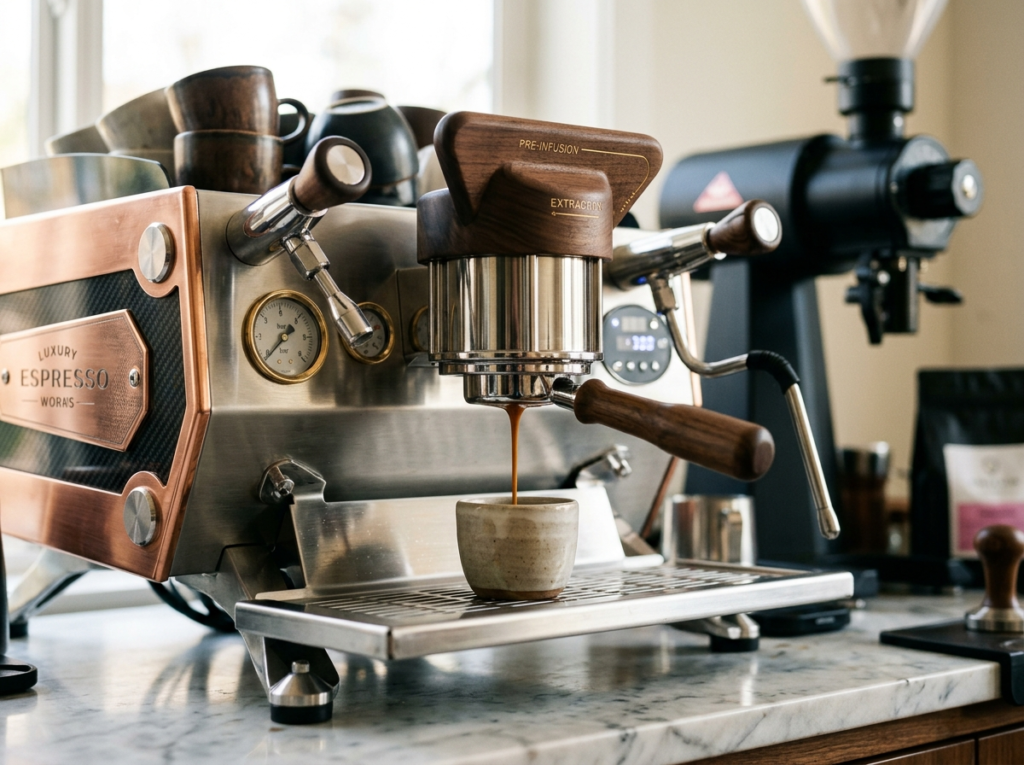
A single espresso machine can cost more than a used car. We’re talking $5,000, $10,000, and some even cross the $20,000 mark. Sounds absurd, right? But here’s the thing — thousands of coffee lovers and professionals buy them every year, and most of them say they’d do it again without hesitation.
So what exactly makes these machines so expensive? Is it just the brand name, or is there real engineering magic behind that price tag? And more importantly, should you even consider spending that kind of money on an espresso machine?
I’ve spent years testing, reviewing, and writing about coffee equipment. And after researching the most expensive espresso machines on the market, I can tell you this — some are absolutely worth it, some are pure luxury theater, and knowing the difference can save you thousands.
Let’s break it all down.
What Actually Makes an Espresso Machine Expensive?
Before we talk about specific machines, you need to understand why certain espresso machines cost as much as they do. It’s not just one thing — it’s a combination of factors that stack on top of each other.
Materials matter more than you think. Budget machines use plastic internal components. High end coffee machines use stainless steel boilers, brass group heads, copper piping, and sometimes even hand-polished aluminum casings. These materials don’t just look better — they conduct heat more evenly, resist corrosion, and last decades instead of years.
Boiler design is a big deal. Entry-level machines use a single boiler, which means you can’t brew espresso and steam milk at the same time. Mid-range machines use a heat exchanger. But the most expensive espresso machines? They typically run dual boilers — sometimes even with PID controllers on each one — giving you independent temperature control for brewing and steaming simultaneously. Some ultra-premium models use saturated group heads, which maintain temperature stability that’s nearly impossible to replicate with cheaper designs.
Build precision drives up cost. Brands like La Marzocco, Slayer, and Decent Espresso invest heavily in CNC machining, hand assembly, and quality control. Every component is tested individually. That level of precision means fewer defects, tighter tolerances, and better performance over time.
Then there’s the R&D factor. Machines like the Decent DE1PRO run custom software, have pressure profiling capabilities, and connect to apps that let you control every variable of your shot in real time. That kind of technology takes years and millions of dollars to develop.
And yes, brand heritage plays a role too. A company like La Marzocco has been making espresso machines since 1927 in Florence, Italy. You’re not just paying for a machine — you’re paying for nearly a century of espresso engineering knowledge baked into every unit.
The Most Expensive Espresso Machines You Can Actually Buy
Let’s get into the specific machines. I’ve organized these from “seriously expensive” to “I-need-to-sit-down expensive.” Each one brings something unique to the table.
La Marzocco Linea Micra — Starting Around $3,500
The Linea Micra is La Marzocco’s answer to the home espresso market, and it’s become one of the top rated espresso machines among serious home baristas. It borrows the dual boiler system and saturated group head technology from its commercial siblings — the same machines you’ll find in specialty coffee shops worldwide.
What makes it special? Temperature stability. The saturated group head design means the brewing temperature barely fluctuates, shot after shot. You also get an integrated app for adjusting brew temperature, pre-infusion settings, and shot timers. The build quality feels commercial because, frankly, it is commercial — just scaled down for your kitchen counter.
At $3,500, it’s not the priciest machine on this list, but it’s the entry point into true luxury espresso machines. If you’re upgrading from a Breville or De’Longhi machine, the jump in shot quality is immediately noticeable.
Victoria Arduino Eagle One Prima — Around $4,700
Victoria Arduino is La Marzocco’s sister brand, and the Eagle One Prima is their take on a premium home machine. It runs on their proprietary NEO brewing system, which uses a gravimetric pump that controls both pressure and flow rate dynamically during extraction.
Think of it this way: most machines push water through coffee at a fixed pressure. The Eagle One Prima can adjust pressure throughout the shot — starting gentle for pre-infusion, ramping up for extraction, then tapering off at the end. That kind of pressure profiling was once exclusive to $15,000+ commercial setups.
The design is also stunning. Clean lines, a compact footprint, and a color touchscreen interface. It looks like it belongs in a modern kitchen more than a coffee shop, which is exactly the point.
Decent DE1PRO — Approximately $3,500 to $4,500
The Decent DE1PRO is the oddball on this list, and I mean that as a compliment. It’s built by a small company founded by John Buckman, and it approaches espresso from a tech-first perspective rather than a traditional Italian engineering approach.
This machine gives you control over everything. Pressure, flow rate, temperature — all adjustable in real time through a tablet interface. You can download shot profiles created by other users, replicate famous café recipes, or design your own from scratch. It even logs every shot with data graphs so you can compare and improve over time.
It’s not the prettiest machine. It won’t win design awards next to a La Marzocco. But for people who geek out over extraction science, it’s arguably the best home espresso machine money can buy. The community around it is passionate and constantly sharing new profiles and techniques.
Slayer Single Group — $6,500 to $9,000
Slayer is a name that gets coffee professionals excited. Based in Seattle, they’ve been building espresso machines since 2007, and their single group home model brings commercial-grade performance into a surprisingly elegant package.
The standout feature is Slayer’s needle valve pre-infusion system. Instead of using electronic controls, it relies on a manual needle valve that lets you adjust the pre-infusion flow with analog precision. It’s a hands-on, tactile experience — and the results in the cup are noticeable. Shots tend to be sweeter, more complex, and less bitter compared to standard machines.
The build quality is exceptional. Hand-assembled in the US, each machine uses custom wood panels (you pick the wood species), stainless steel construction, and a rotary pump that’s whisper quiet. A Slayer on your counter is as much a conversation piece as it is a coffee tool.
La Marzocco GS3 — Around $7,500 to $8,500
If there’s a “gold standard” among luxury espresso machines for home use, it’s probably the La Marzocco GS3. It’s been around since 2008, and it remains one of the most sought-after machines for home baristas and small-volume specialty cafés.
The GS3 comes in two versions: the AV (auto-volumetric) and the MP (manual paddle). The MP version is the one enthusiasts drool over. It features a manual paddle that gives you direct control over water flow, letting you do pressure profiling entirely by feel.
Underneath, you get dual boilers with PID control, a saturated group head, and a plumb-in option so you don’t have to manually fill the water tank. This thing is built to run for 15-20 years with proper maintenance and descaling. Many coffee professionals use a GS3 at home after working on commercial La Marzocco machines all day — and they don’t feel like they’re downgrading.
Kees van der Westen Speedster — $10,000+
Now we’re entering rarefied air. Kees van der Westen is a Dutch manufacturer known for building machines that are equal parts art and engineering. The Speedster, their single group home model, starts around $10,000 and can climb higher depending on customization.
What do you get? A dual boiler system with a unique spring-lever mechanism combined with a pump, giving you hybrid manual-automatic control. The portafilter locking mechanism is unlike anything else on the market — smooth, precise, and deeply satisfying to use.
But let’s be honest: you’re also paying for aesthetics. These machines are gorgeous. Automotive-quality paint finishes, hand-built construction, and a retro-futuristic design that makes them look like something from a luxury car showroom. Every unit is made to order in the Netherlands. If you want one, expect a wait time of several months.
Synesso MVP Hydra — $12,000 to $15,000+
Synesso is another Seattle-based company, and the MVP Hydra is typically a commercial machine — but plenty of well-heeled home baristas install them in their kitchens. It features individually PID-controlled group heads, pre-infusion settings for each group, and a build quality that can handle pulling hundreds of shots per day without breaking a sweat.
For home use, it’s absolute overkill. But some people don’t want the scaled-down home version of commercial quality — they want the real thing. If you can accommodate the size (it’s large and heavy), the Synesso MVP Hydra delivers espresso that’s virtually indistinguishable from what top-tier specialty cafés produce.
Luxury Espresso Machine vs. Specialty Coffee Shop: The Math
Here’s an interesting way to think about the value of expensive espresso machines. Let’s do some rough math.
A specialty latte at a good café costs around $5.50 to $7.00 in most US cities. If you drink one every day, that’s roughly $2,000 to $2,500 per year. For a couple who both drink espresso daily, double it.
A $7,500 La Marzocco GS3 costs about the same as three years of daily café lattes for one person. But that machine will last 15-20 years. Over its lifetime, you’d spend $30,000-$50,000 at a café for the same number of drinks. Even factoring in the cost of quality beans, milk, and occasional maintenance, you come out thousands of dollars ahead.
Of course, this math only works if you’re actually going to use the machine daily and you’ve developed the skills to pull good shots. Which brings us to an important point.
Do You Actually Need a Machine This Expensive?
Honest answer? Probably not.
If you’re just getting into home espresso and you don’t yet know the difference between a 25-second and a 35-second extraction, spending $7,000 on a machine is like buying a Formula 1 car to learn how to drive. You won’t be able to use 80% of its capabilities, and you’ll get frustrated before you get good.
The sweet spot for most home baristas who want genuinely excellent espresso falls in the $1,500 to $3,500 range. Machines like the Breville Dual Boiler, Profitec Pro 600, or the Lelit Bianca give you temperature stability, PID control, and in some cases pressure profiling — all the tools you need to pull café-quality shots. Pair any of them with a good grinder (honestly, the grinder matters more than the machine above a certain price point), and you’ll make espresso that rivals most specialty shops.
So who should actually spend $5,000+?
Experienced home baristas who’ve outgrown mid-range machines and want the absolute best temperature stability and build quality. People who value design and craftsmanship as much as the coffee itself. Small specialty café owners who need commercial reliability in a compact format. And yes, coffee enthusiasts who simply love beautiful equipment and have the budget for it — there’s nothing wrong with that.
The key is going in with realistic expectations. A $10,000 machine won’t automatically make better espresso than a $2,000 machine in untrained hands. Your technique, your grinder, your beans, and your water quality all play equally important roles. If you’re still dialing in those fundamentals, check out how different coffee drinks compare in terms of caffeine and technique to build your understanding first.
What to Look for Before Buying a High End Espresso Machine
If you’ve decided that a luxury espresso machine is right for you, here are the things that actually matter — beyond brand name and price.
Boiler Configuration
Dual boilers are non-negotiable at this price point. They let you brew and steam simultaneously, and they give you independent temperature control for each function. Some machines offer multi-boiler setups for even greater thermal stability. If a machine costs $5,000+ and doesn’t have dual boilers, walk away.
Temperature Stability
This is arguably the most important factor for shot quality. Look for machines with PID controllers and saturated or semi-saturated group heads. These designs keep the brewing temperature within a fraction of a degree, shot after shot. Inconsistent temperature leads to inconsistent extraction, which means some shots taste sour and others taste bitter — even with the same beans and grind.
Pressure Profiling
Not all expensive machines offer this, but it’s becoming a standard feature on the best home espresso machines in the $3,000+ range. Pressure profiling lets you change the brew pressure during extraction. This opens up a world of flavor possibilities — longer, gentler pre-infusions can highlight sweetness, while declining pressure profiles can reduce bitterness.
Build Quality and Repairability
A truly high end machine should last 10-20 years. Look for stainless steel boilers (not aluminum), brass group heads, and commercial-grade components. Just as important: make sure replacement parts are available. Some boutique brands make beautiful machines, but if the company goes under, finding parts becomes a nightmare.
Pro Tip: Ask about the warranty before purchasing. La Marzocco offers a 2-year parts and labor warranty on home machines. Decent Espresso has a reputation for excellent customer support. Kees van der Westen provides direct support from the Netherlands. A strong warranty and accessible service network matter more than most people realize.
Water Connection Options
Many luxury machines offer a plumb-in option, meaning you can connect them directly to your water line instead of manually filling a reservoir. This is a genuine convenience upgrade if you’re pulling multiple drinks a day. Some machines (like the GS3) offer both options, letting you decide based on your kitchen setup.
The Grinder Is Half the Equation
I can’t write about the most expensive espresso machines without mentioning this: your grinder needs to match your machine’s quality. Pairing a $7,000 espresso machine with a $200 grinder is like putting cheap tires on a sports car. You’ll never get the performance you’re paying for.
For machines in the $3,000-$5,000 range, consider grinders like the Niche Zero, Eureka Mignon Specialità, or DF64. For machines above $5,000, you should be looking at flat burr grinders like the Lagom P64, Weber EG-1, or Ceado E37SD. These grinders produce the particle size consistency that expensive machines are designed to exploit.
The total investment — machine, grinder, accessories, and quality beans — can easily reach $5,000 to $15,000+ for a truly premium home setup. But if you’re someone who values the craft and ritual of making espresso, that investment delivers daily joy for years to come. Understanding what goes into your cup, from the right coffee measurements to proper extraction, makes the experience even richer.
Maintenance Reality: What Ownership Actually Looks Like
Owning an expensive espresso machine isn’t a “set it and forget it” situation. These machines need regular care, and skipping maintenance is the fastest way to ruin a five-figure investment.
Daily tasks include purging the group head before and after shots, wiping down the steam wand immediately after use, and backflushing with clean water at the end of the day. Weekly tasks involve backflushing with espresso machine detergent and cleaning the drip tray and shower screen. Monthly tasks mean descaling (depending on your water hardness), lubricating moving parts, and checking gaskets for wear.
If you’re using tap water, consider installing a water filtration system. Hard water causes scale buildup inside boilers, which reduces heating efficiency and can eventually cause leaks or component failure. Many luxury machine manufacturers recommend specific water hardness levels (usually between 35-85 ppm total dissolved solids). Some owners use Third Wave Water mineral packets to create ideal brewing water from distilled water.
If you’re already familiar with troubleshooting common issues on simpler machines, you’ll find that high end machines actually need similar types of attention — just more consistently and carefully.
Are Fully Automatic Luxury Machines Worth It?
There’s a whole separate category of expensive espresso machines that are fully automatic — think Jura Z10, Breville Oracle Jet, or the De’Longhi Maestosa. These machines grind, tamp, brew, and steam milk at the push of a button, and some of them cost $3,000 to $5,000.
They’re excellent for people who want great coffee with minimal effort. The latest models from Jura and Breville produce surprisingly good espresso — not quite on par with a skilled barista using a semi-automatic machine, but honestly close enough for most people.
The trade-off is control. With a fully automatic machine, you can’t manually adjust pressure mid-shot or experiment with different tamping pressures. You’re limited to the machine’s programmed parameters. For some, that’s perfectly fine. For others, it defeats the purpose of owning a premium machine.
Quick fact: The Jura Z10 (around $3,500) is one of the few super-automatics that can brew both hot and cold coffee, using a cold extraction process that’s genuinely impressive for a push-button machine. If you love cold drinks like Starbucks refreshers but want to make similar cold beverages at home, it’s worth a look.
Where to Buy and How to Get the Best Deal
Buying a machine at this price level isn’t like grabbing something off Amazon (though some are available there). Here’s what I’d recommend:
Authorized dealers are your safest bet. Companies like Whole Latte Love, Clive Coffee, Seattle Coffee Gear, and La Marzocco Home are authorized retailers that offer full warranties, expert advice, and often free shipping on large orders. Some also offer financing options that break the cost into monthly payments.
Direct from the manufacturer works for brands like Decent Espresso, which sells exclusively through their website. La Marzocco also has an official online store for their home lineup.
Refurbished or used can save you 30-50%, but proceed with caution. Buy only from reputable sellers who offer at least a 90-day warranty. Check for signs of scale buildup, boiler condition, and whether the machine has been regularly maintained. A well-maintained used GS3 at $4,500 is a far better buy than a new entry-level machine at the same price.
FAQ
What is the most expensive home espresso machine you can buy?
The Kees van der Westen Speedster and the Slayer single group are among the priciest options designed for home use, with prices ranging from $10,000 to $15,000+. Custom configurations and limited editions from brands like Spirit and Synesso can push prices even higher. Some collectors have paid $20,000+ for custom builds with rare materials and unique finishes.
Is a $5,000 espresso machine really better than a $1,500 one?
It depends on what “better” means to you. In terms of temperature stability, build longevity, and shot consistency, yes — a $5,000 machine outperforms a $1,500 one. But the flavor difference in the cup narrows significantly above the $1,500-$2,000 range, especially if you’re using an excellent grinder and quality beans. The premium you’re paying above $3,000 goes increasingly toward build materials, design, features like pressure profiling, and long-term durability rather than raw espresso quality.
What grinder should I pair with a luxury espresso machine?
For machines costing $3,000 or more, your grinder should cost at least $500-$1,000. Popular choices include the Niche Zero (~$700), Eureka Mignon Specialità (~$500), and for higher budgets, the Lagom P64 (~$1,200) or Weber EG-1 (~$3,000). The grinder has arguably more impact on shot quality than the machine itself, so don’t cut corners here.
How long do expensive espresso machines last?
With proper maintenance, most high end espresso machines last 15-20 years. Commercial-grade machines used at home often last even longer because they’re operating well below their designed daily capacity. La Marzocco machines from the 1990s are still in active use in cafés around the world, which tells you something about their engineering standards.
Can I finance a luxury espresso machine?
Yes. Many authorized retailers like Clive Coffee and Whole Latte Love offer financing through Affirm or similar services, letting you break the cost into 12-48 monthly payments. La Marzocco Home also offers financing directly on their website. Just check the interest rates — some plans are 0% APR if you pay within the promotional period.
Your Next Move
Spending $3,000 to $15,000 on an espresso machine is a significant decision, and it’s one that shouldn’t be rushed. If you’re earlier in your home espresso journey, start by nailing the fundamentals on a mid-range machine, invest in a great grinder, and learn to taste the difference between good and truly exceptional espresso. That knowledge will serve you well when you’re ready to upgrade.
If you’re already there — if you’ve outgrown your current setup and you know exactly what temperature stability, pressure profiling, and build quality mean in the cup — then the machines on this list represent the best of what home espresso can offer. They’re tools built by people who are obsessed with coffee, for people who feel the same way.
Pick the machine that matches your workflow, your aesthetic, and your budget. Then pull yourself a shot, sit down, and enjoy the fact that the best espresso you’ve ever had is now sitting on your kitchen counter. If you’re still exploring what kind of coffee drinks rank highest in flavor and caffeine, that curiosity is exactly the kind of mindset that makes owning a premium machine so rewarding.