A single extra gram of coffee grounds can turn your morning cup from smooth and balanced to bitter and undrinkable. And a gram less? You’re basically drinking hot brown water. The frustrating part is that most people don’t even know how much coffee their scoop actually holds — they just wing it and hope for the best.
Here’s the thing. Your coffee scoop isn’t some universal, standardized tool. The one that came with your coffee maker might hold a different amount than the one sitting in your bag of grounds. And that pretty tablespoon you grabbed from the kitchen drawer? That’s a whole different story. So if your coffee tastes inconsistent from one day to the next, the problem probably isn’t your beans or your machine. It’s your scoop.
This coffee scoop size guide breaks down everything you need to know — what a standard scoop actually measures, how it compares to a tablespoon, the right coffee to water ratio per scoop, and how to adjust based on your brewing method. No more guessing. No more bad cups.
What Does a “Standard” Coffee Scoop Actually Hold?
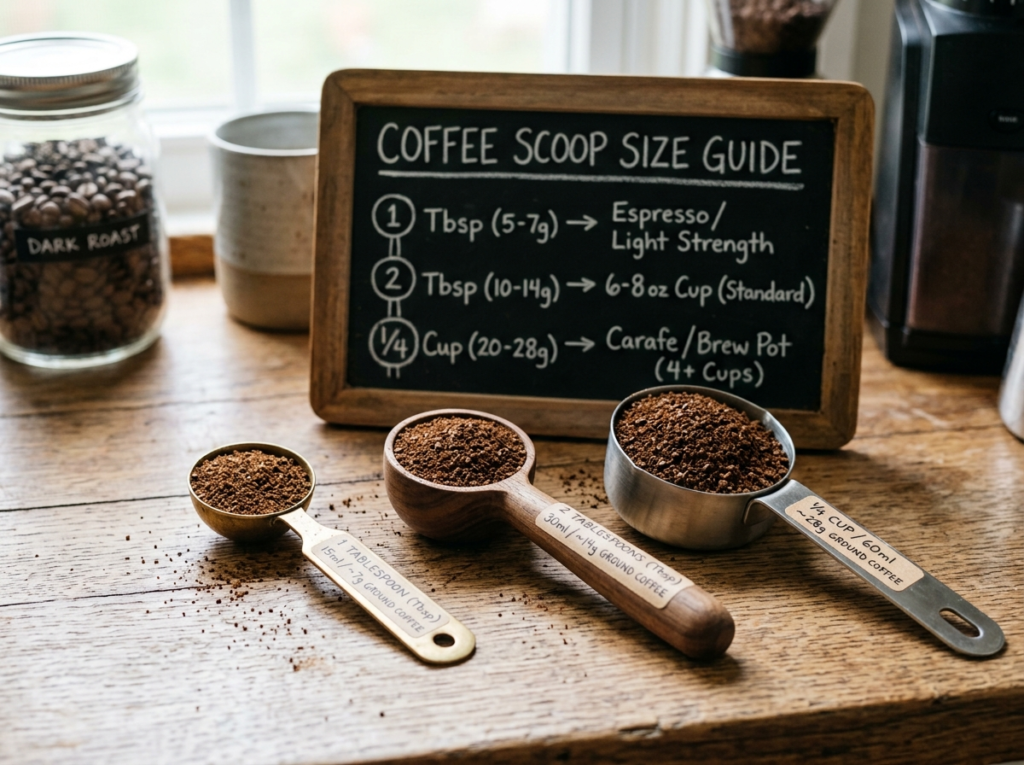
Let’s clear up the biggest source of confusion right away. A standard coffee scoop, the kind you’ll find packed inside a can of Folgers or bundled with a drip coffee maker, is designed to hold 2 level tablespoons of ground coffee. That’s roughly 10 grams of coffee, though the exact weight shifts depending on how fine or coarse the grind is.
So when a recipe or brewing guide says “one scoop,” they’re typically talking about those 2 tablespoons. Not one tablespoon. Not a heaping mountain of grounds piled on top. Two flat, level tablespoons.
This is where the tablespoon to coffee scoop conversion trips people up. If you’re using a regular kitchen tablespoon instead of a coffee scoop, you need two tablespoons to equal one standard scoop. Use just one tablespoon thinking it’s the same thing, and you’ll end up with a noticeably weaker brew.
Quick reference:
- 1 standard coffee scoop = 2 tablespoons = ~10 grams
- 1 kitchen tablespoon = half a coffee scoop = ~5 grams
That “roughly 10 grams” part matters, too. Coffee grounds aren’t like water, where a tablespoon always weighs the same. A tablespoon of finely ground espresso-style coffee is denser and heavier than a tablespoon of coarse French press grounds. So if you’re serious about consistency, a small kitchen scale (you can grab one for under $15) will always beat a scoop for accuracy.
Tablespoon to Coffee Scoop: Why This Confuses Everyone
You’d think measuring coffee would be straightforward. Scoop it, brew it, drink it. But the tablespoon to coffee scoop confusion has been messing with people’s brews for decades, and it comes down to one simple mix-up: people assume a coffee scoop equals a tablespoon.
It doesn’t.
Think of it this way. A tablespoon is a cooking measurement — you use it for sugar, spices, olive oil. A coffee scoop is specifically designed to measure the right amount of grounds for one cup of coffee according to most drip coffee maker standards. They’re related, but they’re not the same tool doing the same job.
Where it gets even messier is that “one cup” on your coffee maker doesn’t mean one 8-ounce cup the way you’d measure water for a recipe. Most coffee makers define a “cup” as 5 to 6 ounces, not 8. So when your 12-cup coffee maker is full, it’s actually holding about 60 ounces of water, not 96. That changes how much coffee you should be using.
If your coffee always tastes weak and you’ve been using one tablespoon per “cup” on your coffee maker, you’ve found your problem. You need two tablespoons — one full coffee scoop — per 6-ounce cup. Double what most people guess.
And here’s a real-world scenario that plays out in kitchens every day. Someone buys a new coffee maker, uses the included scoop, and makes great coffee. The scoop gets lost (because of course it does). They switch to a tablespoon from the silverware drawer, use the same number of scoops, and suddenly their coffee tastes thin. That’s because they’ve cut their coffee amount in half without realizing it.
Coffee Spoon Measurement by Grind Size
Not all coffee grounds measure the same way. This is something most guides skip over, but it’s a real factor in your morning cup. The coffee spoon measurement you use interacts directly with how coarse or fine your grounds are.
Picture this: if you fill a scoop with coarse French press grounds, there’s a lot of air space between those chunky particles. The scoop holds the same volume, but less actual coffee by weight. Fill that same scoop with finely ground espresso coffee, and it packs more tightly — more coffee, more weight, stronger flavor extraction.
Here’s approximately what one level standard coffee scoop (2 tablespoons by volume) weighs across different grind sizes:
Coarse grind (French press, cold brew): about 9 grams per scoop. The larger particles sit loosely, so you’re getting a bit less coffee per scoop. If your French press coffee tastes weak, this is likely why — try adding an extra half-scoop.
Medium grind (drip coffee makers, pour-over): about 10 grams per scoop. This is the baseline most manufacturers assume when they say “one scoop per cup.” It’s the Goldilocks zone for standard scoops.
Fine grind (espresso, Moka pot, AeroPress): about 11–12 grams per scoop. The grounds pack more densely, so you actually end up with more coffee. If you’re using a fine grind in a drip machine (which isn’t ideal, but people do it), your coffee might taste stronger or more bitter than expected.
Does a gram or two really make a difference? Honestly, yes — especially if you’re making just one or two cups. The ratio becomes more forgiving with larger batches because the differences average out. But for a single cup? A gram off can be the difference between smooth and harsh.
If you own a Keurig or another single-serve machine that uses pods, you don’t have to worry about scoop sizes at all — the pods are pre-measured. But if you’re using a reusable K-Cup filter, the same scoop rules apply.
How Much Coffee Per Scoop: The Ratio That Actually Works
Alright, let’s talk about the coffee to water ratio scoop method. This is the part where your coffee goes from “fine, I guess” to genuinely good.
The Specialty Coffee Association (SCA), which is essentially the governing body for coffee quality standards, recommends a ratio of 1:18 — that’s 1 gram of coffee to 18 grams (or milliliters) of water. For people who don’t want to do math at 6 AM, that works out to about 2 tablespoons (one standard coffee scoop) per 6 ounces of water.
But that’s a starting point, not a rule carved in stone. Your perfect ratio depends on your taste and your brewing method.
For standard drip coffee: One scoop (2 tablespoons, ~10g) per 6 ounces of water gives you a balanced, medium-strength cup. Most drip coffee makers, whether it’s a Mr. Coffee, a Cuisinart, or a Breville, are calibrated around this ratio.
For stronger coffee: Bump it up to 1 scoop per 4–5 ounces of water. You’re not changing the scoop size — you’re just using less water per scoop. This is great if you add milk or cream, since the dairy dilutes the brew anyway.
For milder coffee: Use 1 scoop per 7–8 ounces. Some people prefer this lighter ratio, especially with delicate light-roast beans where you want to taste the fruit and floral notes without too much intensity.
One thing people often get wrong is assuming how much coffee per scoop should change with roast level. Here’s the nuance: dark roast beans are actually less dense than light roast beans because they’ve been roasted longer and lost more moisture. So a scoop of dark roast weighs slightly less than a scoop of light roast. If you’re measuring by volume (scoops), you might want a slightly heaping scoop for dark roasts to compensate. If you’re measuring by weight (grams on a scale), this doesn’t matter — 10 grams is 10 grams regardless of roast.
Pro Tip: If you’re making a full pot, don’t just multiply linearly without tasting first. Brewing 12 scoops for a 12-cup pot might actually taste slightly stronger than a single cup would, because larger water volumes have longer contact time with the grounds in many drip machines. Start with 10–11 scoops for a full 12-cup pot and adjust from there.
Coffee to Water Ratio Scoop: A Practical Brewing Chart
Let’s make this really practical. You’re standing in your kitchen, you know how many cups you want, and you just need to know how many scoops.
Here’s a simple guide based on standard 6-ounce coffee maker cups and a 1:18 ratio with a standard coffee scoop:
For 1 cup (6 oz): 1 scoop or 2 tablespoons. This makes a solid single cup. If you’re brewing for just yourself with a pour-over, start here.
For 4 cups (24 oz): 4 scoops or 8 tablespoons. A good small-pot amount for one or two people during a relaxed morning.
For 8 cups (48 oz): 7–8 scoops or 14–16 tablespoons. Notice you can sometimes get away with slightly less per cup in larger batches. Start with 7 scoops and taste.
For 12 cups (72 oz): 10–12 scoops or 20–24 tablespoons. A full pot for the household or when you have guests over. If you’re using a coffee that tends toward bitterness, lean toward 10 scoops.
For cold brew: The rules change completely. Cold brew uses a much higher ratio because the cold water extracts less from the grounds. You’ll want about 1 scoop per 3–4 ounces of water, and then you’ll dilute the concentrate with water or milk later. It sounds like a lot of coffee, and it is — that’s what makes cold brew so smooth and concentrated.
If you’re someone who tracks caffeine intake carefully, knowing how much coffee per scoop helps you estimate your daily consumption. One standard scoop of medium-roast ground coffee contains roughly 60–80mg of caffeine after brewing, depending on the bean variety and extraction.
Why Your Scoop Might Be Lying to You
Here’s something nobody talks about enough. Not all coffee scoops are created equal, and that scoop sitting in your kitchen right now might not hold what you think it holds.
I tested this myself once — gathered five different coffee scoops from various coffee brands and machines. The smallest held about 1.5 tablespoons. The largest was closer to 2.5 tablespoons. That’s a 40% difference between them. If you followed the same “one scoop per cup” instruction with each, you’d get wildly different coffee.
The scoop that came with your Nespresso machine is designed for espresso-style doses and holds much less than a drip coffee scoop. The scoop bundled with a French press might be deliberately larger because French press brewing often uses a higher ratio. Your espresso machine, like a Breville, typically comes with a scoop sized for 7–9 grams — perfect for a single espresso shot but not the same as a drip coffee scoop.
So how do you know what your scoop actually holds? Fill it with water, then pour that water into a measuring spoon. If it’s 2 tablespoons, you’ve got a standard coffee scoop. If it’s more or less, now you know and can adjust.
Or, again — a $10 kitchen scale solves this permanently. Weigh your scoop once, note the number, and you never have to think about it again.
Matching Your Scoop Size to Your Brewing Method
Different brewing methods need different amounts of coffee, and the coffee spoon measurement that works for your drip machine won’t necessarily work for your French press or pour-over. Let’s walk through the most common methods.
Drip Coffee Maker
The standard ratio works perfectly here. One scoop (2 tablespoons, 10g) per 6-ounce cup. Your machine handles the water temperature and timing, so getting the dose right is your main job. If you’re not sure how many ounces your coffee maker considers a “cup,” check the manual — most hover between 5 and 6 ounces. Those little lines on the carafe correspond to coffee cups, not measuring cups.
Pour-Over (Hario V60, Chemex, Kalita Wave)
Pour-over tends to benefit from a slightly higher dose than drip because you have more control over extraction. Try 1 scoop plus an extra teaspoon per 6 ounces as a starting point. With pour-over, the grind size and pour technique matter just as much as the dose, so think of the scoop as your baseline that you fine-tune through experimentation.
French Press
French press coffee uses a coarse grind, which means (as we covered earlier) each scoop holds slightly less coffee by weight. Compensate by using a slightly heaping scoop rather than a perfectly level one. A good starting ratio is 1 heaping scoop per 4 ounces of water. French press is meant to be bold and full-bodied, and skimping on coffee here just makes it taste muddy and under-extracted.
AeroPress
The AeroPress is its own thing entirely. The official AeroPress scoop holds about 14 grams — that’s bigger than a standard coffee scoop. One AeroPress scoop with 6–8 ounces of water gives you a concentrated brew. Many AeroPress enthusiasts actually use two scoops with just 4 ounces of water to get an espresso-like concentrate they can then dilute. There’s a whole competitive scene around AeroPress recipes, and dose is one of the biggest variables people play with.
Espresso
Espresso uses very precise dosing, typically 7 grams for a single shot and 14–18 grams for a double. A standard coffee scoop is too imprecise for espresso — you really do want a scale here. If you’re pulling shots at home on a quality espresso machine, the difference between 16 grams and 18 grams in the portafilter can change the taste dramatically.
If you enjoy espresso-based drinks like a caffè misto or latte, the dose of your espresso shot is the foundation of the entire drink. Get that wrong, and no amount of perfectly steamed milk will save it.
Level Scoop vs. Heaping Scoop: It Matters More Than You Think
This seems like a small detail, but a heaping scoop can hold 25–40% more coffee than a level one. That’s not a rounding error — that’s the difference between a balanced cup and one that makes you wince.
When coffee instructions say “one scoop,” they mean a level scoop unless specifically noted otherwise. Level means you drag a flat edge (your finger, a knife, whatever) across the top of the scoop to remove the excess. The coffee should be flush with the rim.
A “rounded” scoop has a gentle dome on top and holds maybe 10–15% more. A “heaping” scoop is piled as high as it’ll go, and that can be up to 3 tablespoons or more depending on how aggressive you are with it.
If you like strong coffee, absolutely go for a heaping scoop. Just be consistent about it. The enemy of good coffee isn’t using too much or too little — it’s using a different amount every time and never knowing what you’re going to get.
Did you know? The SCAA (now SCA) Golden Cup Standard, established in the 1950s and updated over the decades, specifies 55 grams of coffee per liter of water as the ideal strength. That works out to about 1.6 level standard scoops per 8-ounce cup — slightly stronger than the “one scoop per cup” rule most people follow. If your coffee always tastes just a little flat, try that extra half-scoop. You might find it’s exactly what was missing.
How to Measure Without a Scoop
Lost your scoop? It happens to everyone. Here are some practical workarounds that give you a reliable coffee spoon measurement without the “official” tool.
A standard kitchen tablespoon works perfectly — just remember to use two per cup. You probably have one in your silverware drawer right now.
A regular dinner spoon (not a measuring spoon, just the spoon you eat cereal with) holds roughly one tablespoon, though it varies. It’s not precise, but if you use two slightly heaping dinner spoons, you’re in the right neighborhood for one coffee scoop.
A kitchen scale is the most accurate option. Tare the scale with your filter or portafilter on it, then add 10 grams of coffee per cup. Once you do this a few times, you’ll develop a feel for what the right amount looks like, and you won’t need the scale every single morning.
Here’s an old-school trick that works surprisingly well: use a shot glass. A standard 1.5-ounce shot glass filled with ground coffee holds almost exactly 2 tablespoons — one perfect scoop. It’s not scientific, but it’s consistent, and it’s something almost every kitchen has.
Common Mistakes People Make With Coffee Scoops
Using the wrong scoop and not knowing it. You grabbed a scoop from a different brand’s coffee canister, or you’re using one that came with a protein powder container. These aren’t all the same size. Verify your scoop’s actual capacity at least once.
Scooping from a bag that’s nearly empty. When you’re digging into the bottom of a coffee bag, the grounds are often more compacted from the weight above. Your scoop ends up holding more compressed coffee than it does when the bag is fresh and fluffy. If your last few cups from a bag taste stronger or more bitter, this is probably why.
Not adjusting for different coffees. Switching from a light-roast Ethiopian to a dark-roast Sumatra? The same scoop holds a different weight of each. Light roasts are denser. You might need to tweak your ratio slightly when you change beans.
Adding extra scoops to fix bad-tasting coffee. If your coffee tastes bad, more coffee usually isn’t the fix. Bitterness means over-extraction — you might need a coarser grind or shorter brew time, not more grounds. Sourness means under-extraction — try finer grinds or hotter water before piling on extra scoops.
If you’re drinking your coffee alongside something sweet, like one of the popular Starbucks drinks ranked by caffeine, you’ll notice how much strength and ratio affect the overall experience. A well-dosed home brew can easily rival café drinks when you get the measurements right.
Does Your Coffee Scoop Size Need to Change With Your Cup Size?
Here’s a question worth thinking about. Your favorite mug at home probably holds somewhere between 10 and 16 ounces. That’s way bigger than the 6-ounce “cup” your coffee maker uses as its standard. So when you fill that big mug, you’re actually drinking the equivalent of 2 to 2.5 coffee maker cups.
If you brew a full pot and pour into a 12-ounce mug, you’re fine — the ratio was already set when you measured your scoops against the machine’s cup markings. But if you’re making coffee in a single-serve method like pour-over directly into your mug, you need to scale your scoops to your actual mug size.
For a 10-ounce mug: about 1.5 scoops (3 tablespoons).
For a 12-ounce mug: about 2 scoops (4 tablespoons).
For a 16-ounce travel mug: about 2.5 scoops (5 tablespoons).
This is where the coffee to water ratio scoop method really pays off. Instead of thinking “how many scoops per cup,” think “how many scoops per ounce of water.” One scoop per 6 ounces, scaled to whatever vessel you’re brewing into.
Speaking of cup sizes, if you’ve ever been confused by Dunkin’s cup sizing system or noticed that a “large” at one chain holds a totally different volume than another, you already know that “cup” is one of the most unreliable measurements in the coffee world. Ounces and grams are your friends.
FAQ
How many tablespoons is one coffee scoop?
One standard coffee scoop equals 2 level tablespoons of ground coffee, which weighs approximately 10 grams. If you’re using a kitchen tablespoon as your measuring tool, you’ll need to scoop twice to match what a single coffee scoop holds. This 2:1 tablespoon to coffee scoop ratio is consistent across most major coffee brands and machine manufacturers.
What’s the right coffee to water ratio using scoops?
The widely accepted ratio is 1 standard coffee scoop (2 tablespoons / 10 grams) per 6 ounces of water. This follows the SCA’s recommended brewing guidelines and produces a balanced, medium-strength cup. For stronger coffee, use 1 scoop per 4–5 ounces. For lighter coffee, use 1 scoop per 7–8 ounces. The “right” ratio ultimately depends on your personal taste, so use these numbers as a starting point and adjust.
Are all coffee scoops the same size?
No, and this is a common source of inconsistency. While the industry standard is 2 tablespoons (about 10 grams), scoops from different brands and machines vary. Espresso machine scoops typically hold 7–9 grams. AeroPress scoops hold about 14 grams. Some third-party scoops sold online hold anywhere from 1 to 2.5 tablespoons. Always verify your specific scoop’s capacity by measuring it against a tablespoon or kitchen scale.
Can I use a regular spoon instead of a coffee scoop?
Yes, but know what you’re working with. A typical dinner spoon holds roughly 1 tablespoon of ground coffee, so you’d need two spoonfuls to replace one standard coffee scoop. A dessert spoon holds slightly less. For more accuracy, use an actual measuring tablespoon from a kitchen set — these are calibrated to a precise volume and give you much more consistent results than eyeballing it with flatware.
How many scoops do I need for a full 12-cup pot?
A standard 12-cup coffee maker uses 6-ounce cups, so a “full pot” is about 72 ounces of water. At a ratio of 1 scoop per 6 ounces, you’d need 12 scoops — but in practice, 10–11 scoops often produces a better-tasting pot because larger brew volumes extract slightly more efficiently. Start with 10 scoops, taste, and add more next time if it’s not strong enough for you.
Your Scoop, Your Rules — Just Be Consistent
Here’s what all of this boils down to. The “perfect” scoop size isn’t really about finding some magic number that works universally. It’s about understanding what your scoop holds, knowing the ratio that tastes good to you, and then doing the same thing every morning.
If you take just one thing from this guide, let it be this: measure your scoop once. Fill it with water, pour it into a tablespoon, and find out if it’s actually 2 tablespoons or something different. That thirty-second experiment will improve every cup of coffee you make going forward.
And if you’re ready to geek out even more about what goes into your cup, check out how much caffeine is actually in a tablespoon of ground coffee — it might surprise you. Happy brewing.