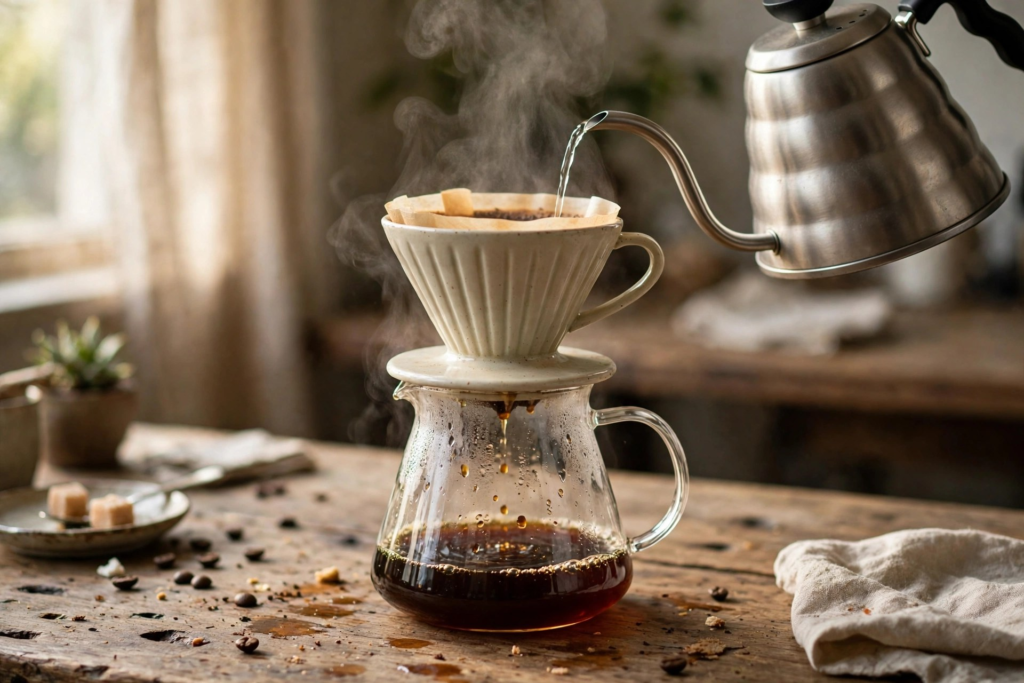
Pour over coffee has a reputation for being fussy, and honestly, some of that reputation is earned. There is a kettle with a funny spout, a scale, a timer, and a whole vocabulary of bloom times and drawdowns. But underneath all of that equipment, the method itself is beautifully simple: hot water poured slowly over ground coffee in a filter, with gravity doing the rest. Once you understand the handful of variables that actually matter, you can brew a cup at home that stands up to anything a good cafe serves.
What pour over gives you, more than any other manual method, is clarity. The paper filter catches oils and fine sediment, so what lands in your cup is clean and bright, with the coffee’s own character front and centre. A fruity Ethiopian tastes fruity. A chocolatey Colombian tastes like chocolate, not like generic coffee. If you have ever wondered why the same bag of beans tastes so different from one brewing method to another, pour over is the method that answers that question most honestly.
What You Actually Need
You do not need a cafe’s worth of gear to start. A dripper and matching paper filters, a vessel to brew into, a kettle, fresh beans, and a grinder will get you most of the way there. A kitchen scale and a timer help enormously, and they are worth picking up early, because guessing at both the coffee dose and the water amount is the fastest route to an inconsistent cup. A gooseneck kettle is the one piece of equipment that genuinely changes the experience: its narrow spout lets you pour slowly and precisely, which matters far more than it looks like it should.
As for the dripper itself, cone-shaped brewers like the V60 are the most common starting point, and flat-bottom brewers like the Kalita Wave are a forgiving alternative. Either one works with the method below. What matters more than the brand on the dripper is that you use the filters made for it, since a filter that does not fit properly will fold, channel water down one side, and quietly ruin an otherwise careful brew.
The Numbers That Matter, Kept in Range
Most good pour over recipes live in the same neighbourhood, and that is reassuring: you are not hunting for one magic number. A coffee-to-water ratio of roughly 1:15 to 1:17 is the standard starting zone, with 1:16 a sensible default. In practical terms, that means about 20 grams of coffee to 320 grams of water for a generous single mug, or about 15 grams to 250 grams for a smaller cup. If you prefer a stronger, heavier cup, drift toward 1:15; if you like something lighter and more tea-like, drift toward 1:17.
Grind size should land around medium-fine, roughly the texture of table salt or coarse sand. Too fine and the water drains slowly, dragging bitter, drying flavours out of the grounds. Too coarse and the water rushes through, leaving the cup thin and sharp, almost sour. Water temperature sits in a similar range across most guides: roughly 92 to 96 degrees Celsius, or about 200 to 205 degrees Fahrenheit, which in practice means water just off the boil. Lighter roasts tend to like the hotter end of that range, while darker roasts often taste better a touch cooler. Total brew time, from the first pour to the last drip, usually lands somewhere around three to three and a half minutes for a single cup.
None of these numbers is a law. They are a starting point you adjust by taste, one variable at a time. Change the grind before you change anything else, because grind size is the lever that moves extraction the most with the least fuss.
Step by Step: Brewing Your First Pour Over
Start by heating more water than you need, so you have plenty for rinsing. Set the filter in the dripper, place the dripper on your carafe or mug, and pour hot water through the empty filter. This does two useful things at once: it rinses away any papery taste from the filter, and it warms the brewer and the vessel so your coffee does not lose heat to cold ceramic or glass. Tip the rinse water away, then add your ground coffee and give the dripper a gentle shake so the bed sits level.
Now comes the bloom. Start your timer and pour just enough water to soak all the grounds, usually about twice the coffee’s weight in water, so around 40 grams of water for 20 grams of coffee. You will see the bed swell and bubble slightly as trapped gas escapes from the fresh grounds. That gas is carbon dioxide released by recently roasted coffee, and letting it out before the main pour helps the water reach the grounds evenly. Wait about 30 to 45 seconds. If the coffee barely blooms at all, it is probably not very fresh, which is useful information in itself.
After the bloom, pour the rest of the water in slow, steady circles, starting from the centre and spiralling outward, then back in again. Keep the stream thin and unhurried, and try not to pour directly down the filter walls, where water can slip past the coffee without extracting much from it. You can pour in two or three stages, letting the water level drop a little between each, or in one long, gentle pour. Both approaches work; the staged pour gives you a little more control, and it is a good habit while you are learning.
Finish pouring at around the two-minute mark, then let the dripper drain. When the dripping slows to an occasional drop, somewhere around three to three and a half minutes in total, lift the dripper away. Give the carafe a gentle swirl, pour, and let the coffee cool for a minute before you judge it. Coffee straight off the brewer always tastes hotter and flatter than it will after a short rest.
Reading the Cup and Fixing What Is Off
The best thing about pour over is that the cup tells you what to change next. A brew that tastes sour, sharp, or thin, and finishes well under three minutes, is almost always under-extracted: the water moved through too fast or the grind was too coarse. Grind a little finer next time and see if the cup rounds out. A brew that tastes bitter, dry, or harsh, and drags on well past three and a half minutes, is usually over-extracted: grind a little coarser and let the water through faster.
If the cup feels weak, add a little more coffee rather than grinding finer. Change one thing at a time and keep a rough note of what you did, or you will never know which change fixed the cup.
Water matters more than most beginners expect, too. Very hard tap water can mute acidity and make everything taste flat, while very soft water can make a cup taste sharp and hollow. If your coffee tastes dull no matter what you adjust, try filtered water before you blame the beans or the brewer.
Choosing Beans Worth the Effort
Pour over rewards good beans more visibly than almost any other method, because there is nowhere for a mediocre coffee to hide. Freshness matters: coffee is at its best roughly one to four weeks after roasting, and it fades noticeably after that. A light or medium roast will usually show more of the origin character that pour over is built to highlight, while a very dark roast can taste ashy and one-dimensional through a paper filter, though plenty of people love exactly that intensity.
Grinding fresh, just before you brew, makes a bigger difference than upgrading your dripper. Pre-ground coffee goes stale within days, and no pouring technique recovers what is already lost. If you are still deciding between manual brewers, our AeroPress tutorial covers a more forgiving, immersion-style alternative, and our Chemex guide walks through a larger-batch brewer from the same pour over family.
Making It a Habit, Not a Performance
It is easy to turn pour over into a ritual so elaborate that you only bother on weekends. Resist that. The whole brew takes about five minutes once the motions are familiar, and the familiarity comes faster than you think. After a dozen brews, the bloom, the spiral pour, and the timing stop feeling like steps to remember and start feeling like one continuous motion.
Keep the variables simple at first: same dose, same ratio, same water temperature, and adjust only the grind until the cup tastes right. Then, once you have a baseline you trust, start playing. Try a new origin, nudge the ratio, or pour a little slower and see what changes. That is the real pleasure of pour over, not the equipment or the precision for its own sake, but the way a small, deliberate change in the morning shows up directly in the cup.