
Walk into a design museum and you may find a coffee brewer sitting among the furniture and glassware. The Chemex — an hourglass of glass with a wooden collar tied on with a leather thong — has been exhibited at the Museum of Modern Art in New York, where it sits in the permanent collection, and in 1958 the Illinois Institute of Technology named it one of the hundred best-designed products of modern times. Not bad for something you can buy for the price of a nice dinner.
Then you brew with it, and the looks stop being the point. The Chemex makes one of the cleanest, sweetest cups in all of coffee — bright, tea-like, with the flavors of the bean laid out clearly and almost no heaviness. It has been doing that, essentially unchanged, for more than eighty years.
A Brewer Invented in a Laboratory
The Chemex was created by Dr. Peter Schlumbohm, a German chemist who emigrated to the United States and spent his career inventing — he held hundreds of patents by the time he died in 1962. Patented in 1941, the brewer is applied chemistry as much as it is cookware. Schlumbohm made it from a single piece of borosilicate glass, the same non-porous glass used in laboratories, because it would never absorb oils or residues from previous brews and taint the next cup. The wooden collar exists because glass full of near-boiling coffee needs a handle; the leather tie holds it on.
America in the early 1940s mostly drank percolator coffee — harsh, boiled, often stewed for hours. The Chemex never came close to outselling the percolator, and coffee historian Mark Pendergrast has noted it appealed mainly to purists and design lovers. But it survived every wave of coffee fashion that followed: the rise of the automatic drip machine, the espresso boom, the pod era. The Chemex Corporation still makes it in Massachusetts today, in sizes from a 3-cup model up to a 13-cup, using the same basic form Schlumbohm patented.
Why the Cup Tastes So Clean
The secret is less the glass than the paper. Chemex filters are 20 to 30 percent thicker than the filters used in most other pour-over brewers, and they are shaped to fit the cone exactly. That heavy paper traps nearly all of the coffee’s oils and every trace of fine sediment, while slowing the flow of water through the grounds. The result is a brew with the clarity of drip coffee but more sweetness and depth — lighter in body than a French press, and completely free of sludge. If you love a coffee for its delicate floral or fruity notes, this is the brewer that shows them off. If you want something thick and heavy, it may taste almost too polite.
What You Need
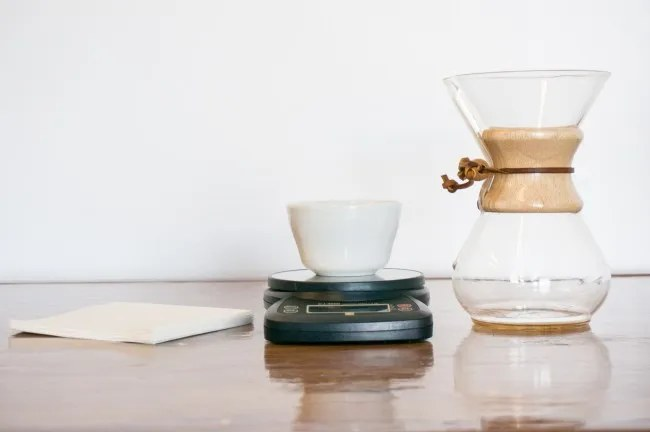
- A Chemex brewer (the 6-cup is the most versatile size)
- Chemex bonded paper filters, square or round
- Fresh whole-bean coffee and a grinder
- A gooseneck kettle, ideally — the controlled pour matters
- A digital scale and a timer
A scale sounds fussy until you try brewing without one twice and get two different cups. Scoops are unreliable measuring tools, since what a coffee scoop holds varies with the bean and the hand that fills it. Weighing takes two seconds and makes the recipe repeatable.
Coffee, Grind and Ratio
Chemex’s own long-standing guidance is one rounded tablespoon of coffee for every 5-ounce cup. In modern terms, a ratio of about 1 part coffee to 17 parts water is a reliable starting point. For a full, satisfying brew of roughly 18 ounces, that works out to 30 grams of coffee and 510 grams of water. Weighing the dose also keeps the caffeine predictable — a tablespoon of grounds carries a fairly consistent amount, as our look at the caffeine in a tablespoon of coffee explains.
Grind medium-coarse: coarser than drip, finer than French press, somewhere around the texture of coarse sea salt. This is the adjustment you will use most. If the water drains too quickly and the cup tastes weak and sour, go a little finer. If the filter clogs and the brew stalls and turns bitter, coarsen it.
Brewing, Step by Step
1. Heat the water
Bring more water than you need — the recipe’s 510 grams plus extra for rinsing. For pouring, you want it just off the boil; taking the kettle off the heat for twenty or thirty seconds lands you in the right zone, around 200°F.
2. Rinse the filter
Set the filter in the cone with the triple-folded side facing the pouring spout — that thick side keeps the paper from collapsing against the spout and sealing it shut. Rinse the filter thoroughly with hot water. Chemex filters are heavy, and skipping this step can leave a papery taste in the cup. Pour the rinse water out. As a bonus, the glass is now warm.
3. Add coffee and bloom
Add your 30 grams of ground coffee and shake the brewer gently to level the bed. Pour in about twice the coffee’s weight in water — 60 grams or so — just enough to saturate everything, and give it a gentle swirl or stir. Then wait. Over the next 30 to 45 seconds the coffee will puff up and bubble as trapped carbon dioxide escapes. This bloom is not ceremony; gas leaving the grounds lets water actually reach the coffee and extract it evenly.
4. Pour in stages
Add the remaining water slowly, in two or three pours, spiraling from the center outward and keeping the water level steady. Leave at least an inch of space below the rim. Slow, patient pouring is the whole craft of the Chemex — rush it and the water finds one path through the grounds and under-extracts the rest. From bloom to final drawdown, the whole brew should take about four minutes.
5. Serve
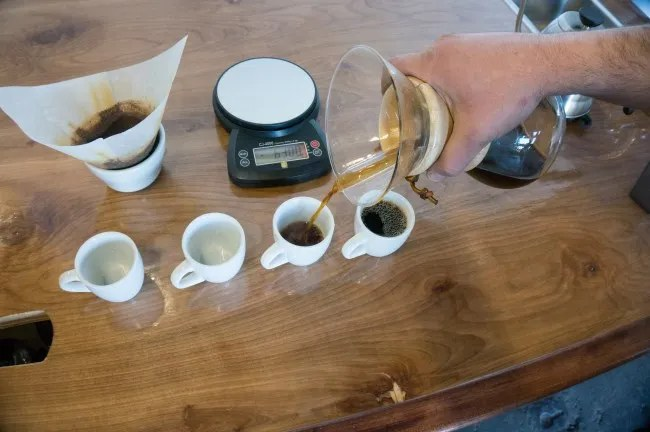
When the last of the water has drawn down and the stream slows to drips, lift out the filter, give the brewer a swirl, and pour. Chemex coffee is at its best in the first minutes, when the aromatics are still lifting off the cup.
Keeping It Warm, Keeping It Clean
One honest weakness: a glass vessel loses heat fast, and coffee left sitting loses its sparkle with it. The simplest fix is to brew only what you plan to drink, or to pour the extra straight into a thermal carafe. Resist the old advice about setting the Chemex on a stovetop grid to keep warm — reheating brewed coffee dulls it, and an insulated carafe does the job without cooking the flavor away.
Cleaning, despite an old reputation for difficulty, is easy. It is a piece of glass: hot soapy water does it. The brewer (with the wood collar untied and removed) can go in the dishwasher. For stubborn coffee stains inside the narrow neck, a handful of ice, a spoonful of salt and a good swirl will scour it clean — an old soda-fountain trick that works beautifully on glass.
A Word on Filters
Paper is the classic choice and gives the cleanest cup, but it is not the only one. Stainless steel filters made for the Chemex, such as the Able Kone, let more oil through, so the cup drinks richer and a little heavier — closer to a press pot in spirit. Cloth filters split the difference and are reusable for months, though they need rinsing and storing damp, which not everyone has the patience for. Note that the small 3-cup Chemex uses its own narrower filter size, and the standard Kone does not fit it.
Eighty-plus years on, the Chemex endures because it got two things right at once: it is beautiful enough to leave on the counter, and it makes a cup clean enough to remind you why you bought good beans in the first place. Brew it slowly, weigh your coffee, respect the bloom — and it will repay you every morning.
1 Comment