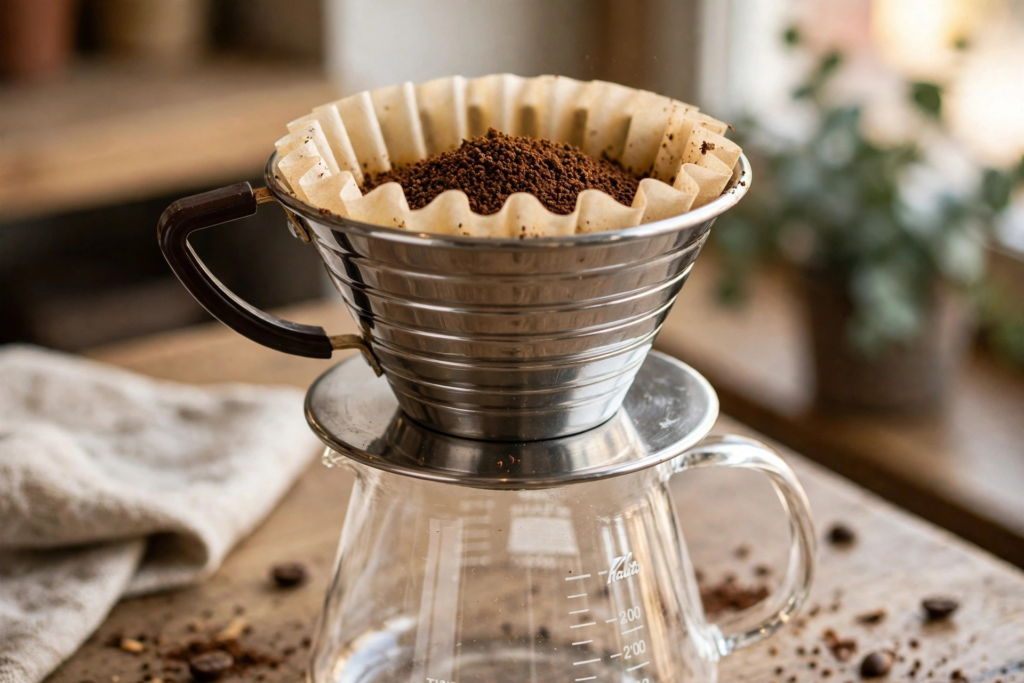
Among pour over brewers, the Kalita Wave has a quiet reputation: it is the one experienced baristas recommend when someone asks for a brewer that forgives small mistakes. It does not look dramatic. It is a squat dripper with a flat bottom, three small holes, and a pleated paper filter that resembles a cupcake wrapper. But that unassuming design solves one of the most common problems in pour over brewing, which is uneven extraction, and it solves it mechanically, before your pouring technique even comes into it.
The Wave comes from Kalita, a Japanese company that has been making coffee equipment and filters since the late 1950s. The dripper is sold in a few materials, most commonly stainless steel, glass, and ceramic, and in two main sizes. The smaller Wave 155 brews roughly one to two cups, while the larger Wave 185 handles two to four cups. Each size takes its own filters, so it is worth checking which one you own before ordering replacements, since the wrong size filter will not seat properly.
Why a Flat Bottom Changes the Brew
Most pour over drippers are cones. In a cone, the coffee bed is deep at the centre and shallow at the edges, so water passes through different depths of coffee depending on where it lands, and the single large hole at the bottom lets it drain fast. That design can produce a brilliant cup, but it punishes sloppy pouring: water that channels down one side extracts far less than water that lingers in the centre.
The Wave flips that geometry. Its flat bottom means the coffee bed sits at a roughly even depth across the whole filter, so water meets a similar amount of coffee wherever it lands. Instead of one large hole, the base has three small holes, which slow the flow and keep water in contact with the grounds a little longer. The pleated filter helps too: its folds hold the paper slightly away from the dripper walls, so water flows down through the coffee bed rather than slipping around the outside of the filter. None of this makes technique irrelevant, but it does mean a slightly uneven pour costs you less than it would in a cone.
The trade-off is a sweeter, rounder, more balanced cup rather than the sparkling, high-acidity cup a cone can deliver at its best. If you love bright, tea-like coffees, a cone may still be your brewer; if you want a dependable sweet cup every morning, the Wave is hard to beat.
What You Need and Which Size to Pick
The kit list is the same as for any pour over: the dripper and its matching Wave filters, a server or mug to brew into, a kettle, a scale, a timer, and freshly ground coffee. A gooseneck kettle helps, but it matters less here than with a cone, since the flat bed forgives a less precise pour.
Size choice comes down to how you usually brew. If you mostly make a single cup for yourself, the 155 is the natural fit, brewing around 200 to 250 grams of water comfortably. If you regularly brew for two people, or you like a large mug, the 185 is the better buy, handling around 400 to 500 grams with ease. You can brew a small amount in the larger dripper, but the bed becomes wide and shallow, which changes the extraction, so matching the brewer to your usual batch size is the simpler path.
Material is mostly taste and habit. Stainless steel is light and unbreakable. Glass lets you watch the brew but loses heat faster. Ceramic holds heat well once preheated, but needs a proper hot-water rinse first, or it will steal warmth from the brew.
The Recipe: A Reliable Starting Point
As with most pour overs, a ratio around 1:15 to 1:17 works well, with 1:16 a good default. For the Wave 155, that means roughly 15 grams of coffee to 240 grams of water. For the Wave 185, roughly 20 grams of coffee to 320 grams of water for a smaller batch, or 30 grams to 500 grams when brewing for two. Grind a touch coarser than you would for a cone dripper, around medium, with a texture like coarse sand or caster sugar. Because the flat bottom and small holes already slow the flow, a grind that is too fine can stall the brew and push it toward bitterness.
Water temperature follows the usual pour over range, roughly 92 to 96 degrees Celsius, or about 200 to 205 degrees Fahrenheit, just off the boil. Lighter roasts generally prefer the hotter end, darker roasts the cooler end, but you will learn your own preference quickly once you have a baseline.
Brewing the Wave, Step by Step
Seat the pleated filter in the dripper, set it over your server, and rinse thoroughly with hot water. The pleats need a good rinse to settle into place and to wash out any papery taste, and the rinse warms the brewer and server at the same time. Discard the rinse water, add your ground coffee, and shake the dripper gently so the bed is level. A level bed matters more in a flat-bottom brewer than anywhere else, since the whole point is even depth.
Start the timer and bloom with about twice the coffee’s weight in water: around 30 grams for a 15-gram dose, or 40 grams for a 20-gram dose. Pour in gentle circles so every ground is wet, then wait 30 to 45 seconds while the coffee releases gas and swells. A fresh coffee will bloom visibly; an older one will sit flat, which tells you something about the beans before you even taste the cup.
After the bloom, pour in stages rather than all at once. For a 20-gram dose, a comfortable pattern is to pour to about 140 grams, let the level fall a little, pour to around 230 grams, then finish at 320 grams, with your pouring done by roughly two minutes. For a 15-gram dose, the same shape scales down: to about 110 grams, then 180 grams, then 240 grams. Keep the pours gentle and centred, spiralling outward and back, and avoid flooding the bed or pouring hard down the filter walls.
Then let it drain. A single-cup Wave 155 brew usually finishes draining around two and three-quarter to three and a quarter minutes in total, while a larger Wave 185 brew lands around three to three and a half minutes, or three and a half to four minutes for a full 500-gram batch. When the dripping slows to a stop, remove the dripper, swirl the server, and let the coffee cool briefly before tasting. That short rest lets the flavours settle and open up.
Reading the Cup and Adjusting
The Wave’s forgiveness has a limit, and the cup will still tell you when you have crossed it. A brew that drains very fast and tastes sour or thin is under-extracted, so grind a little finer or pour a little more slowly. A brew that stalls, drains well past four minutes, and tastes bitter or heavy is over-extracted, so grind a little coarser. If the cup tastes good but feels muddy or flat, check the bed after brewing: grounds stuck high up the filter walls suggest you poured too aggressively, and a gentle, centred pour next time will usually fix it.
One common Wave mistake is rushing the rinse: the pleated filter holds more paper than a cone filter, so an unrinsed filter can lend a papery taste no good coffee covers.
It is also worth learning how the Wave sits alongside other manual methods. If you enjoy tasting coffee critically, our introduction to coffee cupping explains the professional tasting method, and our guide to the art of coffee tasting helps put words to what you are noticing in the cup, whether you brew with a Wave, a cone, or anything else.
Is the Kalita Wave Right for You
The Wave suits a particular kind of coffee drinker: someone who wants pour over clarity without pour over anxiety. It is a strong first brewer, because it teaches the fundamentals, ratio, grind, bloom, and drawdown, while forgiving the wobbles that make a first cone brew frustrating. It is also a brewer that experienced drinkers keep coming back to, because on a busy morning, a dependable sweet cup beats a brilliant cup that only arrives one time in three.
That is not to say it replaces every other method. It will not give you the body of a French press or the intensity of an espresso, and it will not chase the brightest possible acidity the way a well-poured cone can. What it gives you, day after day, is a balanced, sweet, honest cup, brewed with a method you can learn in a morning and refine for years. For most home brewers, that is exactly the right trade.