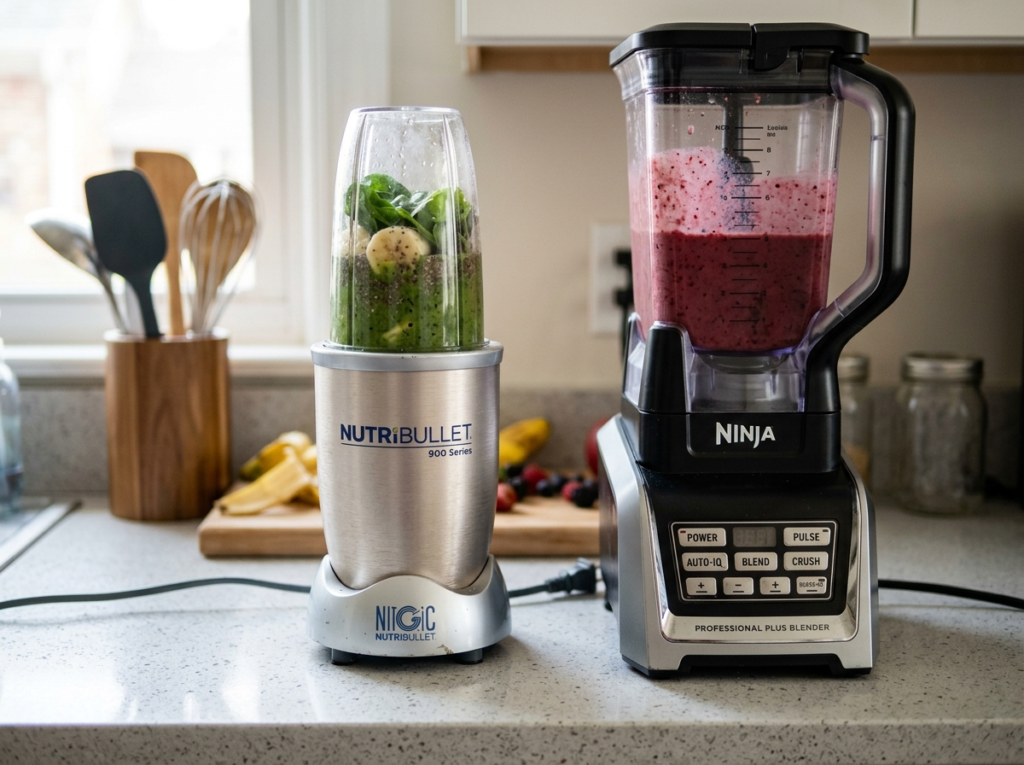
About 75% of blenders bought in the U.S. each year come from just two brands — Nutribullet and Ninja. That stat alone tells you something: most people shopping for a blender end up choosing between these two. And honestly, both are solid options. But they’re built for different people with different needs.
If you’ve been staring at your screen, bouncing between Amazon tabs trying to figure out whether a Nutribullet or a Ninja blender makes more sense for your kitchen, you’re not alone. The confusion is real because both brands make quality products, and the price ranges overlap quite a bit.
Here’s what this article will actually help you do — figure out which blender fits your life. Not the one a random influencer uses. Not the one your coworker swears by. The one that works for the way you eat, drink, and cook. Let’s break it down honestly.
What Makes These Two Brands So Popular?
Before we get into specs and motor power, let’s talk about why Nutribullet and Ninja dominate the blender market in the first place.
Nutribullet carved out its space by doing one thing really well: personal-sized smoothies. When it launched back in 2012, it was marketed as a “nutrition extractor,” and the branding worked. People who wanted a quick morning smoothie without dragging out a full-size blender fell in love with it. The compact design, the twist-and-blend simplicity, and the fact that you could drink straight from the blending cup — all of that made it a hit.
Ninja, on the other hand, came in swinging as a full-kitchen-blender brand at a price that didn’t make your wallet cry. SharkNinja (the parent company) positioned Ninja as the blender that could do what a Vitamix does but for a fraction of the cost. Over time, they expanded into personal blenders too, which is where the overlap with Nutribullet gets interesting.
So you’ve got one brand that started small and personal, and another that started big and versatile. Both have since expanded their lineups, and that’s exactly where the confusion begins.
Motor Power and Blending Performance
Let’s get into what actually matters — how well these things blend.
Nutribullet’s entry-level models (like the original Nutribullet and the Nutribullet Pro) pack motors ranging from 600 to 900 watts. The Nutribullet Ultra has a 1200-watt motor, and the newer Nutribullet Rx pushes even higher. For single-serve smoothies, 900 watts is honestly plenty. It’ll pulverize frozen berries, spinach, protein powder, and ice without breaking a sweat.
Ninja blenders typically pack more raw power. The Ninja Professional Plus runs at 1400 watts. The Ninja Detect Duo hits around 1800 watts. Even their personal-sized blenders, like the Ninja Blast portable, come surprisingly capable for their size.
But here’s something most blender comparison articles won’t tell you: wattage alone doesn’t determine blending quality. Blade design, cup shape, and how the motor engages with the blade assembly — all of that matters. Nutribullet uses a cyclonic extraction blade design that creates a vortex inside the cup, pulling ingredients down into the blades. Ninja uses stacked blade technology in their full-size pitchers, with multiple blade tiers at different heights to catch everything.
Pro Tip: If your main goal is making green smoothies with leafy vegetables, Nutribullet’s extraction blade does a slightly better job of breaking down fibrous greens into a smooth consistency. Ninja’s stacked blades shine when you’re processing larger volumes or harder ingredients like nuts and frozen fruit chunks.
For someone who makes a single protein shake every morning — maybe blending coffee with cacao powder for an energizing breakfast drink — Nutribullet’s 900-watt Pro handles that beautifully. You don’t need a 1400-watt beast for a single-serve smoothie.
Size, Design, and Kitchen Real Estate
Your counter space matters more than you think. If you’ve got a small apartment kitchen, a full-size Ninja blender with its 72-oz pitcher is going to feel massive. And if it doesn’t fit under your cabinets, you’ll end up storing it in a corner where you never use it. The best blender is the one you actually pull out every day.
Nutribullet’s personal blenders are compact by nature. The Nutribullet Pro stands about 13 inches tall and takes up roughly the same footprint as a large coffee mug. You can leave it on the counter permanently without it dominating the space.
Ninja’s full-size blenders are bigger — no way around that. The Ninja Professional Plus stands over 17 inches tall, and the pitcher alone weighs a couple of pounds. But Ninja also makes compact models like the Nutri Ninja Pro and the Ninja Fit, which are closer to Nutribullet’s size. So this isn’t strictly a “big vs. small” comparison — it depends on which specific model you’re looking at.
A real-world consideration: If you share your kitchen with a Keurig coffee maker and maybe a Breville or DeLonghi espresso machine, counter space gets tight fast. A compact Nutribullet fits into that kind of setup way more comfortably than a full-size Ninja.
That said, if you have the space and you want a blender that doubles as a food processor, Ninja’s larger models earn their footprint.
What Can Each Blender Actually Do?
This is where the two brands really start to separate.
Nutribullet is a specialist. It makes smoothies, shakes, and simple blended drinks exceptionally well. The higher-end Nutribullet models (like the Nutribullet Blender Combo) do come with full-size pitchers, but the brand’s sweet spot is still personal-sized blending. You toss your ingredients into the cup, twist it onto the base, blend for 30 seconds, untwist, slap on a to-go lid, and you’re out the door. That workflow is fast and frictionless.
Ninja is a generalist. Most Ninja blender systems come with multiple containers — a full-size pitcher for soups and batches, a personal cup for smoothies, and sometimes a food processing bowl. The Ninja Foodi Power Blender, for instance, can handle hot soup blending, frozen dessert making, dough kneading, and food processing. It’s trying to replace three or four appliances in one.
Here’s a practical breakdown of what each does best:
Nutribullet excels at: Single-serve smoothies and protein shakes, blending soft-to-medium frozen fruits, quick nutrient-packed drinks for one or two people, baby food (smooth purees), and simple sauces.
Ninja excels at: Large batch smoothies for the whole family, crushing hard ice into snow-cone texture, hot soup blending, making nut butters (with patience), food processing tasks like chopping and mixing, and frozen desserts.
If you’re someone who makes a morning smoothie with banana, spinach, almond milk, and some protein powder — and that’s about it — the Nutribullet is honestly all you need. You’d be paying for capabilities you’ll never use with a full-size Ninja.
But if you’re the kind of person who makes a big batch of low-calorie smoothie bowls on Sunday, blends soup on Wednesday, and crushes ice for drinks on Friday night, the Ninja gives you that range.
Noise Levels — The Factor Nobody Talks About Enough
Blenders are loud. All of them. But there’s a difference between “loud” and “waking up your roommate at 6 AM” loud.
Nutribullet’s smaller motors produce less noise overall. The Nutribullet Pro runs at roughly 80–85 decibels during blending, which is comparable to a vacuum cleaner. It’s not quiet, but it’s tolerable, and the blending cycle is usually 30 seconds or less.
Ninja’s larger blenders are noticeably louder. Some full-size Ninja models hit 90+ decibels, which is closer to a lawnmower. The newer models like the Ninja Detect Duo have made strides with noise reduction, but physics is physics — a bigger motor pushing harder is going to make more sound.
Did you know? A difference of 10 decibels actually sounds roughly twice as loud to the human ear. So a 90-decibel Ninja doesn’t just sound “a little louder” than an 80-decibel Nutribullet — it sounds about twice as loud.
If you’re blending early in the morning or late at night in a shared space, noise matters. Nutribullet has a clear advantage here.
Price Comparison: What You Get for Your Money
Let’s talk dollars, because this is usually where the decision gets real.
Nutribullet pricing in 2025: The original Nutribullet (600W) sits around $55–65. The Nutribullet Pro (900W) runs $80–100. The Nutribullet Ultra goes for about $130–150. The Nutribullet Blender Combo (with full-size pitcher) is typically $130–170.
Ninja pricing in 2025: The Ninja Fit (personal blender) is around $50–60. The Ninja Professional Plus (full-size) goes for $90–110. The Ninja Detect Duo lands at $150–200. The Ninja Foodi Power Blender sits around $120–160.
Here’s what’s interesting — at the same price point, you often get more versatility from Ninja. A $100 Ninja blender usually comes with both a personal cup and a full-size pitcher. A $100 Nutribullet gives you a premium personal blending experience but stays in that single-serve lane.
Whether that extra versatility matters depends entirely on how you plan to use the blender. Spending $100 on a Nutribullet Pro that you use every single day is a better investment than spending $100 on a Ninja system that sits in your cabinet because it’s too much hassle to pull out for a quick shake.
Cleaning and Daily Maintenance
A blender you hate cleaning is a blender you stop using. Period.
Nutribullet wins here for daily convenience. The cups and blade assemblies rinse clean in under 30 seconds. Most Nutribullet cups are dishwasher safe (top rack). There’s no pitcher to scrub, no food processor bowl to disassemble. You blend, you rinse, you’re done.
Ninja blenders have more parts. A full-size pitcher with stacked blades requires careful hand washing — those blades are sharp and multi-tiered, so you can’t just casually swipe a sponge through them. The personal cups clean up easily enough, but the pitcher and food processing attachments add cleaning time.
Pro Tip: For either blender, the fastest cleaning method is to fill the container halfway with warm water, add a drop of dish soap, and blend for 10 seconds. It clears out 90% of residue. Then just rinse and air dry.
The Ninja’s larger pitcher also takes up more space on a drying rack, which is a minor annoyance that adds up if you’re using it daily.
Durability and Long-Term Reliability
Both brands have solid reputations, but they fail differently.
The most common complaint with Nutribullet is the blade assembly seal wearing out over time. After 1–2 years of heavy daily use, some users report leaking around the blade gasket. Replacement blade assemblies cost about $15–20, and swapping them is easy, so it’s more of a maintenance cost than a dealbreaker.
Ninja blenders tend to have issues with the pitcher cracking at the base after extended use, particularly with hot liquids. The motor itself usually holds up well, but the plastic components can show wear. Ninja’s blade assemblies are also more complex, so if a blade breaks, the replacement part costs a bit more.
Both brands offer 1–2 year warranties on most models. Nutribullet recently extended warranty coverage on some premium models to 2 years, and Ninja typically offers a 1-year limited warranty.
Quick fact: According to consumer data from 2024, both Nutribullet and Ninja personal blenders have average lifespans of 3–5 years with daily use. Full-size Ninja blenders tend to last a bit longer (4–6 years) because the motor isn’t under as much stress per blending cycle.
Which One Is the Best Blender for Smoothies?
Since most people asking about Nutribullet vs Ninja are really asking “which one makes better smoothies,” let’s address this head-on.
For single-serve smoothies, Nutribullet Pro (900W) is hard to beat. The extraction blade combined with the narrow cup design creates a more consistent blend with fewer chunks. Frozen mango, spinach, chia seeds, a splash of almond milk — you’ll get a cafe-quality smoothie in about 30 seconds. The texture comes out velvety smooth, especially with soft-to-medium frozen fruits.
For larger batch smoothies (say, you’re making smoothies for the family or meal-prepping), Ninja’s full-size blenders do the job more efficiently. Making four smoothies one at a time in a Nutribullet is tedious. A Ninja Professional Plus lets you blend a 48-oz batch in one go.
Here’s something worth noting: if you add ice to your smoothies, Ninja handles ice better across the board. The stacked blades and higher wattage crush ice cubes into a finer consistency. Nutribullet can handle ice, but the manufacturer actually recommends using no more than a few cubes at a time in the smaller models to protect the motor.
If you’re someone who likes to make energy-boosting drinks or caffeinated smoothie bowls, either blender works. But Nutribullet’s single-serve format just fits that quick-and-go lifestyle better.
Portability and On-the-Go Use
Ninja recently entered the portable blender market with the Ninja Blast, a cordless personal blender with a rechargeable battery. It’s a genuinely different product from their full-size lineup, and it competes with Nutribullet’s standard countertop models in an unexpected way.
The Ninja Blast lets you blend anywhere — no outlet needed. It’s great for the gym, office, or travel. But the 18-oz capacity and lower motor power mean it struggles with hard frozen ingredients. It’s best for softer fruits, protein powder, and pre-chopped ingredients.
Nutribullet doesn’t make a cordless blender (as of early 2025), but the regular Nutribullet cups come with to-go lids. So you blend at home, twist on the travel lid, and carry your smoothie with you. It’s not truly portable blending, but the result is a better-quality smoothie since you have full motor power behind it.
For most people, blending at home with a Nutribullet and using the travel cup is still a better experience than blending on the go with a portable unit. Unless portability is your #1 priority, the convenience gap is smaller than you’d think.
Which Blender Fits Your Lifestyle? A Practical Guide
Rather than just saying “it depends” (which is true but unhelpful), let me paint a few scenarios:
You’re a single person or couple, health-focused, busy mornings. You want a quick green smoothie before work. You don’t make soups. You don’t need a food processor. You value speed and easy cleanup. Get the Nutribullet Pro 900W. It’s the best blender for smoothies in this exact use case, and you’ll use it every day because it’s just so simple.
You’re feeding a family, you like batch cooking, you want one appliance that does multiple jobs. You make smoothies for the kids, blend soups, occasionally process salsa or dough. Counter space isn’t a huge concern. Get a Ninja Professional Plus or Ninja Detect Duo. The multi-container system pays for itself in versatility.
You’re a college student in a dorm. Space is limited, budget is tight, and you just want something that works for protein shakes and basic smoothies. Get the original Nutribullet (600W) or the Ninja Fit. Both are under $65, compact, and more than capable for basic blending.
You’re into fitness and meal prep. You make multiple smoothies per day, you blend pre-workout drinks, and you need serious ice-crushing power for thick shakes. Get the Nutribullet Ultra (1200W) or a mid-range Ninja with personal cups included. You want the power to handle frozen bananas, ice, and thick nut butters without the motor struggling.
If you’re the type who also loves experimenting with drinks — like figuring out how to make coffee-based smoothies or fun non-coffee blended drinks at home — either blender handles those just fine. The choice really comes down to volume and how many extra features you’ll actually use.
Accessories and Ecosystem
Nutribullet has a streamlined accessory line. Extra cups, flip-top lids, handled comfort cups, blade replacements — all available and reasonably priced. The ecosystem is simple: buy what you need, nothing more.
Ninja’s accessory range is broader but also more confusing. Different Ninja models use different pitcher sizes, blade assemblies, and lid types, and they’re not always cross-compatible. Before you buy a replacement or extra part, double-check that it fits your specific model number. Ninja has at least 15–20 distinct blender models currently on the market, and the parts aren’t universal.
Warning: One common frustration with Ninja is buying a replacement pitcher only to discover it doesn’t fit your base. Always verify your exact model number (it’s on a sticker underneath the motor base) before ordering parts.
Customer Reviews — What Real Users Say
Across Amazon, Best Buy, and Target, both brands maintain strong average ratings in the 4.4–4.7 star range. But the reasons people love or dislike each brand differ.
Nutribullet fans consistently praise the ease of use, compact size, and smoothie quality. The most common complaints are about motor burnout after 2+ years and the fact that it’s not great for large batches.
Ninja blender fans love the power, versatility, and value for money. The most common complaints involve noise, difficulty cleaning the stacked blades, and occasional plastic cracking on pitchers.
On Reddit threads comparing these two, a pattern emerges: people who switched from Nutribullet to Ninja often miss the simplicity. People who switched from Ninja to Nutribullet often miss the power and batch size. It tells you everything you need to know — they serve different priorities.
FAQ Section
Is Nutribullet better than Ninja for smoothies?
For single-serve smoothies, yes — Nutribullet generally produces a smoother, more consistent texture with less effort. The narrow cup and extraction blade design create a vortex that blends ingredients more thoroughly in a small volume. For large batch smoothies, Ninja’s full-size pitcher is more practical and efficient.
Can a Ninja blender replace a food processor?
Partially. Many Ninja blender models come with food processing attachments that can chop vegetables, mix dough, and make salsas. They won’t match a dedicated food processor for precision tasks like thin slicing or shredding, but for everyday chopping and mixing, a Ninja system can eliminate the need for a separate food processor.
How long do Nutribullet blenders last?
With daily use, most Nutribullet models last 3–5 years. The blade assembly gasket is usually the first component to wear out, and replacements are inexpensive. The motor itself is quite durable, though running the blender for extended periods (over 60 seconds continuously) can shorten its lifespan.
Are Nutribullet cups BPA-free?
Yes. All current Nutribullet cups are made from BPA-free, food-grade plastic. The same is true for Ninja’s personal-size cups and pitchers. Both brands have been BPA-free across their product lines for several years.
Can I blend hot liquids in a Nutribullet?
Nutribullet does not recommend blending hot liquids in most of their personal blender models. The heat can create pressure buildup inside the sealed cup, which is a safety hazard. Ninja’s full-size blenders (certain models) are designed to handle hot liquids and have vented lids to release steam safely. Always check your specific model’s manual before attempting to blend anything hot.
So, Which One Should You Buy?
There’s no universal “winner” between Nutribullet and Ninja — and anyone who tells you one is objectively better than the other is oversimplifying.
If you want simplicity, speed, and the best single-serve smoothie experience on the market, the Nutribullet Pro is your blender. It does one thing, and it does it brilliantly. You’ll use it daily because there’s zero friction between you and a finished smoothie.
If you want a kitchen workhorse that handles everything from morning protein shakes to weekend soup batches, a full-size Ninja blender system gives you more capability per dollar than almost anything else in its price range. Just know that you’re trading simplicity for versatility.
Think about your actual habits — not your aspirational ones. If you’ve never made soup in a blender before, you probably won’t start now just because your Ninja can do it. Buy for how you live, not how you think you should live.
Whichever you choose, you’re getting a solid blender from a brand that’s earned its reputation. The real win is using it consistently, and that comes down to picking the one that fits your routine without adding friction. Sometimes the best kitchen appliance decision is the simplest one.