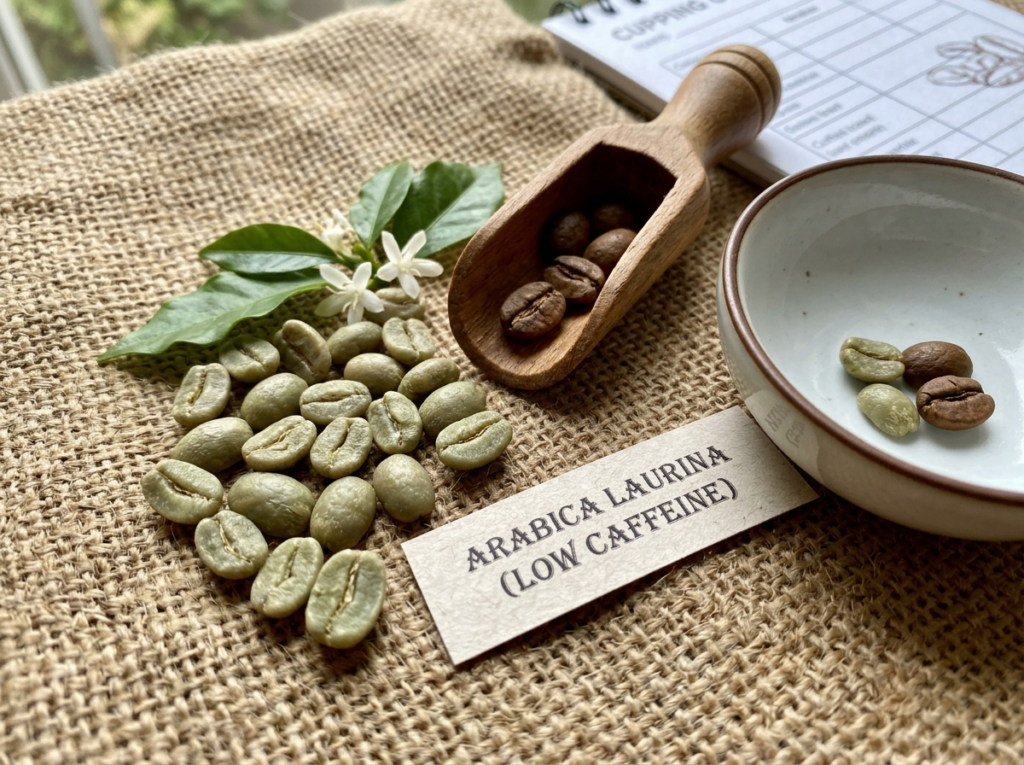
Most coffee lovers assume they only have two choices — go full caffeine or drink decaf that’s been chemically processed until it barely tastes like coffee. But what if a coffee bean existed that naturally carried half the caffeine of regular arabica, tasted genuinely delicious, and didn’t need any processing to be “low caf”? That’s exactly what Arabica Laurina is. This rare, almost forgotten low caffeine arabica variety has been quietly making a comeback in specialty coffee circles, and for good reason. If you’ve been looking for low caffeine coffee beans that don’t sacrifice flavor, this might be the most exciting thing you read today.
Let’s talk about what makes Laurina so special, why it nearly disappeared, and whether it actually lives up to the hype.
What Exactly Is Arabica Laurina?
Arabica Laurina — sometimes called Bourbon Pointu — is a natural mutation of the Bourbon variety of Coffea arabica. It originated on Réunion Island (formerly called Île Bourbon), a small French territory in the Indian Ocean, east of Madagascar. The plant was first documented back in the 1700s, making it one of the oldest recognized coffee varieties in the world.
What sets it apart from your regular cup of arabica? The caffeine content. A typical arabica bean contains around 1.2% to 1.5% caffeine by dry weight. Laurina beans sit at roughly 0.4% to 0.75% — that’s about half, sometimes even less. And here’s the key part: nobody had to strip the caffeine out. The plant just grows that way.
The beans themselves are smaller and more elongated than standard Bourbon beans, almost pointed at the ends (which is where the “Pointu” name comes from). The trees are also smaller, more delicate, and notoriously difficult to grow, which explains why this variety isn’t sitting on every grocery store shelf.
Quick Fact: Laurina’s low caffeine trait isn’t engineered or modified. It’s a naturally occurring genetic mutation that has existed for over 300 years.
Why Did Laurina Almost Disappear?
Here’s the thing about caffeine in coffee plants — it’s not there for us. It’s a natural pesticide. Caffeine helps protect the plant against insects and diseases. So when you have a variety like Laurina that produces significantly less caffeine, the plant becomes far more vulnerable.
Laurina trees are susceptible to coffee leaf rust (a devastating fungal disease), and they produce lower yields compared to hardier varieties. For farmers, this creates a tough equation: more work, more risk, less harvest. During the 19th and 20th centuries, as coffee production scaled up globally, Laurina was gradually abandoned in favor of higher-yielding, more disease-resistant varieties.
By the mid-1900s, Laurina had almost vanished entirely. Only a handful of plants survived on Réunion Island and in a few research collections.
The revival began in the early 2000s when Japanese specialty coffee company Ueshima Coffee (UCC) partnered with researchers and local farmers on Réunion Island to bring Bourbon Pointu back into production. Since then, specialty roasters in Japan, Brazil, Colombia, and parts of Central America have slowly started growing and selling Laurina coffee beans again.
It’s still rare. Production volumes are tiny compared to mainstream varieties. But the interest keeps growing, especially among people searching for naturally decaf coffee options.
How Does Laurina Taste?
This is where Laurina really earns its reputation. Most decaf coffees — let’s be honest — taste a little flat. The decaffeination process (whether Swiss Water, CO2, or chemical solvent methods) inevitably strips out some of the flavor compounds along with the caffeine. You can get decent decaf these days, but there’s usually something missing.
Laurina doesn’t have that problem because nothing has been removed. The beans develop their full flavor profile on the tree, just like any other coffee. The only difference is the naturally lower caffeine content.
So what does it actually taste like? Most cuppers and specialty roasters describe Laurina with notes of:
- Sweet, delicate florals
- Stone fruit (think peach or apricot)
- Light caramel or brown sugar sweetness
- A clean, tea-like body
- Bright but gentle acidity
It’s not a bold, punchy coffee. If you’re someone who loves dark, smoky, heavy-bodied brews, Laurina might feel too light for your preferences. But if you enjoy the nuanced, complex side of coffee — the kind of cup where you actually taste the origin — Laurina can be genuinely special.
Pro Tip: Laurina shines brightest as a light to medium roast. Over-roasting tends to flatten out its delicate flavor notes. If you get your hands on some, try it as a pour-over or a gentle drip brew rather than espresso.
Laurina vs. Regular Decaf: What’s the Real Difference?
People often ask whether low caffeine coffee beans like Laurina are basically the same as decaf. The short answer: not really. They occupy different categories entirely.
Decaf coffee starts as regular high-caffeine beans. The caffeine is then removed through one of several processing methods — Swiss Water Process, supercritical CO2 extraction, or solvent-based methods using ethyl acetate or methylene chloride. These processes remove 97% or more of the caffeine, bringing it down to about 2–7 mg per cup (compared to 80–100 mg in a regular cup).
Laurina doesn’t go through any of that. The beans are simply grown, harvested, processed, and roasted like any other single-origin coffee. The low caffeine is baked into the plant’s DNA. A cup of Laurina will typically contain roughly 40–60 mg of caffeine — significantly less than regular coffee but more than true decaf.
Here’s a quick comparison to put that in perspective. If you’re someone who keeps an eye on caffeine content across different drinks, Laurina falls in an interesting middle ground:
| Caffeine per Cup (approx.) | |
|---|---|
| Regular Arabica | 80–100 mg |
| Arabica Laurina | 40–60 mg |
| Decaf Coffee | 2–7 mg |
| Green Tea | 25–50 mg |
So if you’re someone who gets jittery from a full cup of coffee but finds decaf boring (or wants some caffeine), Laurina sits in a sweet spot. It’s closer to what you’d get from a strong cup of green tea — enough to feel a gentle lift without the anxiety or sleep disruption.
Who Should Consider Drinking Laurina Coffee?
Laurina isn’t for everyone, and that’s okay. But certain groups of people stand to benefit the most from this naturally low caffeine arabica variety.
People sensitive to caffeine. If even one cup of regular coffee makes your heart race or keeps you up at night, Laurina gives you a way to enjoy real, full-flavored coffee without the intensity. You might be surprised — a lot of caffeine sensitivity is dose-dependent, and halving your intake can make a noticeable difference.
Afternoon or evening coffee drinkers. You know that 3 PM craving? Regular coffee that late in the day can mess with your sleep cycle because caffeine has a half-life of about 5–6 hours. Laurina, with its reduced caffeine, is a much safer bet for a late-afternoon cup. You get the ritual and the flavor without lying in bed at midnight staring at the ceiling.
Pregnant or nursing individuals. Medical guidelines (including those from ACOG — the American College of Obstetricians and Gynecologists) generally recommend limiting caffeine to about 200 mg per day during pregnancy. Laurina’s lower caffeine content means you can enjoy more cups within that limit. That said, always check with your doctor — this isn’t medical advice.
Coffee enthusiasts who want something unique. If you’re the type who seeks out rare single-origin beans and cares about tasting notes, Laurina is a collector’s find. Its flavor profile is genuinely different from mainstream varieties, and the history behind it makes every cup a little more interesting.
People who enjoy tracking how caffeine affects them across different beverages will find Laurina a fascinating addition to their rotation.
Where Is Laurina Grown Today?
Laurina’s revival started on Réunion Island, but the variety has since spread — carefully — to a handful of other coffee-growing regions.
Réunion Island remains the spiritual home of Bourbon Pointu. Production here is small-scale and artisanal. The island’s volcanic soil and tropical maritime climate create ideal conditions, but farm sizes are tiny. Most Réunion Laurina is snapped up quickly, often by Japanese buyers who have championed the variety since the early 2000s.
Brazil has become one of the more significant producers of Laurina outside Réunion. Several specialty farms in regions like Minas Gerais and São Paulo have planted Laurina, attracted by growing demand from the specialty market. Brazilian Laurina tends to have a slightly different flavor profile than its Réunion counterpart — often a bit nuttier and chocolatey, reflecting the terroir differences.
Colombia and Costa Rica have also seen experimental and small-scale Laurina plantings. A few forward-thinking farms are working with the variety, though volumes are still limited.
New Caledonia, another French overseas territory in the Pacific, has a historical connection to Bourbon-type coffees and has seen some Laurina cultivation as well.
The challenge everywhere is the same: Laurina yields less, gets sick more easily, and requires more attention than hardier varieties. Farmers who grow it are usually doing so because they believe in the quality, not because it’s the most profitable choice. That dedication is part of what makes Laurina coffee beans special — and expensive.
How Much Does Laurina Coffee Cost?
Let’s not dance around it — Laurina is pricey. You’re typically looking at $30 to $80+ per 100–250 grams, depending on the origin, the roaster, and how limited the batch is. Réunion Island Bourbon Pointu from top producers can go even higher, sometimes reaching $100+ for a small bag.
Why so expensive? It comes down to basic supply and demand. Production is extremely limited. The trees yield less cherry per hectare. The plants need more care. And the specialty coffee market, where most Laurina is sold, prices based on cup quality and rarity.
Is it worth it? That depends on your budget and what you’re after. If you’re used to buying $12 bags of commodity coffee at the grocery store, the price jump will feel steep. But if you already spend on specialty single-origin beans and appreciate the story, the rarity, and the unique cup profile, Laurina delivers an experience you genuinely can’t get from other coffees.
Think of it less like your daily driver and more like a bottle of really good wine you open on special occasions.
How to Brew Laurina for the Best Results
Because Laurina has such a delicate and nuanced flavor, your brewing method matters more than usual. You want a method that highlights clarity and sweetness rather than one that masks the subtleties.
Pour-over (V60 or Kalita Wave) is probably the best way to experience Laurina. The clean extraction brings out the floral and fruit notes beautifully. Use a medium-fine grind, water at about 200–205°F (93–96°C), and a total brew time of around 2.5 to 3.5 minutes.
AeroPress also works well, especially if you prefer a slightly more concentrated cup. Use an inverted method with a shorter steep time (about 1.5 minutes) so you don’t over-extract and lose the delicate flavors.
French press is fine but not ideal. The heavier body of immersion brewing can muddy some of Laurina’s more refined characteristics. If it’s your only option, use a slightly coarser grind than usual and don’t let it steep longer than 3.5 minutes.
Espresso is possible, but most Laurina roasters don’t recommend it. The high pressure and concentration tend to overwhelm the subtle qualities that make Laurina unique. You’ll get a drinkable shot, but you’ll miss what makes it special.
If you’re brewing at home and want to geek out on getting your equipment right, having a well-maintained machine helps. Coffee lovers who use espresso setups should make sure their gear is in top shape — regular descaling makes a real difference in extraction quality.
Did You Know? Japanese coffee culture has embraced Laurina more than any other market. Some Tokyo cafés charge $15–20 for a single cup of Réunion Bourbon Pointu, and customers happily pay it for the experience.
Other Naturally Low Caffeine Coffee Varieties
Laurina isn’t the only naturally low caffeine option, though it’s the most well-known and commercially available. A few other varieties and species exist in the same space.
Coffea eugenioides is a wild coffee species — actually one of the parent species of arabica — that contains very low caffeine levels (around 0.2%). It’s incredibly rare and has a sweet, almost tea-like character. A few specialty producers in Colombia have started offering it, but availability is extremely limited.
Aramosa is a hybrid cross between arabica and Coffea racemosa (another low-caffeine species). Developed in Brazil, Aramosa shows promising results for naturally reduced caffeine content while maintaining decent cup quality. It’s still mostly in the experimental stage.
Decaffito is a naturally caffeine-free mutation discovered in Ethiopia. Research has been ongoing, but commercial production hasn’t really taken off yet.
Among all these options, Laurina remains the most accessible and the one with the longest track record for quality. If you’re specifically looking for low caffeine coffee beans you can actually buy and brew today, Laurina is your best bet.
For those who are also curious about caffeine levels in non-coffee drinks, there are some surprising findings — like whether root beer contains any caffeine or how much is actually in popular energy drinks.
Is Laurina Worth the Hype?
Real talk — Laurina has attracted a lot of attention in the specialty coffee world, and some of that can feel a little breathless. “The rarest coffee!” “Nature’s perfect solution!” You know the kind of marketing.
So let’s be balanced about it.
What Laurina does really well: It provides a genuinely flavorful, naturally low caffeine coffee experience. You don’t need chemical processing. You get real coffee taste. And the history is fascinating. For caffeine-sensitive people who love coffee, it’s a legitimately great option.
Where the limitations are: It’s expensive. It’s hard to find consistently. The flavor profile, while beautiful, is delicate — if you prefer bold, dark-roast coffee, you might not enjoy it. And at 40–60 mg of caffeine per cup, it’s not caffeine-free. If you need to avoid caffeine entirely for medical reasons, true decaf is still your answer.
The hype is mostly justified, as long as you go in with the right expectations. Laurina isn’t trying to replace your daily coffee. It’s offering something different — a quieter, gentler cup with a remarkable backstory.
How to Find and Buy Laurina Coffee Beans
Finding Laurina isn’t as simple as walking into your local supermarket. Here’s where to look.
Specialty online roasters are your best bet. Companies like George Howell Coffee (US), Maruyama Coffee (Japan), and various European micro-roasters periodically offer Laurina beans. Because batches are small, they tend to sell out quickly. Follow your favorite specialty roasters on social media or sign up for their newsletters so you get notified when Laurina drops.
Direct trade platforms like Algrano or Cropster occasionally list Laurina lots, though these are usually geared toward roasters buying green beans rather than consumers.
Specialty coffee subscriptions sometimes include Laurina as a limited or seasonal offering. If you’re subscribed to a service that focuses on rare and unique coffees, keep an eye out.
When you’re buying, look for information about the origin (Réunion, Brazil, Colombia?), the processing method (washed tends to highlight Laurina’s clarity best), and the roast date. Like all specialty coffee, freshness matters. Try to brew within 2–4 weeks of the roast date for the best experience.
If you’re someone who also enjoys exploring unique drinks at places like Starbucks, trying Laurina at home adds a whole other dimension to your coffee experience — one that’s harder to find at any chain café.
FAQ
Is Arabica Laurina the same as decaf coffee?
No. Decaf coffee is made by removing caffeine from regular beans through chemical or water-based processes. Laurina naturally grows with low caffeine — about 0.4% to 0.75% compared to 1.2–1.5% in standard arabica. No caffeine has been stripped from Laurina; it simply produces less. A cup of Laurina still contains around 40–60 mg of caffeine, while decaf has only 2–7 mg.
Where can I buy Laurina coffee beans?
Your best options are specialty online roasters that focus on rare, single-origin coffees. Brands like George Howell Coffee, Maruyama Coffee, and select micro-roasters offer Laurina in limited batches. It’s not available at mainstream grocery stores. Sign up for roaster newsletters — these batches sell out fast.
Does Laurina coffee taste different from regular coffee?
Yes, noticeably. Laurina tends to have a lighter, more delicate cup profile with floral, stone fruit, and sweet caramel notes. It has a tea-like body and gentle acidity. It’s quite different from the bold, heavy-bodied coffee most people are used to. Think of it as the chamomile tea of the coffee world — subtle, complex, and refined.
Why is Laurina coffee so expensive?
Three main reasons: very limited production, lower yields per tree, and higher farming difficulty (the plants are more vulnerable to disease). On top of that, the specialty coffee market prices Laurina based on its rarity and cup quality. Expect to pay $30–$80+ for a small bag, depending on the origin and roaster.
Can I drink Laurina if I’m pregnant?
Laurina has lower caffeine than regular coffee, which can help you stay within the recommended 200 mg daily limit during pregnancy. But it’s not caffeine-free. Always consult your healthcare provider before making changes to your caffeine intake during pregnancy — individual circumstances vary.
Your Next Cup Could Be Different
Arabica Laurina is one of those rare things in the food world — a product that’s both historically fascinating and practically useful. For anyone who loves coffee but struggles with caffeine, finding naturally low caffeine coffee beans that taste this good feels like discovering a secret that’s been hiding in plain sight for 300 years.
You don’t have to give up flavor for comfort. You don’t have to choose between chemical decaf and full-throttle caffeine. Laurina sits right in that middle space, offering a cup that’s gentle on your system but still rewards your palate.
If the price and rarity don’t scare you off, grab a bag next time you see one available. Brew it carefully, sip it slowly, and pay attention. There’s a lot happening in that quiet little cup — and your body will probably thank you for the lighter ride.