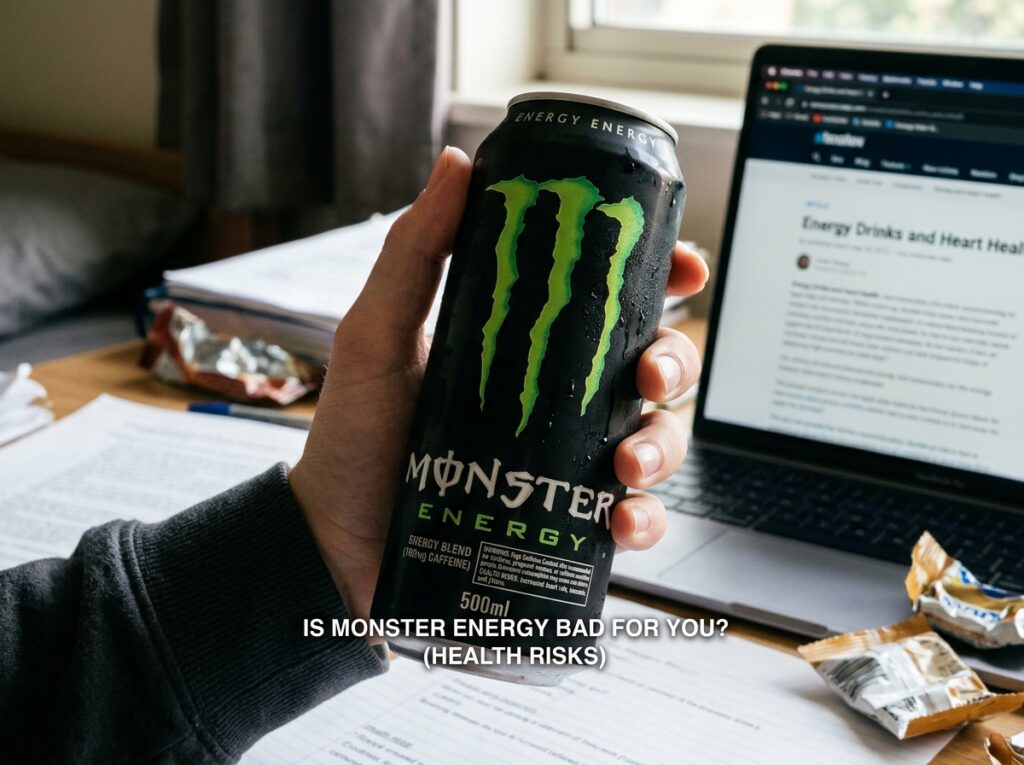
A single 16 oz can of Monster Energy packs 160 mg of caffeine, 54 grams of sugar, and a cocktail of stimulants that your body processes all at once. That’s roughly the caffeine of two cups of coffee — but with a sugar load that equals about 13 teaspoons dumped straight into your bloodstream.
Monster Energy is one of the best-selling energy drinks on the planet. Walk into any gas station, gym, or college campus, and you’ll spot that iconic green claw logo within seconds. Millions of people grab a can every single day to push through a workout, survive a night shift, or just stay awake during a boring afternoon.
But here’s the question that keeps coming up: is Monster Energy bad for you?
The honest answer isn’t a simple yes or no. It depends on how much you drink, how often you drink it, your age, your health conditions, and what else you’re consuming alongside it. This article breaks down exactly what happens inside your body when you crack open a can, what the real monster energy side effects look like, and where the actual line between “occasional pick-me-up” and “health risk” falls.
No scare tactics. No corporate spin. Just the facts you need to make a smart call for yourself.
What’s Actually Inside a Can of Monster Energy?
Before you can decide if something’s bad for you, you need to know what you’re putting into your body. So let’s crack open a standard 16 oz Monster Energy (the original green one) and look at what’s really inside.
The nutrition label tells part of the story:
- Calories: 210
- Total Sugar: 54 g
- Caffeine: 160 mg
- Sodium: 370 mg
- B Vitamins (B2, B3, B6, B12): 200–400% of daily value
But the ingredients list goes deeper. Monster contains an “Energy Blend” that includes taurine, panax ginseng extract, L-carnitine, guarana extract, and glucuronolactone. Each of these has its own effects on your body, and they don’t all work the same way when combined.
Here’s what matters: caffeine isn’t the only stimulant in the can. Guarana is basically a plant-based caffeine source, which means your actual caffeine intake is higher than the 160 mg listed on the label. Some estimates put the real total closer to 180–190 mg when you factor in guarana’s contribution.
If you want a deeper breakdown of exactly how much caffeine you’re getting per can (and how different Monster varieties compare), check out our detailed look at Monster Energy’s caffeine content.
The taurine and B vitamins in Monster aren’t the problem — those are generally safe at these doses. The real concern sits with three things: the caffeine level, the sugar content, and how all these stimulants interact together inside your body.
What Happens to Your Body After Drinking Monster Energy?
Your body doesn’t wait around to react. Within the first 10 minutes of drinking a Monster, the caffeine starts entering your bloodstream. Here’s a rough timeline of what happens next — and this isn’t exaggeration, it’s basic physiology.
Within 15–45 minutes, caffeine levels in your blood peak. Your heart rate increases. Your pupils dilate slightly. Your brain’s adenosine receptors (the ones that make you feel sleepy) get blocked. You feel alert, focused, maybe even a little euphoric. This is the part everyone loves.
Around the 30–50 minute mark, your body has fully absorbed the caffeine. Your liver kicks in to metabolize it. Meanwhile, that 54 grams of sugar triggers a massive insulin spike. Your blood sugar shoots up, giving you that “energy rush” feeling.
By the 60-minute mark, you might start noticing a sugar crash creeping in. Your energy dips. You feel sluggish. Some people get irritable or foggy. The caffeine is still working, but the sugar high is fading, and your body’s trying to bring blood glucose levels back to normal.
3–5 hours later, the caffeine’s half-life means about half of it is still active in your system. You might still have trouble sleeping if you drank the can in the afternoon. Your body is urinating more frequently because caffeine is a diuretic — and you’re losing water and electrolytes along with it.
Want to know exactly how long you can expect the effects to last? We covered that in detail in our article on how long Monster Energy lasts in your system.
The point is: a single can doesn’t just “give you energy.” It puts your cardiovascular system, your blood sugar regulation, and your nervous system through a coordinated stress response. For a healthy adult who drinks one occasionally, that’s manageable. For someone drinking them daily — or multiple cans a day — it’s a different story entirely.
Monster Energy Side Effects You Should Know About
Let’s get specific. These are the documented monster energy side effects that researchers and health professionals consistently flag. Not all of them will happen to every person, but they’re real, and they’re worth understanding.
Cardiovascular Effects
This one gets the most attention, and for good reason. A 2019 study published in the Journal of the American Heart Association found that consuming 32 oz of energy drinks (two standard cans) raised blood pressure and altered the heart’s electrical activity — specifically the QT interval, which measures how long it takes your heart to recharge between beats. A prolonged QT interval can increase the risk of arrhythmias.
You don’t need to be a cardiologist to understand why that matters. Your heart has a rhythm. Caffeine and stimulants mess with that rhythm. One can probably won’t cause problems for most healthy adults. But if you have an undiagnosed heart condition (and many young people do — some estimates suggest 1 in 300 people have an undetected cardiac issue), even a single can could be a trigger.
⚠️ Warning: If you’ve ever experienced chest pain, rapid heartbeat, dizziness, or fainting after consuming caffeine, talk to a doctor before drinking energy drinks. This isn’t overcaution — it’s common sense.
Blood Sugar Spikes and Crashes
A regular 16 oz Monster contains 54 grams of sugar. The American Heart Association recommends no more than 36 grams of added sugar per day for men and 25 grams for women. One can blows past both limits.
That sugar hits your system fast because it’s in liquid form — your body doesn’t have to break down solid food to access it. The result? A rapid blood sugar spike followed by an insulin surge, followed by a crash. Over time, repeated spikes like this contribute to insulin resistance, which is a precursor to type 2 diabetes.
And yes, Monster does sell sugar-free versions (Monster Zero Ultra, for example). These use artificial sweeteners like sucralose and erythritol. They dodge the sugar problem but come with their own debates — some research suggests artificial sweeteners may affect gut bacteria and insulin sensitivity, though the evidence isn’t definitive yet.
Sleep Disruption
Caffeine has a half-life of about 5–6 hours in most adults. That means if you drink a Monster at 3 PM, roughly 80 mg of caffeine is still active in your body at 8 or 9 PM. For some people (especially those who metabolize caffeine slowly due to genetics), it can take even longer.
Poor sleep doesn’t just make you tired. It affects your immune system, your mood, your ability to concentrate, and your long-term cardiovascular health. And here’s the cruel irony: the worse you sleep, the more you crave energy drinks the next day. It becomes a self-reinforcing cycle that’s hard to break.
Anxiety and Jitters
Caffeine stimulates your central nervous system and triggers the release of adrenaline (your “fight or flight” hormone). For people prone to anxiety — and that’s a significant portion of energy drink consumers, especially younger adults — this can make symptoms noticeably worse.
The combination of caffeine plus taurine plus sugar can amplify the jittery, restless feeling that many people report after drinking Monster. It’s not just “being sensitive to caffeine.” It’s a genuine physiological response.
Digestive Issues
Monster Energy is acidic. Combine that acidity with caffeine (which stimulates gastric acid production) and a large sugar load, and you’ve got a recipe for stomach discomfort. Nausea, acid reflux, and diarrhea are common complaints among regular energy drink consumers. If you already deal with GERD or a sensitive stomach, energy drinks can make things significantly worse.
Dental Health
This one gets overlooked, but it shouldn’t. Energy drinks are highly acidic — the pH of Monster sits around 3.0 to 3.4, which is similar to vinegar. That level of acidity erodes tooth enamel over time. A 2012 study in General Dentistry found that energy drinks damaged enamel twice as much as sports drinks. Once enamel is gone, it doesn’t grow back.
Is Monster Energy Safe for Everyone?
No. And that’s not opinion — that’s based on guidelines from organizations like the American Academy of Pediatrics and the FDA.
Teenagers and Children
The American Academy of Pediatrics has been clear: children and adolescents should not consume energy drinks. Their bodies are smaller, their caffeine tolerance is lower, and their brains are still developing. A 160 mg caffeine hit that might give an adult a mild buzz could cause rapid heartbeat, anxiety, or even seizures in a younger person.
Despite this, teenagers are one of the largest consumer groups for energy drinks. Marketing plays a huge role — Monster sponsors extreme sports, gaming tournaments, and music events that directly target young audiences. The bright cans don’t look like “supplements” or “health products.” They look like fun.
📌 Quick Fact: The FDA doesn’t regulate energy drinks the same way it regulates medications or even dietary supplements. Most energy drinks are classified as “conventional beverages,” which means they don’t need to prove safety or efficacy before hitting store shelves.
Pregnant and Breastfeeding Women
Most health organizations recommend pregnant women limit caffeine to 200 mg per day or less. A single Monster hits 160 mg (possibly closer to 190 mg with guarana), leaving almost no room for any other caffeine source — not even a small cup of tea. The high sugar content adds another risk factor for gestational diabetes.
People with Heart Conditions
If you have any diagnosed heart condition — arrhythmias, hypertension, congenital heart defects — energy drinks are a known risk. Multiple case reports in medical literature have linked energy drink consumption to cardiac events, including several involving Monster Energy specifically. These cases are rare, but they’re documented and they’re real.
People on Medications
Caffeine interacts with a surprising number of medications. It can reduce the effectiveness of some sedatives and anxiety medications. It can amplify the effects of stimulant medications used for ADHD. And it can interfere with certain antibiotics like ciprofloxacin, which slows caffeine metabolism and can lead to toxicity symptoms.
If you take any prescription medications regularly, it’s worth checking with your pharmacist about caffeine interactions. This applies to all energy drinks, not just Monster.
Monster Energy Daily Limit: How Much Is Too Much?
The FDA considers 400 mg of caffeine per day to be generally safe for healthy adults. That’s roughly 2.5 cans of standard Monster Energy (at 160 mg each). But “generally safe” doesn’t mean “recommended” — and there’s an important distinction there.
Here’s the practical monster energy daily limit: most health experts suggest sticking to one can per day at most, and not every day. Think of it more like a once-or-twice-a-week thing rather than a daily habit.
Why just one can, if the FDA allows 400 mg of caffeine? Because Monster isn’t just caffeine. You’re also getting:
- 54 grams of sugar (more than your entire daily recommended limit)
- Additional stimulants like guarana and ginseng
- Artificial colors and flavors
- High acidity
The caffeine ceiling is just one piece of the puzzle. When you stack the sugar, the stimulant blend, and the acidity on top of it, the safe number drops significantly.
And if you’re getting caffeine from other sources throughout the day — coffee, tea, soda, pre-workout supplements — those milligrams add up fast. Someone who has a morning coffee (95 mg), an afternoon Monster (160 mg), and a pre-workout shake (150–300 mg) could easily blow past 400 mg without realizing it.
💡 Pro Tip: If you’re tracking caffeine, don’t forget about less obvious sources. Some sodas, certain teas, chocolate, and even some medications contain caffeine. Our articles on caffeine in different drinks can help you get a clearer picture of your total daily intake.
Monster Energy vs. Other Caffeinated Drinks: Some Perspective
It’s easy to demonize energy drinks while ignoring other caffeine sources that carry their own risks. Let’s put things in perspective.
A 16 oz Monster has 160 mg of caffeine. A 16 oz Starbucks Pike Place brewed coffee has about 310 mg — nearly double. A standard espresso shot has about 63 mg. A Starbucks Refresher has roughly 35–45 mg.
So from a caffeine-only perspective, Monster isn’t the worst offender. Coffee drinkers regularly consume more caffeine without the same level of scrutiny.
But here’s where the comparison breaks down. Black coffee has no sugar, no artificial additives, no taurine, and a much simpler ingredient profile. The health risks of Monster aren’t just about caffeine — they’re about the entire package. The sugar, the stimulant blend, the acidity, the way it’s marketed (encouraging you to chug a full can quickly rather than sip slowly), and the tendency for consumers to drink multiple cans.
If you’re curious about which energy drinks pack the most caffeine (and which ones you really need to be careful with), we put together a comparison of the energy drinks with the most caffeine on the market.
Also worth comparing: Red Bull, Monster’s biggest competitor, comes in a smaller 8.4 oz can with 80 mg of caffeine and 27 grams of sugar. That’s exactly half the caffeine and half the sugar of a standard Monster. If you want to know how Red Bull’s effects compare, the difference in serving size makes a real impact on how your body handles each drink.
Who’s Actually at Risk? Let’s Be Honest
Not everyone who drinks a Monster is going to have a health crisis. That would be dishonest to suggest. Millions of adults drink energy drinks regularly and feel perfectly fine. So let’s be clear about who faces the highest monster energy health risks.
You’re at higher risk if you:
- Are under 18
- Have a pre-existing heart condition (diagnosed or not)
- Are pregnant or breastfeeding
- Have an anxiety disorder
- Take stimulant medications or certain other prescriptions
- Consume multiple cans per day
- Mix Monster with alcohol (this is a whole separate danger — the caffeine masks alcohol’s sedative effects, making you feel less drunk than you actually are, which leads to overconsumption)
- Have diabetes or pre-diabetes
- Don’t consume caffeine regularly and have low tolerance
You’re at lower risk if you:
- Are a healthy adult between 18 and 65
- Drink one can occasionally (not daily)
- Don’t have underlying heart or metabolic conditions
- Stay hydrated alongside your Monster
- Don’t mix it with alcohol or other stimulants
The problem is that a lot of people in the “higher risk” category don’t know they’re in it. Undiagnosed heart conditions, early-stage insulin resistance, unrecognized anxiety — these are more common than most people think, especially in the 16–30 age group that drinks the most energy drinks.
Smarter Ways to Get Your Energy (Without the Risks)
If you’re reaching for a Monster because you’re genuinely exhausted, it’s worth asking why you’re that tired in the first place. Energy drinks don’t create energy — they borrow it from your body’s stress response systems and mask the fatigue signals your brain is sending.
Here are some alternatives that actually address the root cause:
Sleep. This sounds painfully obvious, but most energy drink consumers are chronically under-sleeping. Seven to nine hours of quality sleep does more for your energy levels than any can of anything ever will. If you’re sleeping less than six hours regularly, no amount of caffeine can truly compensate — it just delays the crash.
Water. Dehydration is one of the most common and most overlooked causes of fatigue. Your brain is about 75% water. Even mild dehydration (1–2% loss) can cause noticeable drops in concentration and energy. Before reaching for Monster, try drinking 16 oz of water and waiting 20 minutes.
Black coffee or green tea. If it’s specifically caffeine you want, these deliver it without the sugar bomb, the artificial ingredients, or the stimulant blend. Green tea also contains L-theanine, which smooths out caffeine’s jittery edges and promotes calm focus.
Short walks. A 10-minute walk outside — even a slow one — increases blood flow, oxygen delivery to the brain, and endorphin production. Research from the University of Georgia found that regular low-intensity exercise reduced fatigue by 65% in study participants.
Smaller, more frequent meals. Blood sugar crashes are a major energy killer. Eating balanced meals and snacks with protein, fiber, and healthy fats keeps your blood sugar stable and your energy consistent — no cans required.
Frequently Asked Questions
Can one Monster Energy drink kill you?
For a healthy adult, one can is extremely unlikely to cause death. The lethal dose of caffeine for most adults is estimated between 5,000–10,000 mg — you’d need to drink over 30 cans in a very short time. That said, rare cases of cardiac events have occurred after consuming energy drinks in people with undiagnosed heart conditions. The risk isn’t zero, especially for vulnerable individuals.
Is Monster Energy worse than coffee?
From a pure caffeine standpoint, a standard Monster (160 mg) has less caffeine than a large brewed coffee (200–300+ mg). But Monster also contains 54 grams of sugar, artificial additives, and additional stimulants that coffee doesn’t have. So while coffee may deliver more caffeine, Monster delivers a more complex — and arguably riskier — mix of ingredients.
Can I drink Monster Energy every day?
Technically, a single can won’t exceed the FDA’s 400 mg daily caffeine guideline. But daily consumption means daily sugar spikes (54 g per can), daily acid exposure to your teeth, and a growing caffeine dependency. Most health professionals recommend against daily energy drink consumption. If you find yourself needing one every day, that’s a sign to look at your sleep, diet, and overall lifestyle first.
Is Monster Zero Ultra a healthier option?
It’s a less bad option, not a healthy one. Monster Zero Ultra removes the sugar (0 g) and calories (10 per can), which eliminates the blood sugar spike and crash. But it still contains 150 mg of caffeine, artificial sweeteners, and the same stimulant blend. It’s a better choice if you’re going to drink Monster regardless, but it’s not something nutritionists would call “healthy.”
How long should I wait between Monster Energy drinks?
Given caffeine’s 5–6 hour half-life, you should wait at least 6–8 hours between cans if you’re going to have more than one. But honestly? If you feel like you need a second can in the same day, your body is telling you something — and the answer isn’t more stimulants. It’s rest, food, or water.
The Bottom Line on Monster Energy
Is Monster Energy bad for you? Here’s the most honest answer: it’s not great for you, and for some people, it’s genuinely dangerous.
One can on occasion — say, before a long drive or during a particularly brutal deadline — isn’t going to wreck your health if you’re a healthy adult with no underlying conditions. Your body can handle it. The caffeine wears off, the sugar processes through, and you move on.
But “one can occasionally” isn’t how most people drink Monster. The pattern tends to be daily consumption, multiple cans, or pairing it with other stimulants or alcohol. That’s where the real monster energy health risks pile up — cardiovascular strain, sugar overload, sleep destruction, dental erosion, and caffeine dependency that only gets harder to break over time.
If you’re going to drink it, do it with open eyes. Know what you’re putting in your body. Keep it to one can, keep it occasional, and pay attention to how you feel afterward — not just the first 30 minutes of alertness, but the hours after that.
And if you ever find yourself thinking “I literally can’t function without this” — that’s not the drink working. That’s dependency talking. Your body is capable of producing all the energy you need. Sometimes it just needs better fuel, better sleep, and a little more water.
📌 Medical Disclaimer: This article is for informational purposes only and doesn’t constitute medical advice. If you have concerns about caffeine consumption, energy drink safety, or any health condition mentioned in this article, please consult a qualified healthcare professional.