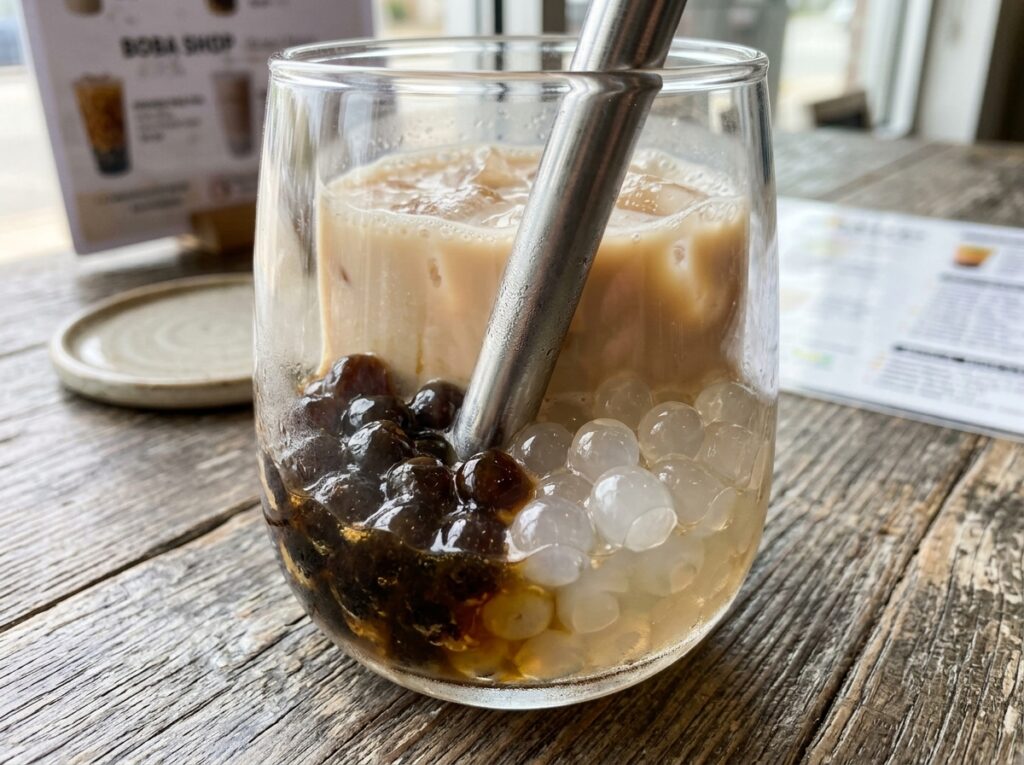
Most people walk into a boba shop, stare at the topping menu, and freeze the moment they see “honey boba” and “crystal boba” listed as two separate options. They look the same-ish. They both go in tea. So what’s the actual difference — and does it even matter?
It matters more than you’d think. These two types of boba pearls come from completely different ingredients, taste nothing alike, and change the entire vibe of your drink. One is rich, sweet, and chewy. The other is light, translucent, and barely there in flavor. Pick the wrong one and your drink feels off. Pick the right one and you’ll wonder why you ever bothered with regular tapioca pearls.
This guide breaks down honey boba vs crystal boba — what they’re made of, how they taste, which drinks they work best in, and how to decide between them based on what you actually enjoy. No fluff, no filler, just the stuff that helps you order with confidence next time.
What Exactly Is Honey Boba?
Honey boba is a variation of the classic tapioca pearl that most people picture when they think of bubble tea. It’s made from tapioca starch (extracted from cassava root), but what sets it apart is the addition of honey or honey-flavored syrup during the cooking and soaking process.
You know those dark brown or amber-colored pearls sitting at the bottom of your milk tea? That’s often honey boba. The honey isn’t just mixed in on top — the pearls get soaked in a honey-brown sugar mixture after cooking, which lets the sweetness absorb deep into each ball.
The honey boba taste is noticeably sweeter than plain tapioca pearls. There’s a warm, almost caramel-like quality to it. If you’ve ever had brown sugar boba, honey boba sits in a similar family — rich, bold, and meant to be the star of the drink rather than just a textural add-on.
Quick Fact: Some boba shops use actual raw honey, while others use honey-flavored syrup made with sugar and flavoring. The taste difference between real honey and honey syrup is subtle in a drink but more noticeable if you eat the pearls on their own.
Texture-wise, honey boba has that signature QQ chewiness — the bouncy, slightly gummy bite that boba lovers obsess over. It’s denser than crystal boba and requires more chewing, which is exactly what some people want. That chew is a huge part of the appeal.
What Exactly Is Crystal Boba?
Crystal boba looks completely different from any other types of boba pearls you’ve seen. It’s translucent, almost see-through, with a jelly-like appearance that makes it look like tiny glass marbles floating in your drink. Some people call it “agar boba” or “white pearls” depending on the shop.
Here’s the big distinction: crystal boba isn’t made from tapioca at all. It’s typically made from konjac (a plant-based fiber) or agar-agar (a seaweed-derived gelatin substitute). That’s why it looks and feels so different from traditional boba.
The texture is softer, more jiggly, and less chewy. Think of it as closer to jelly than gum. You don’t need to really work your jaw with crystal boba — it kind of breaks apart gently when you bite into it. For people who find traditional tapioca pearls too tough or sticky, crystal boba often feels like a relief.
Flavor-wise, crystal boba is very mild on its own. It’s slightly sweet, but the sweetness is quiet — more like a whisper compared to honey boba’s shout. Most shops flavor crystal boba with light syrups (think coconut, citrus, or plain sugar syrup), so it tends to take on whatever drink it’s sitting in rather than competing with it.
Pro Tip: Crystal boba is naturally lower in calories than honey boba. If you’re watching your intake but still want that boba experience, crystal boba is usually the smarter pick — often coming in under 70 calories per serving compared to honey boba’s 150+ calories for the same portion.
Honey Boba vs Crystal Boba: A Direct Comparison
Let’s put these two side by side, because that’s really what you’re here for.
Ingredients and Origin
Honey boba starts with tapioca starch and gets infused with honey or honey-flavored syrup. It belongs to the same family as classic black tapioca pearls and brown sugar boba. Crystal boba, on the other hand, comes from konjac or agar-agar — both plant-based but entirely different from cassava-derived tapioca. If you have a sensitivity to tapioca or want something with more dietary fiber, crystal boba is the natural alternative.
Appearance
You can spot the difference instantly. Honey boba is dark — usually a deep amber, golden brown, or dark caramel color depending on how much brown sugar or honey it absorbs. Crystal boba is almost transparent, sometimes with a slight white or pale yellow tint. In a fruit tea, crystal boba practically disappears, while honey boba stands out against any background.
Texture
This is where personal preference really splits people. Honey boba gives you that dense, satisfying chew — the kind where your teeth sink in and the pearl pushes back before giving way. It’s sticky, substantial, and feels like you’re eating something with weight. Crystal boba is the opposite. It’s soft, delicate, and breaks apart with minimal effort. Some describe it as “bouncy jelly” rather than “chewy ball.”
Taste
The honey boba taste is sweet, warm, and rich. You’ll notice flavors like caramel, brown sugar, and (obviously) honey. It adds its own sweetness to whatever drink it’s in. Crystal boba tastes almost neutral — faintly sweet, clean, and easy to overlook if the drink has strong flavors already. This isn’t a weakness, though. It’s by design. Crystal boba is meant to complement, not dominate.
Calorie Count
A standard serving of honey boba (about 1/4 cup of pearls) can run anywhere from 150 to 200 calories, mostly from sugar and starch. Crystal boba, especially the konjac-based variety, often lands between 30 and 70 calories for the same amount. That’s a significant gap if you’re drinking boba multiple times a week. If you’re someone who enjoys low calorie Starbucks drinks or generally watches sugar intake, crystal boba will feel more aligned with your habits.
Which Drinks Work Best With Each Type?
Here’s something most boba guides don’t talk about enough: the pearls you choose should match the drink you’re ordering. Not every boba pearl works equally well in every beverage.
Honey Boba Pairs Best With:
Rich, creamy, milk-based drinks. Think classic milk tea, taro milk tea, Thai tea, brown sugar lattes, or matcha lattes. The sweetness and chewiness of honey boba match the heaviness of these drinks. The flavors blend together — you get honey and caramel notes mixing into creamy tea, and it just works. There’s a reason most traditional boba milk tea shops default to tapioca-family pearls. The pairing is proven.
If you enjoy bold coffee-based boba drinks, honey boba holds its own against espresso flavors too. It’s like adding a sweet, chewy dessert element to your cappuccino — the bitterness of coffee and sweetness of honey boba balance each other out nicely.
Crystal Boba Pairs Best With:
Lighter, fruit-forward, refreshing drinks. Fruit teas, lemonade-based boba drinks, floral teas (jasmine, rose), and any drink where you don’t want a heavy, overly sweet topping competing with delicate flavors. Crystal boba sits quietly in these drinks, adding texture without changing the taste profile.
It also works really well in drinks you’d typically find on a Starbucks refresher-style menu — fruity, icy, and light. If you’ve ever wondered whether boba is available at Starbucks, you’ll appreciate knowing that crystal boba-style toppings are closer to the popping pearls some coffee chains have started experimenting with.
Did You Know? In Taiwan, where bubble tea originated in the 1980s, shops often recommend specific topping-drink pairings on their menus. Mixing crystal boba into a heavy brown sugar milk tea is considered a mismatch because the delicate pearls get lost. Similarly, putting honey boba in a light peach green tea can overwhelm the tea’s flavor.
The Best Boba Flavor Depends on YOU (Here’s How to Decide)
People keep searching for the “best boba flavor” like there’s one universal answer. There isn’t. But there IS a best boba for your specific preferences. Let me break it down simply.
Go with honey boba if:
You love chewy textures that give your jaw a little workout. You prefer drinks that lean sweet, rich, and indulgent. You want your boba to taste like something on its own — not just be a texture thing. You’re ordering milk tea, taro, matcha, or anything creamy. You treat boba as a dessert experience.
Go with crystal boba if:
You prefer lighter textures that feel more like jelly than gum. You want your drink’s flavor to stay front and center without a sweet topping fighting for attention. You’re calorie-conscious and don’t want a 200-calorie add-on in your cup. You’re ordering fruit tea, green tea, or anything citrus-based. You find traditional tapioca pearls too heavy or too sticky.
There’s also a third option many people overlook — mixing them. Some boba shops let you do a half-and-half topping, which gives you the chewiness of honey boba and the lightness of crystal boba in the same cup. It sounds strange, but the textural contrast is genuinely fun.
Crystal Boba vs Regular Boba: Is Crystal Boba “Better”?
This question pops up constantly, so let’s address it directly. When people search crystal boba vs regular boba, they usually want to know if crystal boba is a healthier or tastier upgrade over standard black tapioca pearls.
Here’s the honest answer: it depends on what “better” means to you.
Nutritionally, crystal boba usually wins. Konjac-based crystal boba contains dietary fiber and significantly fewer calories. Regular tapioca boba is almost entirely starch and sugar — it’s delicious, but it’s not doing your body any nutritional favors. If health is your priority, crystal boba makes more sense.
Taste-wise, regular boba (and its cousin, honey boba) has a deeper, more satisfying flavor. Crystal boba tastes mild, which some people interpret as “bland.” You won’t get that warm, sweet, caramelly hit from crystal boba that you get from well-made tapioca pearls soaked in brown sugar or honey.
Texture-wise, it’s entirely subjective. Some people think the chewy resistance of regular boba is the whole point of drinking bubble tea. Others find it too gummy and prefer the gentler, jelly-like bite of crystal boba.
Neither is objectively better. They serve different purposes. Saying crystal boba is “better” than regular boba is like saying sparkling water is “better” than orange juice — they’re just different things.
How to Tell If Your Boba Shop Uses Quality Pearls
Not all honey boba or crystal boba is created equal. A great boba shop makes a real difference, and you can usually tell the quality within the first sip.
Signs of good honey boba: The pearls are uniformly soft and chewy throughout — no hard center, no mushy outer layer. The honey flavor tastes natural, not like artificial syrup. The color is a rich, even amber, not jet black (that often means over-caramelized sugar masking low-quality tapioca). And they’re served fresh — tapioca pearls that sit too long become tough and lose their bounce.
Signs of good crystal boba: The pearls are consistently translucent with a clean, slight sweetness. They should be firm enough to hold their shape on a spoon but soft when you bite into them. If they taste like nothing at all — literally flavorless — the shop probably skipped the light syrup soak that gives crystal boba its subtle sweetness.
Warning: Some shops use pre-packaged, mass-produced boba pearls that have been sitting in syrup for days. These tend to taste overly sweet, have a rubbery texture, and lack the fresh, delicate quality of pearls made in-house or prepared daily. If your boba feels like chewing a rubber band, it’s not a reflection of the pearl type — it’s a quality issue.
Making Honey Boba and Crystal Boba at Home
You don’t have to rely on boba shops every time. Both types are surprisingly doable at home, though they require different approaches.
Honey Boba at Home
You’ll need tapioca starch (or buy ready-made dried tapioca pearls from an Asian grocery store — brands like WuFuYuan and BoBo are widely available). Boil the pearls in water for about 20-25 minutes, then let them sit in the hot water for another 15-20 minutes with the lid on. Drain them and immediately toss them in a mixture of honey and brown sugar while they’re still warm. The heat helps the pearls absorb the sweetness. Use them within 4-6 hours — tapioca pearls harden as they cool and age.
Crystal Boba at Home
For crystal boba, you’ll need konjac powder or agar-agar powder, water, and a sweetener of your choice (coconut sugar works nicely). Dissolve the powder in hot water, stir continuously, and pour the mixture into molds or let it set in a flat dish, then cut into small pearl-sized pieces. Some people use a squeeze bottle to drip the warm mixture into cold water, which naturally forms small spheres — similar to the “reverse spherification” technique used in molecular gastronomy.
Pro Tip: If you’re making crystal boba at home, add a tiny splash of fruit juice (like lychee or mango) to the mixture before it sets. It gives the pearls a subtle flavor that pairs beautifully with iced teas. This is a trick some high-end boba shops use, and it makes a noticeable difference.
If you enjoy DIY drink projects, you might also want to explore fun blending experiments like mixing coffee with cacao powder — it’s the same creative spirit, just applied to a different beverage.
Types of Boba Pearls Beyond Honey and Crystal
While we’re comparing honey boba and crystal boba, it’s worth knowing they’re just two options in a much bigger world of boba toppings. Understanding the full range helps you make better choices at the counter.
Classic Black Tapioca Pearls are the OG — dark, chewy, and flavored with brown sugar or caramel. Honey boba is essentially a variation of this, with honey replacing or supplementing the brown sugar soak.
Popping Boba (also called bursting boba) has a thin outer skin filled with flavored juice. You bite into it and it pops — releasing mango, strawberry, lychee, or passion fruit juice. It’s not chewy at all. Think of it as a completely different experience from both honey and crystal boba.
Taro Balls and Sweet Potato Balls are popular in Taiwanese boba shops. They’re made from taro or sweet potato starch and have a softer, more starchy chew compared to tapioca. The flavor is earthy and subtle.
Aloe Vera Jelly and Coconut Jelly are sometimes grouped with crystal boba because of their translucent appearance, but they’re different products. Aloe vera jelly comes from actual aloe vera pulp, while coconut jelly (nata de coco) is made from fermented coconut water.
Each type brings something different to a drink, and most experienced boba drinkers eventually develop preferences based on their go-to orders. If you’re someone who likes exploring different flavor options at your favorite chains, applying that same curiosity to boba toppings will make your bubble tea experience much richer.
Does the Sweetness Level of Your Drink Matter When Choosing Boba?
Absolutely — and this is something a lot of first-time boba drinkers miss.
If you order your drink at 100% sweetness (full sugar) AND add honey boba on top, your drink might end up cloyingly sweet. Honey boba already brings a significant amount of sugar to the party. Smart boba drinkers who prefer honey boba usually drop their drink’s sugar level to 50% or even 30% to compensate. That way, the boba provides the sweetness and the tea provides the flavor — everything stays balanced.
With crystal boba, you have more flexibility. Since it’s mildly sweet, you can order your drink at 70-100% sweetness without worrying about sugar overload. The crystal pearls won’t push it over the edge.
Here’s a real-world example: a mango green tea at 70% sweetness with crystal boba tastes refreshing and balanced. The same drink at 70% sweetness with honey boba might taste a bit too sweet for some people, because the honey-soaked pearls add another layer of sugary richness. Not necessarily bad — just something to be aware of.
FAQ
Is crystal boba healthier than honey boba?
Generally, yes. Crystal boba made from konjac is lower in calories (often 30-70 calories per serving vs. 150-200+ for honey boba), contains dietary fiber, and has less sugar. If you’re managing calorie intake or blood sugar levels, crystal boba is the lighter option. That said, “healthier” is relative — both are fine as an occasional treat.
Can I get honey boba and crystal boba in the same drink?
Many boba shops allow you to mix toppings, either for free or for a small upcharge. Combining honey boba and crystal boba in one drink gives you a contrast of textures — dense and chewy alongside soft and jiggly. It’s worth trying at least once if your shop offers it.
What does honey boba taste like compared to brown sugar boba?
They’re cousins, not twins. Brown sugar boba has a deeper, more molasses-like sweetness with a slightly smoky, caramelized edge. Honey boba is lighter and has a floral, smoother sweetness — closer to actual honey flavor. If you like one, you’ll probably enjoy the other, but they’re not interchangeable in terms of taste.
Is crystal boba vegan?
In most cases, yes. Crystal boba made from konjac or agar-agar is entirely plant-based. Tapioca-based boba (including honey boba) is also technically vegan if the honey syrup is replaced with a plant-based sweetener — but since real honey isn’t considered vegan by strict definitions, it depends on the shop’s recipe. Always ask if it matters to you.
Why does crystal boba sometimes have no flavor?
Crystal boba that tastes like nothing usually hasn’t been soaked in any syrup or flavoring after preparation. Good boba shops give their crystal pearls a light soak in simple syrup, coconut milk, or fruit juice to add a subtle sweetness. If your crystal boba tastes like plain gelatin, it’s more of a preparation issue than a flaw of the pearl itself.
Your Next Boba Order Starts Here
Choosing between honey boba and crystal boba doesn’t have to be stressful. Think of it as matching the topping to the drink and to your mood. Craving something indulgent, sweet, and chewy with a milk tea? Honey boba. Wanting something light, refreshing, and low-key with a fruit tea? Crystal boba. And on days when you genuinely can’t decide, mix them both and enjoy the contrast.
The boba world keeps growing — new flavors, new textures, new combinations show up at shops every season. The best way to figure out what you love isn’t reading about it (though that helps). It’s ordering something new the next time you’re at the counter. Start with the pairing suggestions above, adjust the sweetness level to your liking, and pay attention to what makes your taste buds light up.
That’s really all there is to it. Go enjoy your next cup.