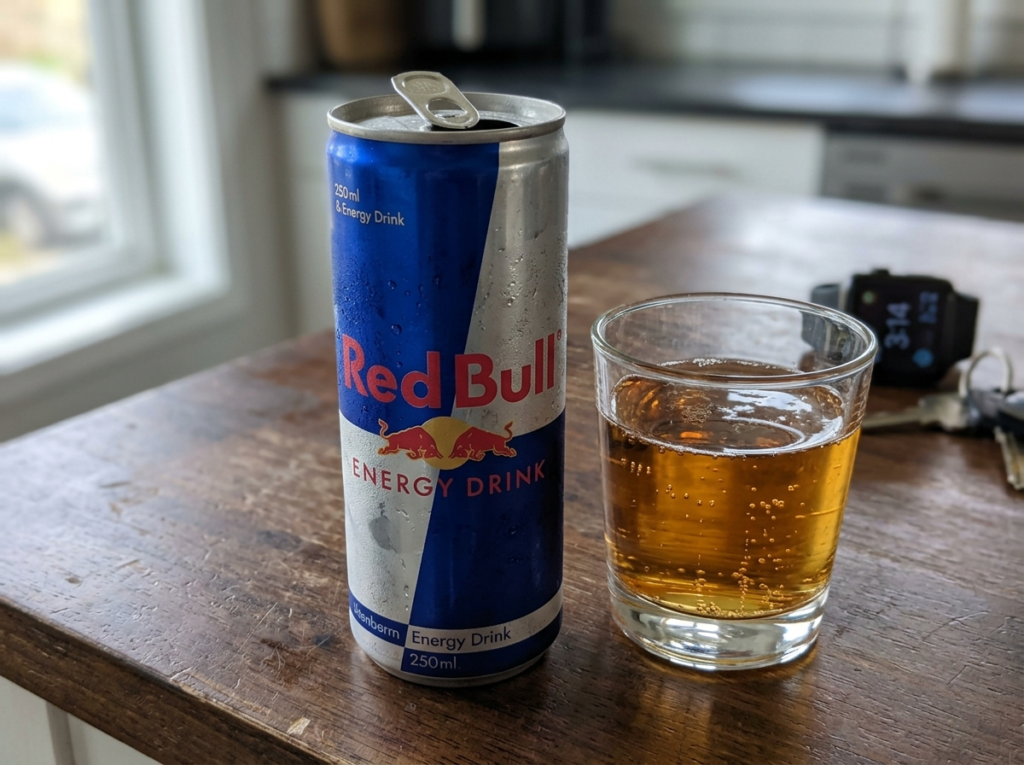
You cracked open a Red Bull 30 minutes before your night shift, and now you’re wondering — how long is this thing actually going to work? Will you crash in two hours? Five? Or will it keep buzzing through your system all night and mess up your sleep?
A standard 8.4 oz Red Bull contains about 80 mg of caffeine — roughly the same as a regular cup of coffee. That caffeine has a half-life of about 5 to 6 hours in most adults, which means the effects don’t just vanish after a fixed window. Your body processes it gradually, and the whole experience follows a pretty predictable timeline.
But caffeine isn’t the only player here. Red Bull also packs taurine, B-vitamins, and about 27 grams of sugar (in the regular version). These ingredients work together to create that “boost” you feel — and they also influence how and when that boost fades.
Let’s break down exactly what happens inside your body from the moment you take your first sip, how long you can expect the energy to last, and what the so-called Red Bull crash actually feels like.
What Happens After You Drink a Red Bull? The Hour-by-Hour Breakdown
Your body doesn’t process Red Bull all at once. The effects roll in stages, and understanding this timeline helps you plan your intake better — whether you’re using it for studying, driving, working out, or just getting through a long afternoon.
The First 10 Minutes: Caffeine Enters Your Bloodstream
The moment Red Bull hits your stomach, your body starts absorbing the caffeine. Within about 10 minutes, caffeine begins entering your bloodstream. You probably won’t feel much yet, but the process has already started. Your heart rate might increase slightly, and your body is gearing up for what’s coming.
If you drank it on an empty stomach, absorption happens faster. If you just had a big meal, it’ll take a little longer for the caffeine to kick in fully. That’s why some people feel a Red Bull hit them like a truck, while others barely notice it — timing and stomach contents matter more than most people realize.
Want to know more about how quickly you’ll feel the effects? Check out our detailed piece on how long Red Bull takes to kick in.
15 to 45 Minutes: Peak Alertness Kicks In
This is the sweet spot. Around 15 to 45 minutes after drinking, caffeine levels in your blood reach their peak. You’ll feel the most alert, focused, and energized during this window.
Here’s what’s happening inside your body: caffeine blocks adenosine receptors in your brain. Adenosine is the chemical that makes you feel sleepy, and caffeine essentially sits in its spot, preventing that drowsy signal from getting through. At the same time, your body releases small amounts of adrenaline, which sharpens your focus and speeds up your reaction time.
The sugar in a regular Red Bull also spikes your blood glucose during this period, giving you that quick burst of physical energy on top of the mental alertness. If you went with a Sugar-Free Red Bull, you’ll still get the caffeine effects, but without the glucose spike.
1 to 3 Hours: Sustained Energy (But It’s Already Fading)
After that initial peak, the effects start to plateau and gradually taper off. You’re still alert, still functioning well — but the peak intensity is behind you. Most people describe this phase as “feeling normal but awake,” which honestly is exactly what you want from an energy drink.
During this window, your liver is actively metabolizing the caffeine. About half of the caffeine you consumed will still be in your system after 5 to 6 hours (that’s what “half-life” means), but you’ll notice the sharpest decline in perceived energy between hours 2 and 4.
If you had the sugar version, your blood glucose is also dropping back to normal during this phase. That drop can make you feel more tired than you actually are — your body interprets the declining sugar as a signal to slow down.
3 to 5 Hours: The Red Bull Crash Window
This is the part nobody enjoys. Somewhere between 3 and 5 hours after drinking, most people experience what’s commonly called the Red Bull crash. It’s not dramatic — you’re not going to fall asleep at your desk mid-sentence — but you’ll notice a distinct dip in energy and mood.
The crash happens for two main reasons. The sugar crash hits first (usually around hour 2-3), as your blood glucose normalizes. Then the caffeine itself starts wearing off enough that adenosine — that sleepy chemical — begins flooding back into its receptors. Your brain basically goes from “blocked from feeling tired” to “catching up on all the tiredness it missed.”
Common crash symptoms include mild fatigue, reduced concentration, slight irritability, and sometimes a headache. The intensity depends on your caffeine tolerance, how much sleep you got the night before, and whether you ate anything alongside the Red Bull.
5 to 12 Hours: Caffeine Is Still in Your System
Here’s something that surprises a lot of people. Even after you stop “feeling” the Red Bull, caffeine is still circulating through your body. After 5 to 6 hours, about 40 mg (half of the original 80 mg) is still in your bloodstream. After 10 to 12 hours, trace amounts remain.
This is exactly why drinking a Red Bull at 4 PM can mess up your sleep at 11 PM, even though you feel “totally fine” by evening. Your brain might not register the alertness consciously, but the caffeine is still interfering with your natural sleep architecture. Studies from the Journal of Clinical Sleep Medicine suggest that caffeine consumed even 6 hours before bedtime can reduce total sleep by more than an hour.
How Long Does Red Bull Actually Last? The Short Answer
If you just want a straightforward answer, here it is.
The noticeable energy boost from one standard Red Bull (8.4 oz, 80 mg caffeine) lasts roughly 1 to 3 hours for most people. The caffeine itself stays in your system for 5 to 6 hours at half-strength, and 10 to 12 hours until it’s mostly cleared out.
But “how long it lasts” really depends on what you mean by “lasts.” If you mean “how long will I feel wired and alert?” — that’s about 1 to 3 hours. If you mean “how long until it stops affecting my body at all?” — that’s closer to 10 to 12 hours.
The Red Bull duration also varies significantly from person to person. Your body weight, caffeine tolerance, age, medications, and even genetic factors all play a role. Someone who drinks energy drinks daily will burn through 80 mg of caffeine much faster than someone who rarely touches caffeine.
What Affects How Long Red Bull Lasts in Your Body?
Not everyone metabolizes Red Bull at the same rate. A bunch of factors speed up or slow down how your body processes caffeine, and understanding them can help you figure out your own personal Red Bull duration.
Your Caffeine Tolerance
If you’re a regular caffeine consumer — whether through coffee, tea, or other energy drinks like Monster — your body has built up a tolerance. Your liver produces more of the enzymes that break down caffeine, so it moves through your system faster. That means both a shorter peak AND a shorter overall duration.
Someone who rarely drinks caffeine might feel one Red Bull for 4+ hours. A daily caffeine user might feel it wear off after just 90 minutes.
Body Weight and Composition
Caffeine is distributed through your body based on your weight. A 130-pound person will feel 80 mg of caffeine more intensely (and for longer) than a 200-pound person. It’s simple math — the same dose concentrates differently across different body masses.
Genetics and Liver Metabolism
Some people are genetically “fast metabolizers” of caffeine, and some are “slow metabolizers.” This is determined by variations in your CYP1A2 gene, which controls the primary enzyme responsible for breaking down caffeine. If you’re a slow metabolizer, Red Bull will last longer in your body, and you’re also more sensitive to side effects like jitteriness and sleep disruption.
There’s no easy way to test this at home, but you probably already know which camp you fall into. If a single coffee keeps you wired for hours, you’re likely a slow metabolizer.
Medications and Health Conditions
Oral contraceptives can nearly double caffeine’s half-life. So can certain antibiotics, antidepressants, and liver conditions. Pregnancy also slows caffeine metabolism significantly — the half-life can extend to 15 hours or more in the third trimester. If you’re on any medications, it’s worth checking whether they interact with caffeine.
Whether You Ate Anything
Drinking Red Bull on an empty stomach means faster absorption, a sharper peak, and often a more noticeable crash. If you pair it with food — especially protein and healthy fats — the caffeine absorbs more slowly, giving you a more gradual, extended energy curve.
Red Bull vs. Coffee: Which Energy Lasts Longer?
People ask this a lot, and the answer isn’t as simple as comparing caffeine numbers.
A standard Red Bull has about 80 mg of caffeine. A typical 8 oz cup of brewed coffee has about 95 mg. So on paper, coffee has more caffeine and should last slightly longer — and for pure caffeine duration, that’s basically true.
But Red Bull feels different because of the sugar and taurine. The sugar gives you a faster initial burst but also sets you up for a steeper crash. Taurine (an amino acid) has been shown in some studies to work alongside caffeine, potentially smoothing out the energy curve slightly — though the research on taurine’s independent effects is still mixed.
Coffee drinkers often report a more sustained, steady alertness. Red Bull drinkers tend to describe a sharper spike followed by a more noticeable crash. Neither lasts dramatically longer than the other, but the shape of the energy boost feels different.
If you’re curious about caffeine levels in different drinks, the differences can be eye-opening.
The Red Bull Crash: Why It Happens and How to Minimize It
Let’s talk about the crash in more detail, because it’s the part people dread most.
The Red Bull crash isn’t some catastrophic shutdown of your body. It’s your system returning to baseline — and sometimes dipping slightly below baseline because of rebound effects. You suppressed tiredness with caffeine, and now that tiredness is catching up.
The sugar component makes it worse. When you drink a regular Red Bull, your blood sugar spikes and then drops. That drop triggers a cortisol response, which can make you feel sluggish, foggy, and even a little anxious. It’s a mild version of what happens with any high-sugar food — a rapid rise followed by a rapid fall.
Practical Ways to Soften the Crash
Eat something before or with your Red Bull. A small meal with protein and complex carbs slows down both caffeine and sugar absorption, giving you a smoother ride and a gentler comedown.
Choose Sugar-Free Red Bull. Without the glucose spike, there’s no glucose crash. You’ll still experience some caffeine withdrawal as it wears off, but it won’t be compounded by blood sugar fluctuations.
Stay hydrated. Caffeine is a mild diuretic, and dehydration makes fatigue worse. Drinking water alongside your Red Bull can offset some of the crash symptoms.
Don’t stack another Red Bull on top. It’s tempting to grab a second can when the first one starts wearing off, but you’re just delaying the crash and making it worse when it finally hits. You’re also pushing your daily caffeine intake higher, which increases the chance of side effects like heart palpitations and anxiety.
Take a 20-minute nap. Sounds counterintuitive alongside caffeine, but a brief power nap during the tail end of your Red Bull’s effects can be incredibly effective. Your body gets rest while the caffeine prevents you from falling into deep sleep, so you wake up feeling refreshed without grogginess.
Does Red Bull Size Change How Long It Lasts?
Absolutely. Red Bull comes in several sizes, and the caffeine content scales up accordingly.
The 8.4 oz can has 80 mg of caffeine. The 12 oz can has about 114 mg. The 16 oz can packs roughly 150 mg. And the 20 oz can delivers about 189 mg.
More caffeine means a longer-lasting effect, but it also means a stronger crash and more potential for side effects. A 16 oz Red Bull isn’t just “twice as much energy for twice as long.” The peak is higher, the duration stretches by maybe an hour or so, and the crash can be noticeably sharper.
If you regularly reach for the larger cans, you might want to compare how Red Bull’s caffeine stacks up against other high-caffeine energy drinks to understand where you fall on the intake spectrum.
The FDA recommends that healthy adults cap their daily caffeine at 400 mg. A single 20 oz Red Bull puts you nearly halfway there. Two of them in one day, and you’re close to the ceiling — especially if you’re also having coffee, tea, or caffeine from sodas.
When Is the Best Time to Drink Red Bull?
Timing your Red Bull correctly can make a big difference in how useful it is — and how much it disrupts your night.
For workouts: Drink it about 20 to 30 minutes before exercise. That way, the caffeine peaks right as you start your session. Studies show that caffeine improves endurance, power output, and perceived effort during exercise.
For studying or work: Mid-morning (around 10 AM) or early afternoon (around 1-2 PM) tends to work best. Your natural cortisol levels dip during these times, so caffeine fills the gap nicely without fighting your body’s own alertness signals.
For driving: If you’re fighting drowsiness on a long drive, Red Bull can help — but only for about 2 to 3 hours. Don’t rely on it as a substitute for actual sleep. The effects will wear off, and drowsy driving is just as dangerous after the crash.
The cutoff time? Most sleep experts recommend no caffeine after 2 PM if you go to bed around 10-11 PM. If you’re sensitive to caffeine or you’re a slow metabolizer, push that cutoff to noon. Your future self at midnight will thank you.
Is It Safe to Drink Red Bull Every Day?
One standard 8.4 oz Red Bull per day is generally considered safe for healthy adults. The 80 mg of caffeine is well within the FDA’s 400 mg daily limit, and the European Food Safety Authority has reached similar conclusions.
That said, “safe” and “ideal” aren’t the same thing. Daily consumption builds tolerance, meaning you’ll need more over time to get the same effect. You’ll also develop a mild physical dependence — skip your usual Red Bull and you might get headaches, fatigue, and irritability for a day or two.
The sugar is the bigger concern for daily drinkers. One regular Red Bull has 27 grams of sugar, which is more than half of the American Heart Association’s recommended daily limit (36 grams for men, 25 grams for women). Day after day, that adds up. Switching to Sugar-Free Red Bull eliminates this problem, though the artificial sweeteners have their own ongoing debate.
⚠️ Important Note: People with heart conditions, high blood pressure, anxiety disorders, or sensitivity to caffeine should talk to a doctor before making energy drinks a regular habit. Pregnant or breastfeeding women should limit caffeine to 200 mg per day or less, per ACOG guidelines. This article is informational and doesn’t replace medical advice.
Does Red Bull Expire or Lose Its Potency Over Time?
Since we’re talking about how long Red Bull lasts, let’s address the shelf life question too — because people genuinely ask this.
An unopened Red Bull can lasts 18 to 24 months from its production date. The expiration date is printed on the bottom of the can. After that date, the drink is still safe to consume for a while, but the flavor may degrade and the carbonation will weaken.
Once you open a can, drink it within a few hours. The carbonation disappears quickly, and the sugar creates an environment where bacteria can grow if left out at room temperature. If you opened it and stuck it in the fridge, you’ve got maybe 24 hours before it tastes flat and questionable.
The caffeine itself doesn’t really “expire” — it’s a very stable molecule. But the overall drink quality declines, and a flat, room-temperature Red Bull is nobody’s idea of a good time.
Red Bull Effects Compared to Other Energy Drinks
If you’re choosing between energy drinks, the duration and intensity of effects vary quite a bit based on caffeine content and other ingredients.
Monster Energy (16 oz) contains 160 mg of caffeine — double what a standard Red Bull has. The effects last longer (roughly 3-5 hours of noticeable energy), but the crash tends to be proportionally heavier. If you’ve been thinking about this comparison, here’s a full look at how long Monster Energy lasts.
5-Hour Energy takes a different approach entirely. It’s a concentrated shot with about 200 mg of caffeine and no sugar. The effects come on faster and last about 4-6 hours for most people, with a less dramatic crash because there’s no sugar component.
Coffee remains the most customizable option. You control the brew strength, the amount, and there’s no added sugar unless you put it in yourself. For most people, a cup of coffee and a Red Bull provide very similar durations of alertness — the delivery and experience just feel different.
If you want to explore caffeine content across different drinks, the numbers can help you choose what fits your needs best.
FAQ
How long does one Red Bull keep you awake?
A single 8.4 oz Red Bull will keep you noticeably more alert for about 1 to 3 hours. The caffeine stays in your system for 5-6 hours at half-strength, so it can subtly affect your wakefulness and sleep quality for much longer than you actively “feel” it. If you’re counting on it to keep you awake through a full night shift, one can alone probably won’t be enough.
Can Red Bull keep you up all night?
Not reliably. One standard Red Bull doesn’t have enough caffeine to fight your body’s natural sleep drive for an entire night. You might manage it with multiple cans spread out, but that comes with diminishing returns — each subsequent Red Bull is less effective than the last, and you’ll build up a serious sleep debt. Genuine all-nighters are best avoided when possible, regardless of how many energy drinks you have.
How long does it take for Red Bull to wear off completely?
From a caffeine standpoint, it takes about 10 to 12 hours for your body to clear most of the caffeine from one Red Bull. The noticeable energy boost wears off much sooner (1-3 hours), but the residual caffeine can still affect your heart rate, blood pressure, and sleep quality for many hours after you stop feeling “energized.” This is why afternoon Red Bulls are the most common sleep disruptors.
Is Sugar-Free Red Bull different in how long it lasts?
The caffeine duration is identical because both versions contain 80 mg of caffeine. The difference is in the energy curve. Sugar-Free Red Bull doesn’t give you the blood glucose spike, so the initial boost feels slightly less intense, but there’s also no sugar crash on the back end. Many people find that the overall experience feels smoother and more even, even if the peak alertness isn’t quite as sharp.
Does Red Bull work better than coffee for staying alert?
They’re comparable for pure alertness because the caffeine content is similar. Red Bull’s sugar and taurine can make the onset feel faster and more noticeable, while coffee tends to deliver a steadier, longer-lasting alertness. Preference comes down to personal taste and how you respond to sugar. If you’re purely optimizing for sustained focus, black coffee without sugar tends to produce fewer ups and downs.
Your Red Bull, Your Timing
Now that you know the full Red Bull effects timeline, the most practical takeaway is this: plan your Red Bull around what you need it for. If you need sharp focus for a 2-hour study session, drink it 20 minutes before you start. If you’re worried about sleep, keep it to mornings only. And if you’re a daily drinker, consider rotating between caffeinated and non-caffeinated beverages to keep your tolerance from building too fast.
One Red Bull isn’t going to hurt you. It’s a well-researched, regulated product that millions of people use every day. But like any tool, it works best when you understand exactly how it works — and how long it works — so you can use it on your terms, not the other way around.