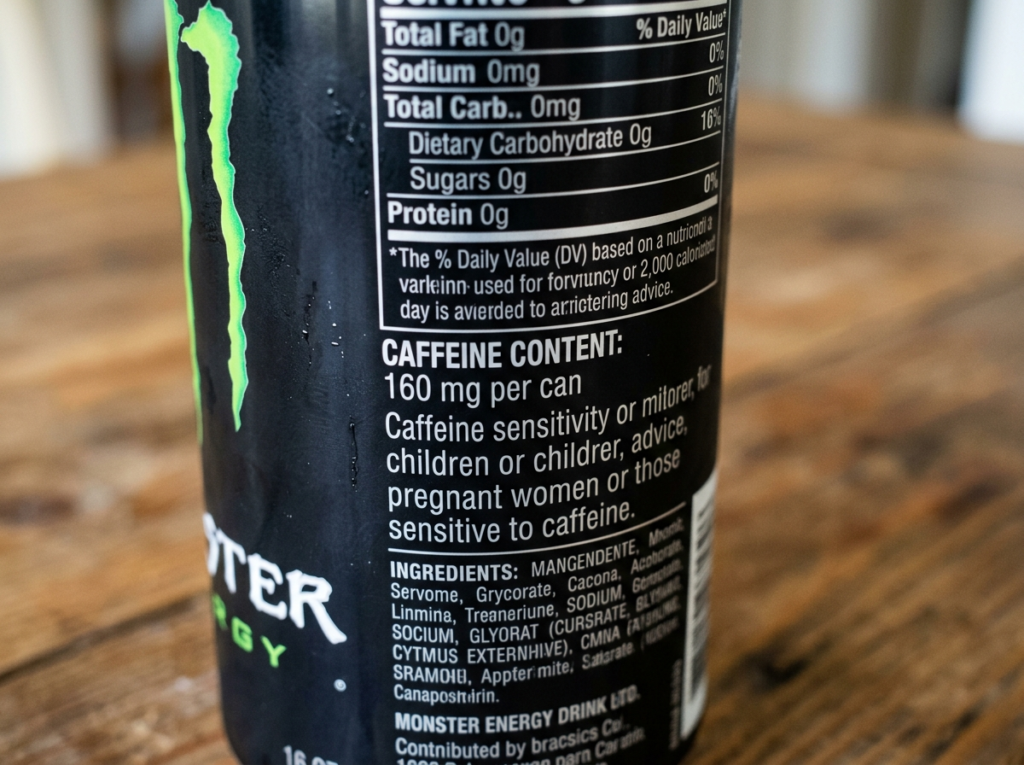
A single 16 oz can of Monster Energy packs 160 mg of caffeine — roughly the same as two standard cups of brewed coffee, except you’re drinking it ice-cold, often faster, and sometimes on an empty stomach. That number alone doesn’t tell the whole story, though. Monster has over 40 flavor variants on shelves right now, and the caffeine content bounces around quite a bit depending on which one you grab. Some cans sit at a modest 140 mg, while others push well past 200 mg.
If you’ve ever stood in a gas station aisle wondering how much caffeine in Monster you’re actually signing up for, you’re not alone. That’s one of the most searched questions around energy drinks, and honestly, the answer gets confusing fast because Monster doesn’t always make it easy to find on the label.
This article breaks down the caffeine in every major Monster variant, compares it against other popular energy drinks, and gives you practical guidance on whether that caffeine level is something to think twice about. No hype, no scare tactics — just straight numbers and context you can actually use.
How Much Caffeine Is in a Standard Monster Energy?
The classic Monster Energy (green can) contains 160 mg of caffeine per 16 fl oz can. That works out to about 10 mg per fluid ounce.
Here’s some context for that number. A typical 8 oz cup of drip coffee has around 80–100 mg of caffeine. So you’re basically getting two coffees’ worth of caffeine in one Monster can, except the delivery is different. Most people sip coffee over 20–30 minutes. A cold energy drink? Many people finish it in under 10 minutes. That speed matters because your body absorbs the caffeine faster, and the effects hit harder.
Monster lists its caffeine on the “Supplement Facts” panel rather than the “Nutrition Facts” label. That’s because energy drinks in the U.S. are often marketed as dietary supplements, which follows different FDA labeling rules than conventional beverages. So if you’ve been squinting at the wrong part of the can looking for caffeine info, that’s why.
Quick Fact: The 160 mg figure includes caffeine from all sources in the blend — both the added anhydrous caffeine and any caffeine that comes from guarana extract, which is another ingredient in Monster’s “Energy Blend.”
Monster Caffeine mg — Every Popular Variant Compared
Not all Monsters are created equal. The caffeine content shifts depending on the product line, can size, and flavor. Here’s how the most popular options stack up:
Monster Original Lineup
The standard Monster flavors — Original, Lo-Carb, Assault, and Import — all contain 160 mg per 16 oz can. These are the ones you see most often in convenience stores and vending machines. They all use the same energy blend base, so the caffeine stays consistent even though the flavors change.
Monster Ultra Series
The Monster Ultra line is where things get interesting for anyone watching calories. Monster Ultra White, Ultra Blue, Ultra Sunrise, Ultra Violet, Ultra Rosa, Ultra Gold, and Ultra Watermelon all contain 150 mg of caffeine per 16 oz can — slightly less than the original. These are zero-sugar options, and the 10 mg difference from the original is small but worth knowing if you’re tracking your intake closely.
Monster Ultra caffeine sits at a moderate level compared to the full lineup. A lot of people assume “sugar-free” means “less caffeine,” but that’s not really what’s happening here. The reduction is minimal, and you’re still getting a solid caffeine dose.
Monster Java Line
Monster Java combines coffee and energy drink ingredients. Most Monster Java flavors pack 188 mg of caffeine per 15 oz can. That’s higher than the original, and the can is actually slightly smaller. The caffeine density per ounce is noticeably stronger here because you’re getting caffeine from both the coffee component and the energy blend.
Monster Juice & Rehab
Monster Juice variants (Mango Loco, Pipeline Punch, Pacific Punch) deliver around 160 mg per 16 oz can, keeping them in line with the original. Monster Rehab Tea + Lemonade, on the other hand, contains about 160 mg per 15.5 oz can — similar numbers but in a slightly smaller container.
Monster Mega (24 oz Cans)
Here’s where the caffeine climbs significantly. The bigger 24 oz Monster cans — sometimes called BFC cans — contain 240 mg of caffeine. That’s 50% more caffeine than the standard 16 oz version. If you’re casually drinking one of these because it “looks like a bigger version of the same thing,” you should know you’re taking in meaningfully more caffeine.
If you’re curious about which energy drinks carry the highest caffeine loads on the market, Monster’s mega cans don’t even top the list — some competitors go well past 300 mg per can.
Monster vs Red Bull Caffeine — The Real Comparison
This is probably the most common comparison people search for, and the answer surprises a lot of people.
A standard 8.4 oz Red Bull has 80 mg of caffeine. A standard 16 oz Monster has 160 mg. At first glance, Monster looks like it has twice the caffeine. But here’s the thing — Monster’s can is literally twice the size of Red Bull’s standard can.
When you compare them ounce for ounce, they’re almost identical. Red Bull delivers about 9.5 mg per oz, and Monster delivers about 10 mg per oz. The difference is negligible. You’d barely notice it.
So why does Monster feel “stronger” to many people? Volume. You’re consuming double the liquid in a single sitting, which means double the total caffeine intake. Your body doesn’t care about per-ounce ratios — it cares about the total amount hitting your bloodstream.
Red Bull does sell a 12 oz can (with about 114 mg caffeine) and a 16 oz can (with roughly 151 mg caffeine). When you compare the 16 oz versions, Monster and Red Bull are practically neck and neck.
The real differences between these two brands show up in other areas — sugar content, B-vitamin levels, amino acid blends, and price per ounce. But on caffeine alone? It’s much closer than most people think.
Want to know how long that Red Bull buzz actually lasts once it kicks in? There’s a solid breakdown of how long Red Bull’s effects last that covers the timeline pretty well.
Is Monster Caffeine High? Putting It in Perspective
Whether 160 mg is “a lot” depends entirely on what you’re comparing it to and how your body processes caffeine. Let’s put some numbers next to each other.
A 16 oz Starbucks Grande brewed coffee contains around 310 mg of caffeine — nearly double a Monster. A Starbucks Vanilla Frappuccino (bottled, 13.7 oz) has about 95 mg of caffeine. A 12 oz can of Pepsi has roughly 38 mg, and a Coke Zero packs about 34 mg per 12 oz.
So Monster sits firmly in the middle of the caffeinated beverage spectrum. It’s significantly stronger than soda, comparable to coffee, and weaker than many specialty coffee drinks. If you check out how Starbucks drinks rank by caffeine, you’ll notice that several popular Starbucks orders blow Monster out of the water.
The FDA considers 400 mg of caffeine per day a generally safe limit for healthy adults. One Monster can uses up about 40% of that daily allowance. That’s not alarming on its own, but it becomes a concern when you add up everything else you consume — your morning coffee, an afternoon tea, a chocolate bar, maybe a pre-workout supplement. Caffeine adds up from multiple sources faster than most people realize.
⚠️ Warning: Teens, pregnant women, and people with heart conditions should be especially cautious with energy drinks. The American Academy of Pediatrics recommends that adolescents consume no more than 100 mg of caffeine per day — a single Monster exceeds that limit by 60%.
What Happens When You Drink a Monster — The Caffeine Timeline
Understanding when the caffeine peaks and fades helps you time your intake better.
Within 10–15 minutes of finishing a can, caffeine starts entering your bloodstream. You’ll begin feeling more alert, and your heart rate may increase slightly. Around the 30–45 minute mark, you hit peak blood caffeine levels. This is when you feel the most focused and energized.
Between 3 to 5 hours after drinking, your body has metabolized about half the caffeine — this is known as caffeine’s “half-life.” So if you drank 160 mg at 2 PM, you’d still have around 80 mg active in your system at 7 PM. That’s enough to interfere with sleep for many people.
The full effects typically clear your system within 6 to 8 hours, though this varies based on age, body weight, liver function, and genetics. Some people are genetically “slow metabolizers” of caffeine and might feel the effects for 10+ hours. If you’ve ever wondered in detail about how long Monster Energy actually lasts, it’s worth reading up on because the answer is more individual than you’d expect.
Pro Tip: If you use Monster for a late-afternoon energy boost, try to finish it before 2 PM. Anything later than that risks interfering with your sleep quality, even if you feel fine falling asleep. Caffeine doesn’t just affect whether you fall asleep — it reduces the quality of your deep sleep stages.
The “Energy Blend” Factor — It’s Not Just Caffeine
Monster’s effects don’t come from caffeine alone. Each can contains what Monster calls an “Energy Blend” — a proprietary mix of several active ingredients. Understanding these helps explain why Monster can feel different from a cup of coffee with the same caffeine amount.
Taurine shows up in doses around 2,000 mg per can. Despite persistent rumors, taurine isn’t extracted from bull anything — it’s a synthetic amino acid. Research suggests it may support cardiovascular function and has mild anti-anxiety properties, which might explain why energy drinks feel “smoother” than straight caffeine for some people.
Guarana extract is essentially a plant-based caffeine source. Monster’s listed caffeine number already accounts for the caffeine from guarana, so you’re not getting secret extra caffeine on top of the 160 mg. But guarana also contains small amounts of theobromine and theophylline — compounds related to caffeine that may extend the stimulant effect slightly.
B-vitamins are present in large doses (often several hundred percent of daily values), though your body simply excretes what it doesn’t need through urine. That neon-yellow color after drinking Monster? That’s excess riboflavin (B2) leaving your body. It’s harmless.
Ginseng and L-Carnitine round out the blend. The amounts in Monster are generally considered too low to have significant standalone effects, but they contribute to the overall formulation.
The point here isn’t that these ingredients are dangerous or magical — they’re mostly well-studied at these doses. But they do interact with the caffeine in ways that make the energy drink experience distinct from coffee or soda.
Who Should Be Careful with Monster’s Caffeine Level?
Most healthy adults can handle 160 mg of caffeine without issues. But “most” isn’t “all,” and some groups need to pay closer attention.
Caffeine-sensitive individuals might experience jitteriness, rapid heartbeat, or anxiety even at 100 mg. If you know you’re sensitive to caffeine, a full Monster can is probably too much in one sitting. You could try the 8 oz Monster cans (available in some markets) or simply pour half and save the rest.
People taking certain medications should check with their doctor. Caffeine interacts with some antibiotics (like ciprofloxacin), certain antidepressants, and medications for asthma or heart conditions. These interactions can either amplify caffeine’s effects or slow its metabolism, keeping it in your system much longer than normal.
Anyone who already drinks a lot of coffee should count their total daily intake. If you’re having two cups of coffee in the morning and then a Monster in the afternoon, you could easily be pushing past 400 mg — the FDA’s recommended daily cap. That’s where side effects like insomnia, digestive issues, and elevated blood pressure start showing up more consistently.
There’s a more detailed look at whether Monster Energy is bad for you if you want the full picture on health considerations beyond just caffeine.
Smart Ways to Manage Your Monster Caffeine Intake
Knowing the numbers is useful. Knowing what to do with them is better. Here are some practical approaches that don’t require giving up energy drinks entirely.
Track your total daily caffeine from all sources. This is the single most useful habit. Most people focus on their Monster can but forget about the caffeine in their morning coffee, their afternoon tea, or even their pre-workout supplement. A simple note on your phone works. You don’t need an app — just a running tally.
Don’t drink Monster on an empty stomach. Caffeine absorption happens faster without food in your system, which means the spike hits harder and the crash afterward feels worse. Having even a small snack 20 minutes before your energy drink can smooth out the experience noticeably.
Alternate with lower-caffeine options on some days. Not every afternoon slump needs 160 mg of caffeine. Sometimes a drink with 35–50 mg is enough. If you’re looking for options with much lower caffeine, something like a Starbucks Refresher offers a lighter pick-me-up without the full energy drink load.
Set a personal caffeine curfew. Based on caffeine’s half-life, finishing your last caffeinated drink 6–8 hours before bedtime is a solid rule. For most people, that means no Monster after 2–3 PM if you’re aiming to sleep around 10–11 PM.
Stay hydrated separately. Monster contains water, sure, but the caffeine has a mild diuretic effect. Keep a water bottle going throughout the day independently of your energy drink consumption.
How Monster’s Caffeine Compares to Other Popular Drinks
It helps to see where Monster lands on the broader caffeine map. These numbers are per standard serving size:
A 12 oz can of Coca-Cola has about 34 mg. A 12 oz Mountain Dew comes in at around 54 mg. Sprite, if you’re curious, has zero caffeine — it’s a fully caffeine-free soda. A 16 oz Monster Original delivers 160 mg. A 16 oz Rockstar typically has 160 mg as well. An 8.4 oz Red Bull contains 80 mg. A 16 oz Bang Energy packs 300 mg. And a 16 oz Starbucks Grande Pike Place brewed coffee hits roughly 310 mg.
Monster sits right in the middle tier. It’s not a low-caffeine drink by any stretch, but it’s also far from the most aggressive option out there. Drinks like Bang, Reign, and Celsius push into the 200–300 mg range per can, making Monster look relatively moderate by comparison.
One thing that often gets overlooked: a tablespoon of ground coffee used for brewing contains around 60–70 mg of caffeine. If you’re making a strong pour-over with 2–3 tablespoons, you’re already in Monster territory before you even leave your kitchen.
FAQ
How much caffeine is in Monster Zero Ultra?
Monster Zero Ultra (all flavors in the Ultra line) contains 150 mg of caffeine per 16 oz can. That’s 10 mg less than the original Monster, with zero sugar and very few calories. The caffeine difference is small enough that most people won’t feel a practical difference between Ultra and the original.
Can I drink two Monsters in one day?
Two standard 16 oz cans would give you 320 mg of caffeine — which is under the FDA’s 400 mg daily guideline for healthy adults. But that guideline assumes no other caffeine sources during the day. If you’re also drinking coffee, tea, or pre-workout, two Monsters could easily push you over 400 mg. The sugar and other stimulant ingredients (taurine, guarana) also stack up, so even within “safe” caffeine limits, two cans daily isn’t ideal as a regular habit.
Is Monster stronger than coffee?
Per ounce, no. Monster has about 10 mg of caffeine per ounce, while brewed coffee averages 12–15 mg per ounce. A 16 oz cup of coffee from most cafes delivers more caffeine than a 16 oz Monster. The difference is that Monster contains additional stimulant-adjacent ingredients like taurine and guarana that can make the energy feel different — often described as a more immediate, sharper boost compared to coffee’s slower, steadier effect.
How long does Monster caffeine stay in your system?
Caffeine’s half-life is roughly 5 hours for most adults. So about 5 hours after drinking a Monster, you’d still have approximately 80 mg of caffeine active in your body. It takes around 10–12 hours for the caffeine to fully clear. Individual factors like age, medication use, pregnancy, and liver health can shorten or extend this timeline significantly.
Does Monster have more caffeine than Starbucks?
Generally, no. Most medium and large Starbucks coffee drinks contain significantly more caffeine than a Monster can. A Starbucks Grande (16 oz) brewed coffee has around 310 mg — almost double a Monster. Even some of Starbucks’ non-coffee drinks carry moderate caffeine levels that aren’t far off from what you’d find in a smaller energy drink.
Final Thoughts
Monster’s caffeine content — 160 mg in the standard can — is a meaningful dose, but it’s not the extreme amount that some people imagine. It’s roughly equal to a medium cup of coffee and significantly less than what you’d get from a large brewed coffee at most cafes. The Monster Ultra caffeine content drops slightly to 150 mg, and specialty variants like Monster Java push higher.
The real question isn’t just “how much caffeine in Monster” — it’s how that number fits into your total daily caffeine intake and your personal tolerance. If Monster is your only caffeine source for the day and you don’t have any sensitivity issues, 160 mg is well within safe territory for most adults. If it’s stacking on top of three cups of coffee and a pre-workout, that’s a different conversation.
Pay attention to how your body responds. Track your total intake. Respect the caffeine curfew. And if you find that you need a Monster every single day just to function, that might be a signal to look at your sleep habits, hydration, or diet rather than reaching for another can. Energy drinks work best as an occasional tool, not a daily crutch.