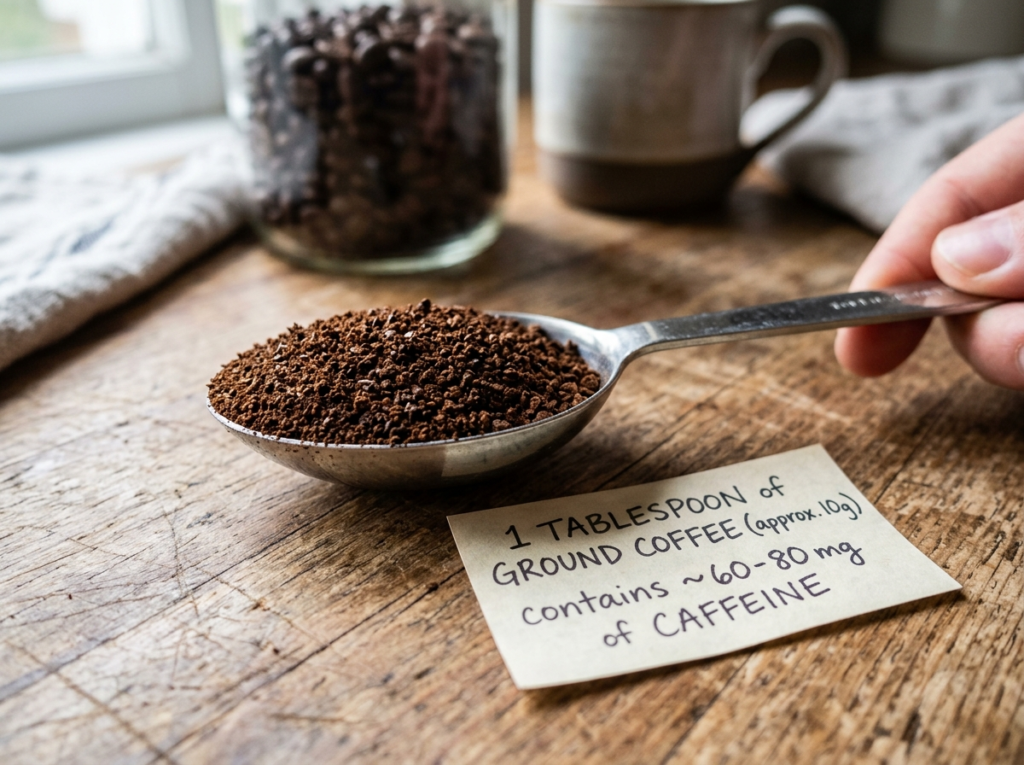
A single tablespoon of ground coffee holds roughly 60 to 100 mg of caffeine — and that range isn’t random. The type of bean, the roast level, and how finely you grind it all push that number up or down. Most people scoop their coffee without thinking twice, but if you’ve ever felt jittery after one cup or completely unaffected after two, your tablespoon is probably the reason why.
Here’s the thing — caffeine content doesn’t just matter for people who are “sensitive.” If you’re tracking your daily intake for health reasons, managing anxiety, pregnant, or simply trying to figure out why your homemade coffee hits differently than a coffee shop brew, understanding how much caffeine sits in that little scoop changes everything. Let’s break down the actual numbers, what affects them, and how you can measure your caffeine by coffee measurement with real accuracy.
How Much Caffeine Is Actually in a Tablespoon of Ground Coffee?
Let’s get the core answer out of the way. One level tablespoon of ground coffee — roughly 5 to 7 grams depending on grind size — contains about 60 to 100 mg of caffeine. The USDA estimates that a standard 8-ounce cup of brewed coffee (which typically uses about 2 tablespoons of grounds) delivers around 95 mg of caffeine. That puts each tablespoon somewhere in the 48 to 65 mg range for a standard Arabica brew.
But wait — that’s the caffeine that ends up in your cup, not the total caffeine in the grounds. The ground coffee caffeine content before brewing is actually higher. Your brewing method only extracts about 80–90% of the available caffeine from the grounds. So the dry tablespoon itself holds more caffeine than what you actually drink.
Why does this matter? Because some people eat coffee grounds (yes, in smoothies, baked goods, or energy bars), and that means they’re consuming the full caffeine load. If you’re adding a tablespoon of grounds to your morning smoothie, you’re getting closer to that full 60–100 mg, not the reduced brewed amount.
Quick Fact: Caffeine is water-soluble, which is why hot water extracts most of it during brewing. But “most” doesn’t mean “all.” About 10–20% of the caffeine stays trapped in your used grounds.
What Makes the Caffeine Per Tablespoon Coffee Vary So Much?
That 60–100 mg range is pretty wide, right? A 40 mg difference per tablespoon means your two-tablespoon morning cup could have anywhere from 120 to 200 mg of caffeine. That’s nearly double at the high end. So what’s causing this swing?
Bean Type: Arabica vs. Robusta
This is the single biggest factor. Arabica beans — the ones you’ll find in most specialty and grocery store coffees — contain about 1.2% caffeine by weight. Robusta beans, commonly used in instant coffee, espresso blends, and budget brands, pack roughly 2.2% caffeine by weight. That’s almost double.
So a tablespoon of Robusta ground coffee could easily hit 100 mg or more, while the same tablespoon of a light-roasted single-origin Arabica might sit closer to 60 mg. If your coffee label doesn’t specify, check the brand’s website. Most specialty roasters use 100% Arabica. If it just says “coffee” without specifying, there’s a decent chance Robusta is in the mix.
If you’re curious about how different coffee types and varieties stack up in terms of caffeine, you might want to check out how caffeine compares across Starbucks drinks ranked by caffeine to see how bean choice plays out in real-world beverages.
Roast Level: Light, Medium, or Dark
There’s a persistent idea floating around that dark roast coffee has more caffeine because it tastes stronger. The truth is almost the opposite — but it depends on how you measure.
By weight, light roast beans have slightly more caffeine. Roasting burns off a tiny amount of caffeine and also reduces the bean’s mass (dark roast beans are lighter and more porous). So if you weigh your coffee, a tablespoon of light roast grounds will actually weigh a touch more than dark roast grounds, giving you slightly more caffeine.
By volume (which is how most people scoop), it gets complicated. Dark roast beans are bigger and less dense, so fewer grounds fit into a tablespoon. Fewer grounds = less caffeine per scoop.
The practical difference? It’s small — maybe 5–10 mg per tablespoon. But over multiple cups a day, it adds up.
Grind Size Matters Too
A tablespoon of finely ground coffee weighs more than a tablespoon of coarsely ground coffee. Fine grounds pack together more tightly, so you’re fitting more actual coffee into the same volume. More coffee = more caffeine.
This is one reason espresso packs such a caffeine punch per ounce. Espresso uses very finely ground coffee, and the grounds are densely packed. A single espresso shot uses about 7 grams of finely ground coffee, which would be a heaping tablespoon — delivering roughly 63 mg of caffeine in just one ounce of liquid.
Caffeine in a Tablespoon: Grounds vs. Brewed vs. Instant
People often confuse these three, and the caffeine numbers are wildly different for each.
Dry ground coffee (1 tablespoon, ~5–7g): 60–100 mg of caffeine total. This is the raw, unbrewed caffeine sitting in your grounds.
Brewed coffee from 1 tablespoon of grounds: About 48–85 mg, depending on extraction. Hot water, steep time, and brewing method determine how much of that total caffeine actually makes it into your cup.
Instant coffee (1 tablespoon of granules): Roughly 30–60 mg. Instant coffee goes through an extraction and drying process during manufacturing, which reduces its overall caffeine content compared to fresh grounds.
So if you’re comparing caffeine per tablespoon coffee across different forms, fresh ground coffee always wins. Instant coffee gives you roughly half to two-thirds of what ground coffee delivers.
Pro Tip: If you’re using instant coffee and want a stronger caffeine kick, you’d need about 1.5 to 2 tablespoons to match one tablespoon of regular ground coffee. Or you could just switch to a properly brewed cup and understand your coffee scoop size for better consistency.
How Brewing Methods Change Caffeine Extraction
Your tablespoon of ground coffee is just the starting point. What you do with it next — the brewing method — determines how much of that caffeine actually reaches your mug.
Drip Coffee Maker
Standard drip machines brew at around 195–205°F and take 4–6 minutes to complete a cycle. They typically extract about 85–90% of the available caffeine. Two tablespoons of grounds in a standard drip maker gives you roughly 80–140 mg per 8-ounce cup.
French Press
A French press steeps grounds in hot water for about 4 minutes. Because the grounds sit in contact with water the entire time, extraction is pretty efficient — around 80–85% of available caffeine. The coarser grind used for French press means your tablespoon holds slightly less coffee by weight, but the long steep time compensates.
Pour Over
Pour over methods like Hario V60 or Chemex give you a lot of control. Water temperature, pour speed, and bloom time all affect extraction. A well-executed pour over with one tablespoon of medium-fine grounds typically delivers 60–80 mg of caffeine per cup.
Espresso
Espresso is an interesting case. A standard single shot uses about one tablespoon (7g) of finely ground coffee, brewed under 9 bars of pressure for 25–30 seconds. Despite the short brew time, the high pressure extracts caffeine very efficiently — about 63 mg per shot.
The caffeine per tablespoon coffee in espresso is actually lower than drip because the contact time is so short. But because you drink espresso in tiny 1-ounce portions, the concentration per ounce is much higher. If you’re interested in how this plays out in espresso-based drinks, cappuccino vs. coffee caffeine comparisons break it down nicely.
Cold Brew
Cold brew is the outlier. It uses room temperature or cold water and steeps for 12–24 hours. The long extraction time pulls out a huge amount of caffeine — some cold brew concentrates contain 200+ mg per cup when made with a standard coffee-to-water ratio. If you’re using 2 tablespoons of grounds per cup of cold brew, you could be looking at 150–200 mg depending on steep time and dilution.
Converting Tablespoons to Real-World Caffeine Numbers
Let’s make this practical. Most people don’t weigh their coffee — they scoop it. Here’s what your daily coffee routine probably looks like in caffeine terms.
If you use 1 tablespoon per cup (a lighter brew), your 8-ounce mug has about 48–70 mg of caffeine from Arabica beans brewed in a drip machine. That’s actually less than the FDA’s cited 95 mg “average” cup because most standard recommendations call for 2 tablespoons per 6 ounces of water.
If you follow the SCAA (Specialty Coffee Association) golden ratio — about 2 tablespoons (10g) per 6 ounces of water — your cup delivers roughly 95–140 mg of caffeine. This is the “standard cup” most caffeine guidelines refer to.
Three cups a day at 2 tablespoons each means you’re using 6 tablespoons of grounds and consuming 285–420 mg of caffeine. The FDA recommends most adults stay under 400 mg per day, so three strong cups could push you right to the edge.
Did you know? An energy drink like Monster contains about 160 mg of caffeine per 16-ounce can. That’s roughly equivalent to a coffee made with 2–3 tablespoons of Arabica grounds. Your homemade coffee might actually have more caffeine than that can of energy drink — it just depends on how heavy your hand is with the scoop.
Why Measuring by Tablespoon Isn’t Always Accurate
Here’s something most coffee articles don’t tell you: a tablespoon is a terrible unit for measuring coffee if you care about consistency.
The problem is density. One tablespoon of coarsely ground coffee weighs about 4–5 grams. One tablespoon of finely ground coffee weighs about 6–8 grams. That’s a 50–60% difference in actual coffee mass from the same measuring spoon. And since caffeine is directly tied to how much coffee you’re using, that weight difference translates directly into caffeine variation.
This is why serious coffee enthusiasts and baristas use a kitchen scale. Weighing 7 grams of coffee every time guarantees consistent caffeine content regardless of grind size. If you use a blade grinder that produces an uneven grind, your tablespoon measurements become even more unpredictable.
That said, most home coffee drinkers do just fine with tablespoon measurements. You’re not running a chemistry lab — you’re making breakfast. Just know that your “tablespoon” could mean different things depending on your grinder settings.
Pro Tip: If you don’t want to buy a scale, at least be consistent with your scoop. Use the same grinder setting, the same coffee, and the same scoop every morning. Consistency matters more than precision for daily brewing. A proper coffee scoop guide can help you nail this down.
Caffeine in Decaf: Is a Tablespoon Really Caffeine-Free?
Decaf doesn’t mean zero caffeine. A tablespoon of decaf ground coffee still contains about 2 to 7 mg of caffeine. The decaffeination process removes 97–99% of caffeine, but a small amount always remains.
For most people, this is completely negligible. But if you’re extremely caffeine-sensitive, pregnant, or have a medical condition that requires strict caffeine avoidance, those 2–7 mg per tablespoon can add up. Three cups of decaf using 2 tablespoons each could deliver 12–42 mg of caffeine — about the same as half a can of cola.
If you’re looking for genuinely caffeine-free alternatives, herbal teas or some non-coffee drinks at Starbucks are better options. Some sodas like Sprite and Fanta are also completely caffeine-free.
How to Control Your Caffeine Intake Using Tablespoon Measurements
You don’t need an app or a chemistry degree to manage your caffeine. Your tablespoon is actually a pretty useful tool once you know the basics.
Want less caffeine? Use 1 tablespoon per 8-ounce cup instead of 2. Switch to 100% Arabica beans. Choose a coarser grind. Opt for a shorter brew time. These small changes can cut your caffeine per cup by 30–50%.
Want more caffeine? Use 2 heaping tablespoons per cup. Try a blend that includes Robusta beans. Grind finer. Steep longer (especially with French press or cold brew). Or simply brew with a higher coffee-to-water ratio.
Want consistent caffeine? Stick with the same brand, same roast, same grind size, and same number of tablespoons every time. The biggest source of caffeine variation in home coffee isn’t the beans — it’s inconsistent measuring.
Something most people overlook: the temperature of your water affects extraction too. Water between 195–205°F extracts caffeine most efficiently. If your water is too cool (common with some single-serve machines), you’ll get less caffeine even with the same amount of grounds. That’s one reason troubleshooting your Keurig or your Cuisinart coffee maker matters — a malfunctioning machine might be under-heating your water.
Caffeine Sensitivity: When Every Tablespoon Counts
About 10% of the population are “hyper-metabolizers” of caffeine — their bodies break it down so fast that they barely feel it. Another 10% or so are slow metabolizers who feel wired for hours from just a small amount. The rest of us fall somewhere in between.
If you’re a slow metabolizer, reducing from 2 tablespoons per cup to 1.5 could be the difference between productive energy and anxious jitters. The CYP1A2 gene largely controls how quickly your liver processes caffeine, and genetics aren’t something you can change. What you can change is your dose — and that starts with your tablespoon.
Pregnant women are generally advised to stay under 200 mg of caffeine per day (per the American College of Obstetricians and Gynecologists). That’s roughly 2 tablespoons of Arabica grounds brewed in a drip machine — essentially one standard cup. Knowing your ground coffee caffeine content helps you stay within that limit without guessing.
People on certain medications — including some antibiotics (ciprofloxacin), antidepressants (fluvoxamine), and heart medications — should also be careful. These drugs can slow caffeine metabolism dramatically, making your usual 2-tablespoon cup feel like a 4-tablespoon one.
A Quick Reference: Caffeine by Coffee Measurement
Here’s a handy comparison for different measurements and what they deliver in terms of caffeine.
1 teaspoon of ground coffee (~2–3g): About 20–35 mg of caffeine. This is a very weak cup if brewed solo.
1 tablespoon of ground coffee (~5–7g): About 60–100 mg of total caffeine (48–85 mg in your cup after brewing).
2 tablespoons of ground coffee (~10–14g): About 120–200 mg total. This is the standard “one cup” measurement most guidelines reference.
1 standard coffee scoop (equivalent to 2 tablespoons): Same as above — 120–200 mg. Most coffee scoops that come with your machine hold exactly 2 tablespoons.
1 tablespoon of espresso grounds (finely ground, ~7–8g): About 63–75 mg of caffeine per espresso shot.
1 tablespoon of instant coffee (~3–5g): About 30–60 mg.
These are Arabica-based estimates. Switch to Robusta and you can add 40–60% to each number.
FAQ
How many milligrams of caffeine are in one tablespoon of ground coffee?
One level tablespoon of ground Arabica coffee (about 5–7 grams) contains approximately 60–100 mg of caffeine. After brewing, roughly 48–85 mg of that caffeine ends up in your cup, since the extraction process doesn’t pull 100% of the available caffeine from the grounds. The exact amount depends on bean type, roast level, and grind size.
Is the caffeine in a tablespoon of instant coffee the same as ground coffee?
No, instant coffee has significantly less caffeine per tablespoon. A tablespoon of instant coffee granules contains about 30–60 mg of caffeine, compared to 60–100 mg for the same volume of regular ground coffee. The manufacturing process for instant coffee — which involves brewing, concentrating, and then drying — reduces the overall caffeine content.
Does dark roast coffee have more caffeine per tablespoon than light roast?
Not really. When measured by volume (tablespoon), dark roast coffee actually tends to have slightly less caffeine. Dark roast beans are larger, less dense, and lighter by weight, so fewer grounds fit in a tablespoon. The difference is small — roughly 5–10 mg per tablespoon — but light roast edges out dark roast for caffeine content per scoop.
How many tablespoons of coffee is safe to consume per day?
Based on the FDA’s recommendation of 400 mg of caffeine per day for healthy adults, you can safely use about 4–6 tablespoons of regular Arabica ground coffee daily (yielding 2–3 standard cups). Pregnant women should limit intake to about 2 tablespoons per day (one cup), staying under the 200 mg guideline. Individual tolerance varies, so adjust based on how your body responds.
Does eating a tablespoon of coffee grounds give you more caffeine than drinking brewed coffee?
Yes. When you eat coffee grounds directly, you consume all of the caffeine in them — roughly 60–100 mg per tablespoon. Brewing only extracts about 80–90% of that caffeine. So eating grounds gives you about 10–20% more caffeine than drinking coffee brewed from the same amount. The caffeine also absorbs more slowly when eaten with food, so the onset may feel different.
Your Tablespoon, Your Call
Knowing the caffeine in a tablespoon of coffee puts you in control. You’re no longer guessing whether your morning cup is a gentle nudge or a full-blown caffeine rocket. The beans you choose, the way you grind them, and how many tablespoons you scoop — each of these decisions shapes your caffeine intake in measurable ways.
Start paying attention to your scoops for a week. Notice how you feel with one tablespoon versus two. Try switching roasts or grind sizes and see what changes. Your perfect caffeine balance is somewhere in those tablespoons — you just need to find it. And next time someone tells you all coffee is the same, you’ll know exactly why that isn’t true.