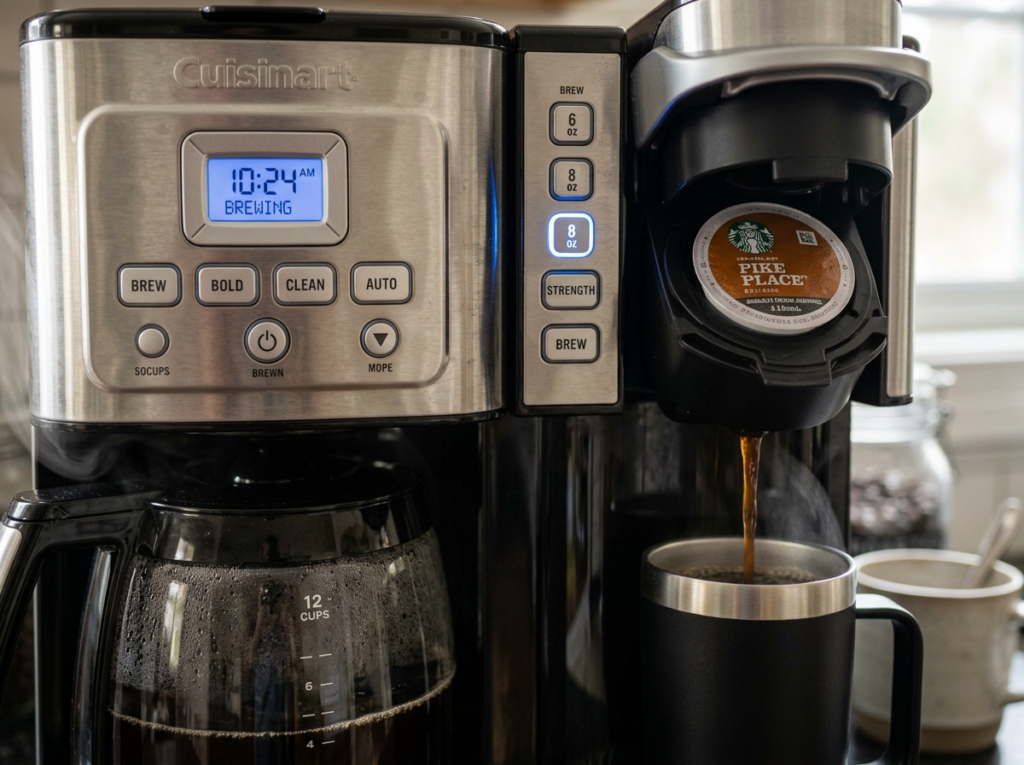
Your household runs on two different coffee rhythms. One person wants a quick single cup before rushing out the door. The other prefers a full carafe that stays warm through the lazy weekend morning. Buying two separate machines? That eats up counter space, doubles your cleaning duties, and honestly feels wasteful.
That’s exactly the problem dual coffee makers solve. These combination coffee makers pack a single-serve brewer and a full carafe side into one machine. You get flexibility without the clutter. But here’s the catch — not all 2-way brewers are built equally. Some nail the single-serve side but brew a weak pot. Others make a great carafe but take forever on the single cup.
I’ve spent weeks going through dual coffee maker reviews, comparing brew quality, build materials, ease of cleaning, and real user feedback. This guide breaks down what actually matters, which models stand out, and how to pick the best dual coffee maker for your specific situation.
Why a Dual Coffee Maker Makes Sense for Most Households
Think about your typical morning. Maybe you’re the only coffee drinker on weekdays, so a single cup is all you need. But when guests come over on Saturday, you need a full pot ready. A dual coffee maker handles both scenarios from one spot on your counter.
The appeal goes beyond convenience. You save money compared to buying a dedicated single-serve machine and a separate drip brewer. You save counter space — and if you’ve ever lived in an apartment kitchen, you know every inch counts. You also simplify your routine because there’s only one machine to maintain, one water reservoir to fill, and one set of instructions to remember.
Combination coffee makers have improved significantly over the past few years. Earlier models often felt like a compromise, where neither side worked particularly well. The latest generation, though, gives you genuinely good coffee from both the single-serve and carafe sides. Brands like Hamilton Beach, Cuisinart, and Keurig have put real engineering effort into getting this balance right.
Pro Tip: If you’re already dealing with issues on your current brewer, check out our Cuisinart coffee maker troubleshooting guide or our Keurig troubleshooting tips before deciding whether to upgrade.
What to Look for Before Buying a Dual Coffee Maker
Before jumping into specific models, let’s talk about the features that actually separate a great 2-way brewer from a mediocre one. Because specs on a product page don’t always tell the full story.
Brew Quality on Both Sides
This is the number one thing people overlook. Many combination coffee makers do the carafe side well but produce a lukewarm, underwhelming single cup — or vice versa. You want a machine that brews at the right temperature (between 195°F and 205°F, which is the sweet spot recommended by the Specialty Coffee Association) on both sides.
Read user reviews specifically mentioning brew temperature and flavor. If multiple people say the single-serve side tastes watery, believe them.
Water Reservoir Design
Some dual coffee makers use a shared water reservoir for both sides. Others have separate reservoirs. A shared reservoir is simpler, but it means you might run out of water mid-pot if you’ve been making single cups all morning. Separate reservoirs give you more control, though they take up slightly more space.
K-Cup Compatibility vs. Ground Coffee
This is a big decision point. Some 2-way brewers only work with K-Cups on the single-serve side. Others include a reusable filter basket that lets you use your own ground coffee for both single cups and full pots. If you care about coffee quality and variety — or you just don’t want to keep buying pods — look for a model with a ground coffee option on both sides.
Carafe Type: Glass vs. Thermal
Glass carafes sit on a hot plate to stay warm. They’re cheaper, but the coffee develops that burnt taste after sitting too long. Thermal carafes keep coffee hot without a heating element, and the flavor stays cleaner for a couple of hours. Thermal carafes cost more upfront, but your coffee tastes better by the second cup.
Build Quality and Durability
This one’s easy to check. Does the machine feel solid, or does it flex when you press buttons? Are the buttons responsive? Does the drip tray feel flimsy? Dual coffee makers have more moving parts than a standard drip brewer, so durability matters more here. Stainless steel housing tends to outlast plastic, though it adds to the price.
Best Dual Coffee Makers for 2025 — Honest Picks
I’ve narrowed this down to models that consistently perform well across dual coffee maker reviews, offer genuine value, and don’t just look good on paper. Each one fits a different need.
Hamilton Beach FlexBrew Duo — Best Overall Value
Hamilton Beach practically invented the mainstream dual coffee maker category, and the FlexBrew Duo remains one of the most popular combination coffee makers you can buy. The single-serve side accepts both K-Cup pods and ground coffee through a single-serve brew basket. The carafe side handles up to 12 cups.
What makes it stand out is the price-to-performance ratio. You’re getting a genuinely capable 2-way brewer for roughly $90 to $100. The brew strength selector lets you customize both sides — regular or bold — and the programming feature means your carafe can be ready before you even walk into the kitchen.
There are some trade-offs. The glass carafe relies on a hot plate, so the coffee won’t taste as fresh after 30 to 40 minutes. And the plastic housing, while functional, doesn’t feel as premium as pricier models. But for most households, this machine hits the sweet spot between capability and affordability.
Did You Know? The difference between a “regular” and “bold” setting on most brewers isn’t about adding more coffee — it’s about slowing the water flow so it has more contact time with the grounds, extracting deeper flavors.
Cuisinart SS-15 Coffee Center — Best for Coffee Snobs
Cuisinart’s Coffee Center takes the dual coffee maker concept and pushes it upmarket. The single-serve side is K-Cup compatible and works with a reusable capsule for ground coffee. The 12-cup carafe side has Cuisinart’s Brew Strength Control and comes with a charcoal water filter, which makes a noticeable difference if your tap water isn’t great.
The build quality here is a step above most competitors. The stainless steel accents feel solid, and the control panel is intuitive without being overcomplicated. Brew temperature runs hotter and more consistent than budget models, which translates to better-tasting coffee on both sides.
At around $160 to $200, it’s a meaningful investment. But if you drink coffee every single day — and you care about how it tastes — you’ll appreciate the difference. If you’re the type who knows the difference between a caffè misto and a latte, this machine speaks your language.
Keurig K-Duo Plus — Best for K-Cup Loyalists
If your household already buys K-Cups regularly, the Keurig K-Duo Plus feels like a natural fit. The single-serve side brews K-Cups the way you’d expect from Keurig — quick, consistent, and in three size options (6, 8, or 10 oz). The carafe side brews 6 to 12 cups and comes with a thermal carafe instead of glass.
That thermal carafe is a real upgrade. Coffee stays hot for over an hour without the burnt taste you get from a hot plate. The 60-ounce removable water reservoir is large enough that you won’t need to refill it constantly, even in a busy household.
One limitation: the carafe side only uses ground coffee. You can’t use K-Cups to fill a full pot. For most people, that’s not an issue, but it’s worth knowing. Also, Keurig’s single-serve side doesn’t accept ground coffee unless you buy a separate reusable K-Cup filter.
The K-Duo Plus runs between $170 and $190. It’s priced similar to the Cuisinart, but the thermal carafe and Keurig’s pod ecosystem give it a different appeal.
Ninja DualBrew Pro — Best for Customization
Ninja has earned a strong reputation in kitchen appliances, and the DualBrew Pro shows why. This is one of the most flexible combination coffee makers available. The single-serve side works with both pods and ground coffee. The carafe side brews up to 12 cups. But what sets it apart is the specialty brew options.
You get settings like Classic, Rich, Over Ice, and Specialty (a concentrated brew designed for making lattes and cappuccinos at home). The “Over Ice” setting is genuinely useful — it brews a stronger, hotter concentrate that won’t taste diluted when it hits the ice. If you’re someone who switches between hot coffee and iced drinks depending on the season, this feature alone might justify the purchase.
The fold-away frother is a nice bonus, though it’s not as powerful as a dedicated milk steamer. Pricing sits around $150 to $180, which puts it in the same ballpark as the Cuisinart and Keurig models but with more versatility.
Hamilton Beach FlexBrew Single-Serve — Best Budget Pick
Not everyone needs a full 12-cup carafe. If you’re a one-or-two-cup household, the FlexBrew Single-Serve gives you dual brewing (K-Cup and ground coffee) without the carafe side. It’s compact, simple, and costs between $50 and $70.
You lose the “pot of coffee” option, but you gain counter space and simplicity. The brew basket handles ground coffee with a reusable filter, which means you’re not locked into buying pods. It brews up to 10 ounces at a time — enough for a standard mug.
This is a great starter option if you’re not sure whether a full dual coffee maker is right for you.
Single Serve vs. Carafe: When Do You Actually Need Both?
Here’s an honest question worth asking: do you really need both sides? Because a dual coffee maker only makes sense if you’ll genuinely use both functions regularly.
You should get a dual coffee maker if:
Your household has mixed coffee habits. Maybe you drink one cup in the morning, but your partner drinks three. Or you brew single cups on weekdays but make a full pot when friends visit. Combination coffee makers eliminate the need for two separate machines.
You might not need one if:
You live alone and only ever drink one or two cups. A dedicated single-serve machine or a simple pour-over setup would serve you better, take up less space, and cost less.
Also consider your caffeine intake in the bigger picture. If you’re someone who supplements coffee with energy drinks throughout the day, you might want to be mindful of total consumption. The caffeine in a tablespoon of coffee adds up faster than most people realize, especially when you’re brewing full pots.
How to Get the Best Coffee From Your 2-Way Brewer
Owning a good dual coffee maker is only half the equation. How you use it determines whether you get great coffee or just okay coffee. These tips apply regardless of which model you own.
Use the Right Grind Size
For the carafe (drip) side, a medium grind works best — about the texture of sea salt. Too fine, and you’ll get bitter, over-extracted coffee. Too coarse, and it’ll taste weak. For the single-serve side using ground coffee, a medium-fine grind gives slightly better results because the water has less contact time with the grounds.
Don’t Ignore Water Quality
Your coffee is over 98% water. If your tap water tastes off, your coffee will too. Use filtered water, or look for a machine with a built-in charcoal filter like the Cuisinart SS-15. This single change makes a bigger difference than upgrading your beans.
Clean It Regularly
Mineral buildup (scale) inside the water lines reduces brew temperature and flow rate over time. Descale your machine every two to three months — more often if you have hard water. Most manufacturers recommend a vinegar-and-water solution, though some models have a specific descaling mode. If you own a different type of brewer too, we’ve got a separate guide on how to descale a Breville espresso machine that covers the general process well.
Measure Your Coffee Properly
Eyeballing coffee grounds is the fastest way to inconsistent brews. The standard ratio is about 2 tablespoons of ground coffee per 6 ounces of water. Our coffee scoop size guide breaks this down if you want exact measurements.
Common Frustrations With Dual Coffee Makers (And How to Handle Them)
No machine is perfect. Dual coffee makers have a few recurring issues that show up across brands. Knowing about them upfront helps you make a better buying decision — and troubleshoot faster if something feels off.
“The single-serve side brews too slowly”
This usually points to mineral buildup restricting water flow. A descaling cycle almost always fixes it. If it doesn’t, check that the needle (on K-Cup models) isn’t clogged with old coffee grounds. A paperclip gently inserted into the needle opening clears the blockage.
“My carafe coffee tastes burnt after 20 minutes”
That’s the hot plate doing its job — poorly. Glass carafe models keep the plate on continuously, which scorches the coffee. Your options: pour what you need into a thermal mug, switch the hot plate off manually, or invest in a model with a thermal carafe.
“Both sides won’t brew at the same time”
Most dual coffee makers share a heating element between the single-serve and carafe sides. That means you can only use one side at a time. This isn’t a defect — it’s a design limitation. Plan your morning accordingly. Brew the single cup first (it takes about two minutes), then start the full pot.
“The machine drips water after brewing”
Some dripping after the brew cycle ends is normal, especially on the single-serve side. If it’s excessive, make sure the brew basket or pod holder is seated properly. A misaligned component causes water to bypass the usual path.
Dual Coffee Maker vs. Separate Machines: The Real Cost Breakdown
People assume a dual coffee maker saves money, and in most cases it does. But let’s put actual numbers on it.
A decent standalone single-serve machine (like a Keurig K-Mini) costs around $70 to $90. A decent 12-cup drip brewer costs another $50 to $80. That’s $120 to $170 total for two machines, plus double the counter space.
A good dual coffee maker ranges from $90 to $200, does both jobs, and takes up roughly the footprint of one standard drip brewer. Even at the high end, you’re paying roughly the same as two separate machines while getting your counter space back.
The only scenario where separate machines win is if you want specialty quality on both sides — say, a Nespresso for espresso-style drinks and a high-end drip brewer for pour-over quality. If that’s your situation, you might want to compare Nespresso Vertuo vs. Original systems and pair one with a standalone drip machine.
How Caffeine Content Changes Based on How You Brew
Something most people don’t think about: the brewing method affects how much caffeine ends up in your cup. A single-serve K-Cup typically contains 75 to 100 mg of caffeine per 8-ounce cup. A standard drip-brewed cup from the carafe side usually delivers 95 to 165 mg for the same 8 ounces.
Why the difference? Drip brewing uses hotter water with a longer contact time, which extracts more caffeine from the grounds. K-Cups use a pre-measured, often slightly smaller dose of coffee.
This matters if you’re watching your caffeine intake or if you’re sensitive to it. If you want to compare how coffee stacks up against other drinks, check our breakdown of caffeine in Pepsi or the caffeine content in a Starbucks Pink Drink. It puts things in perspective.
FAQ
Can a dual coffee maker brew both sides at the same time?
Most dual coffee makers can’t brew both sides simultaneously because they share a single heating element and water pump. You’ll need to brew one side, wait for it to finish, and then use the other. A single cup typically takes about 2 to 3 minutes, so the wait isn’t long.
Are dual coffee makers harder to clean than regular coffee makers?
They do require a bit more attention because you have two brewing mechanisms to maintain. The carafe side needs regular cleaning of the filter basket and carafe itself. The single-serve side needs periodic needle cleaning and descaling. But the process isn’t complicated — it just takes an extra few minutes compared to a single-function machine.
Do dual coffee makers work with reusable K-Cup pods?
Most K-Cup-compatible dual coffee makers do accept reusable pods. Models like the Hamilton Beach FlexBrew and Ninja DualBrew go a step further by including a ground coffee basket, so you don’t need pods at all on the single-serve side. Always check the specific model’s compatibility before buying a reusable pod, though, because sizing can vary slightly.
How long do dual coffee makers typically last?
With proper care — regular descaling, keeping it clean, using filtered water — a good dual coffee maker should last 3 to 5 years. Premium models from Cuisinart and Ninja tend to last on the longer end of that range. Budget models sometimes develop issues with the heating element or pump after 2 to 3 years of heavy daily use.
Is coffee from a dual coffee maker as good as from a dedicated machine?
The best combination coffee makers in 2025 produce coffee that’s genuinely comparable to dedicated single-serve and drip machines in the same price range. You’re not sacrificing quality anymore — at least not with the top-tier models. Where you might notice a difference is at the extreme high end, where dedicated machines costing $300+ offer features a dual brewer can’t match.
Your Next Move
Picking the best dual coffee maker really comes down to your daily habits. If value matters most, the Hamilton Beach FlexBrew Duo gives you everything you need without overspending. If brew quality is your priority, the Cuisinart SS-15 punches above its weight. And if you want maximum flexibility with specialty drink options, the Ninja DualBrew Pro earns its spot on your counter.
Whatever you choose, remember that the machine is only as good as what you put into it. Fresh beans, the right grind size, clean water, and regular maintenance will always matter more than which brand name is on the front. Treat your dual coffee maker right, and it’ll reward you with great coffee — one cup or a full pot — every single morning.