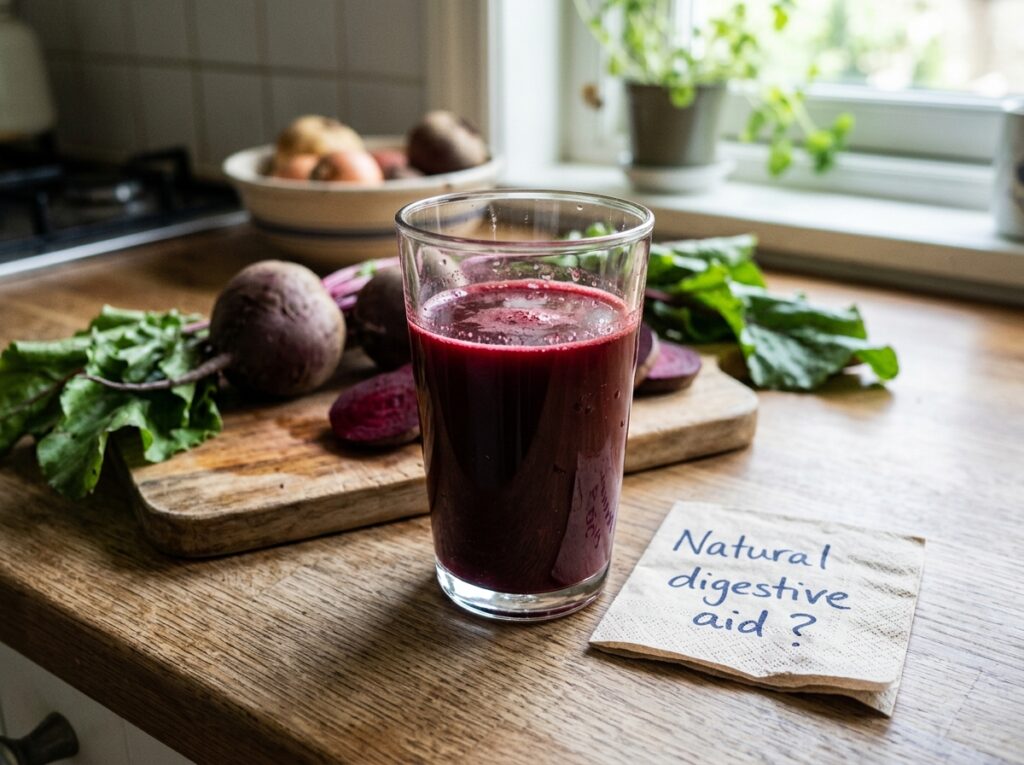
You just drank a tall glass of beet juice, and now your stomach’s doing things. Maybe you’re sitting on the toilet wondering, “Wait… did that beet juice just make me poop?” Or maybe you haven’t tried it yet, but someone told you it works like a natural laxative. Either way, you’re not imagining things.
Beet juice does affect your digestion — and yes, it can make you poop. But the “why” behind it is more interesting than a simple yes or no. Your body responds to beets in ways that go beyond just fiber content, and understanding those reasons can help you use beet juice smartly — whether you’re dealing with constipation or just curious about what’s happening inside your gut.
Let’s break it all down.
Why Does Beet Juice Make You Poop?
The short answer? Beets contain a combination of fiber, natural sugars, and specific compounds that stimulate your digestive system. But let’s get into the details, because each of these plays a slightly different role.
Fiber content is the most obvious reason. A single cup of raw beets has about 3.8 grams of dietary fiber. That might not sound like a lot, but when you’re juicing beets — and especially if you’re drinking a large glass — you’re consuming a concentrated dose of nutrients that your gut has to process quickly. Some juicers retain more pulp than others, and that pulp carries insoluble fiber, which adds bulk to your stool and helps push things along.
Then there’s betaine. This naturally occurring compound in beets supports stomach acid production. Why does that matter? Because adequate stomach acid helps your body break down food more efficiently. When digestion works well at the top (your stomach), things move smoothly at the bottom too.
Beets also contain natural sugars, particularly a type called raffinose. Your small intestine doesn’t fully digest raffinose — instead, it travels to your large intestine where gut bacteria ferment it. That fermentation process can produce gas and stimulate bowel movements. If you’ve ever felt bloated or gassy after drinking beet juice, this is likely why.
And there’s one more factor people don’t talk about enough: nitrates. Beets are one of the richest dietary sources of nitrates, which your body converts into nitric oxide. Nitric oxide relaxes smooth muscle tissue — including the muscles in your intestinal walls. Relaxed intestinal muscles can mean easier and faster passage of stool.
So it’s not just one thing. It’s a combination of fiber, betaine, natural sugars, and nitrates all working together. That’s why the beet juice laxative effect feels so noticeable for many people.
Beets and Digestion: The Full Picture
Your digestive system is basically a long assembly line. Food goes in, nutrients get absorbed, and waste comes out. Beets interact with almost every stage of that process.
Starting with your stomach, the betaine in beet juice helps maintain healthy acid levels. Low stomach acid is a surprisingly common issue, especially as people age. It leads to sluggish digestion, bloating, and — you guessed it — constipation. By supporting acid production, beets help your stomach do its job properly.
Moving to your small intestine, the nutrients in beet juice get absorbed quickly because they’re in liquid form. Your body doesn’t have to work as hard to break down juice compared to whole food, so the sugars, vitamins, and minerals hit your bloodstream fast. But some of those sugars (like raffinose) pass through undigested, which means they become food for bacteria further down the line.
In your large intestine, that’s where the real action happens. Gut bacteria feed on the undigested sugars and fiber remnants from beet juice. This fermentation creates short-chain fatty acids that nourish your colon lining and stimulate peristalsis — the wave-like muscle contractions that move stool toward the exit.
Here’s something interesting: a 2021 study published in the British Journal of Nutrition found that dietary nitrate from beetroot juice could positively influence gut microbiome composition. Participants who consumed beetroot juice for two weeks showed an increase in beneficial bacteria like Prevotella and a reduction in bacteria associated with poor gut health. A healthier microbiome generally means better, more regular digestion.
So beets don’t just make you poop in the moment. If you drink beet juice regularly, it might actually improve your overall digestive health over time. That’s a pretty solid deal for something that costs a few dollars at the grocery store.
Beet Juice Benefits for Constipation
If you’re someone who struggles with constipation — and roughly 16% of adults worldwide do, according to a 2020 meta-analysis in the American Journal of Gastroenterology — beet juice might be worth adding to your routine.
Why? Because constipation usually boils down to a few key issues: not enough fiber, not enough water, poor gut motility, or a combination of all three. Beet juice addresses most of these at once.
The fiber angle is straightforward. Even though juicing removes some fiber compared to eating whole beets, beet juice still retains a decent amount — especially if you use a blender rather than a centrifugal juicer. Blending keeps the pulp intact, giving you both soluble and insoluble fiber. Soluble fiber absorbs water and softens stool, while insoluble fiber adds bulk and speed.
The hydration angle matters too. Beet juice is mostly water. When you drink an 8-ounce glass, you’re adding hydration to your system alongside the fiber. Dehydration is one of the most overlooked causes of constipation. Your colon absorbs water from stool — so if you’re not drinking enough fluids, your stool becomes hard and difficult to pass. Beet juice gives you fluid plus gut-stimulating compounds in one shot.
The motility angle ties back to those nitrates we talked about. Nitric oxide relaxes smooth muscle throughout your body, and that includes the muscles lining your intestinal tract. Relaxed intestinal muscles can contract more rhythmically, which promotes healthier peristalsis. Think of it like this: a tense, tight muscle doesn’t move well. A relaxed one flows naturally.
There’s also a psychological benefit that people underestimate. When you’re constipated, you often feel sluggish, bloated, and uncomfortable. Drinking something healthy and nutrient-dense like beet juice can shift your mindset toward making other gut-friendly choices throughout the day — drinking more water, eating more vegetables, moving your body. Small habits compound.
One thing to note: beet juice isn’t a replacement for medical treatment if you have chronic constipation. If you’ve been constipated for weeks and nothing is helping, talk to a doctor. But for occasional sluggishness? A glass of beet juice can genuinely help get things moving.
How Much Beet Juice to Drink for Digestive Benefits
This is the question everyone asks — and the answer depends on your body, your goals, and your tolerance.
For most healthy adults, 4 to 8 ounces (about 120 to 240 ml) per day is a reasonable starting point. That’s roughly half a glass to one full glass. If you’ve never had beet juice before, start with the lower end. Your digestive system needs time to adjust to the concentrated sugars, fiber, and nitrates.
Drinking too much too quickly can backfire. People who chug 16 ounces of beet juice on an empty stomach sometimes end up with cramping, loose stools, or diarrhea — not because beet juice is harmful, but because their gut wasn’t ready for that much stimulation at once.
Timing matters too. Many people find that drinking beet juice in the morning, about 30 minutes before breakfast, produces the strongest digestive response. Your gut is most active during the morning hours (there’s actually a biological reason for this — your colon’s motility peaks after you wake up and after meals, thanks to something called the gastrocolic reflex). Pairing beet juice with your body’s natural rhythm can amplify the effect.
If you’re specifically trying to relieve constipation, here’s a practical approach that works for many people:
Start with 4 ounces of beet juice mixed with an equal amount of water or another juice (apple or carrot works well). Drink it on an empty stomach in the morning. Give your body 2 to 3 days at this amount. If you tolerate it well and want a stronger effect, increase to 6 or 8 ounces. Stay consistent for at least a week before judging whether it’s making a difference.
A quick warning: beet juice is relatively high in natural sugars — about 13 grams per cup. If you’re watching your sugar intake or managing diabetes, factor this into your daily totals. You might also want to dilute your beet juice with water or pair it with something that has protein or healthy fat to slow the sugar absorption. If you’re interested in low-calorie drink alternatives for daily sipping, there are plenty of options that won’t spike your sugar levels.
What About the Color? (Yes, Let’s Talk About It)
If nobody warned you about this, here’s your heads-up: beet juice can turn your poop red or dark pink. It can also turn your urine reddish. This is completely normal, and it’s caused by pigments called betalains — the same compounds that give beets their deep crimson color.
About 10 to 14% of the general population experiences this more noticeably. It’s called beeturia (for urine) and it happens because your body doesn’t always fully break down betalains during digestion. The pigment passes through and shows up in your waste.
Here’s the important part: if you’ve recently eaten or drunk beets, red-colored stool is almost certainly just the betalains. But if you haven’t consumed beets or any red-colored food, red stool can indicate blood — and that’s something you should bring up with a doctor.
The color change usually happens within 12 to 24 hours after drinking beet juice, and it fades within a day or two after you stop consuming beets. It’s harmless, but it catches a lot of first-timers off guard. Now you know.
Who Should Be Careful With Beet Juice?
Beet juice is safe for most people, but a few groups should be cautious.
People with kidney stones — particularly calcium oxalate stones — should limit beet juice intake. Beets are high in oxalates, which can contribute to stone formation in susceptible individuals. If you have a history of kidney stones, check with your doctor before making beet juice a daily habit.
People on blood pressure medication should also be aware. Beet juice can lower blood pressure thanks to its nitrate content. That’s actually one of its well-researched health benefits — a 2013 study in Hypertension (an American Heart Association journal) showed that drinking about 250 ml of beetroot juice daily reduced blood pressure by approximately 8/4 mmHg. But if you’re already taking medication for blood pressure, adding beet juice on top could potentially drop your pressure too low. Coordination with your healthcare provider is smart here.
People with irritable bowel syndrome (IBS) may find that beet juice triggers symptoms. Beets contain FODMAPs (fermentable oligosaccharides, disaccharides, monosaccharides, and polyols), which can cause gas, bloating, and diarrhea in sensitive individuals. If you have IBS, start with a very small amount and see how your body reacts.
Pregnant women can generally enjoy beet juice in moderate amounts, but the same rules apply — don’t overdo it, and mention it to your OB if you’re making it a regular thing.
Quick disclaimer: this article is for informational purposes only. It’s not medical advice. If you have ongoing digestive issues or any health condition, please talk to a qualified healthcare professional.
Fresh Juice vs. Store-Bought: Does It Matter?
It does, actually. Not hugely — but there are differences worth knowing.
Freshly made beet juice retains more fiber (especially if you blend rather than juice), more active enzymes, and higher levels of heat-sensitive nutrients like vitamin C. You also control exactly what goes into it — no added sugars, preservatives, or fillers. The digestive impact tends to be stronger with fresh juice because those enzymes and fibers are intact.
Store-bought beet juice (like brands such as Beet It or Lakewood Organic) is still effective, especially for the nitrate and betalain content. These are shelf-stable compounds that don’t degrade much during pasteurization. But most commercial juices are pasteurized, which means some enzymes and vitamin C are reduced. The fiber content is also typically lower since commercial juicing processes strain out most of the pulp.
If convenience is your priority, store-bought works fine. If you want the maximum digestive benefit — particularly the beet juice laxative effect — homemade is the way to go. A simple recipe: blend one medium raw beet (peeled and chopped) with half an apple, a small piece of ginger, and a cup of water. Strain if you prefer smooth juice, or drink it as-is for maximum fiber.
Speaking of blending, if you’re shopping for a good blender for juice-making, the difference between models can be significant. A comparison like Nutribullet vs. Ninja can help you figure out which one handles root vegetables like beets more efficiently.
Other Drinks That Affect Your Digestion
Beet juice isn’t the only beverage that can move things along in your gut. Coffee is probably the most well-known example — caffeine stimulates colonic motor activity, and many people find that their morning cup sends them straight to the bathroom. In fact, research shows that coffee can stimulate the colon within just four minutes of consumption.
If you’re curious about caffeine content across different drinks, you might find it useful to check out how much caffeine is in a tablespoon of coffee or how cappuccino compares to regular coffee in terms of caffeine strength.
Certain teas — peppermint, ginger, and senna — also have digestive effects. Prune juice is another classic choice for constipation relief. And warm water with lemon, while not as scientifically supported, is a popular morning ritual that many swear by.
But beet juice stands out because it offers digestive benefits alongside impressive nutritional value. You’re getting folate, manganese, potassium, iron, vitamin C, and those powerful antioxidant betalains. Most other digestive-friendly drinks don’t pack that kind of nutritional punch.
If you’re someone who enjoys mixing up what you drink throughout the day, you might also appreciate knowing which popular beverages are caffeine-free, especially if you’re trying to calm your nervous system and let your gut work without extra stimulation.
How to Make Beet Juice Easier on Your Stomach
Some people find straight beet juice a bit intense — especially on an empty stomach. If that’s you, here are some practical ways to get the benefits without the discomfort.
Dilute it. Mix your beet juice with water in a 1:1 ratio. This reduces the concentration of sugars and compounds that can overwhelm your gut. You still get the benefits, just at a gentler pace.
Pair it with other ingredients. Carrot, apple, and ginger are classic partners for beet juice. Carrot and apple add natural sweetness that balances beet’s earthy flavor, while ginger is a well-documented digestive aid on its own. Ginger contains gingerols and shogaols, which speed up gastric emptying and reduce nausea.
Don’t drink it ice cold. Cold beverages can temporarily slow digestion by constricting blood vessels in your stomach lining. Room temperature or slightly cool beet juice is easier for your gut to process.
Eat something small first. If beet juice on an empty stomach gives you cramps, try eating a handful of nuts or a piece of toast 15 minutes before. Having some food in your stomach creates a buffer.
Build up gradually. Your gut microbiome needs time to adjust to new foods. If you jump from zero beet juice to a full glass daily, your bacteria won’t be prepared for the influx of fermentable sugars. Start small — even 2 ounces — and increase over a week or two.
The Bigger Picture: Beet Juice as Part of a Healthy Gut Routine
Drinking beet juice occasionally for constipation relief is perfectly fine. But the real magic happens when you make it part of a broader gut-health strategy.
Your digestive system thrives on diversity. The more varied your diet — especially in terms of plant foods — the more diverse your microbiome becomes. And a diverse microbiome is strongly linked to better digestion, stronger immunity, and even improved mood (thanks to the gut-brain axis).
Beet juice can be one piece of that puzzle. Combine it with other fiber-rich foods like oats, beans, leafy greens, and whole grains. Stay hydrated throughout the day. Move your body regularly — even a 20-minute walk after meals can stimulate digestion significantly.
And pay attention to what your body tells you. If beet juice makes you feel great and keeps you regular, that’s your body saying it works for you. If it causes bloating or discomfort even after gradual introduction, it might not be the best fit — and that’s okay. Everyone’s microbiome is different.
If your morning routine involves both beet juice and coffee, you might want to space them out. Having both on an empty stomach can be a lot for some digestive systems. Try beet juice first thing, then coffee with or after breakfast. That way you’re working with your body’s natural rhythms rather than overwhelming it.
For those who are exploring different beverages and their effects on the body, understanding what certain drinks contain — and don’t contain — can help you make smarter choices for your overall health.
FAQ
Does beet juice work as a laxative?
Beet juice has a mild laxative effect for most people. It contains fiber, natural sugars (like raffinose), betaine, and dietary nitrates — all of which stimulate digestion and promote bowel movements. It’s gentler than over-the-counter laxatives and works best when consumed regularly. If you have severe constipation, beet juice alone may not be enough, and you should consult a healthcare provider.
How quickly does beet juice make you poop?
Most people notice a bowel movement within 12 to 24 hours after drinking beet juice, though some experience effects within a few hours — especially if consumed on an empty stomach. The speed depends on your individual digestive system, how much you drink, and what else you’ve eaten that day.
Can beet juice cause diarrhea?
Yes, drinking too much beet juice — especially if your body isn’t used to it — can cause loose stools or diarrhea. This typically happens because of the concentrated sugars and fiber overwhelming your digestive system. Starting with a small amount (4 ounces) and gradually increasing can prevent this.
Is it normal for poop to be red after drinking beet juice?
Absolutely. Betalains, the pigments that give beets their deep red color, can pass through your digestive system and tint your stool red or dark pink. This is harmless and usually resolves within 24 to 48 hours. If you see red stool without having consumed beets or red-colored foods, consult a doctor to rule out other causes.
Can I drink beet juice every day?
For most healthy adults, drinking 4 to 8 ounces of beet juice daily is safe and can support digestive health, blood pressure management, and athletic performance. People with kidney stone history, those on blood pressure medication, or individuals with IBS should consult their doctor before making it a daily habit.
Your Move
Beet juice does make you poop — and it does so through a pretty elegant combination of fiber, natural sugars, betaine, and nitrates that work together to stimulate your digestive system from top to bottom. It’s not a magic fix for chronic constipation, but for everyday digestive support? It’s one of the most nutrient-dense, affordable, and accessible options out there.
Start with a small glass. Give your body a few days to adjust. Pay attention to how you feel — not just your bowel movements, but your energy, your bloating levels, your overall gut comfort. And if that first trip to the bathroom after beet juice surprises you with some color? Now you know exactly why.
Your gut is smarter than you think. Give it the right fuel, and it’ll do its job beautifully.