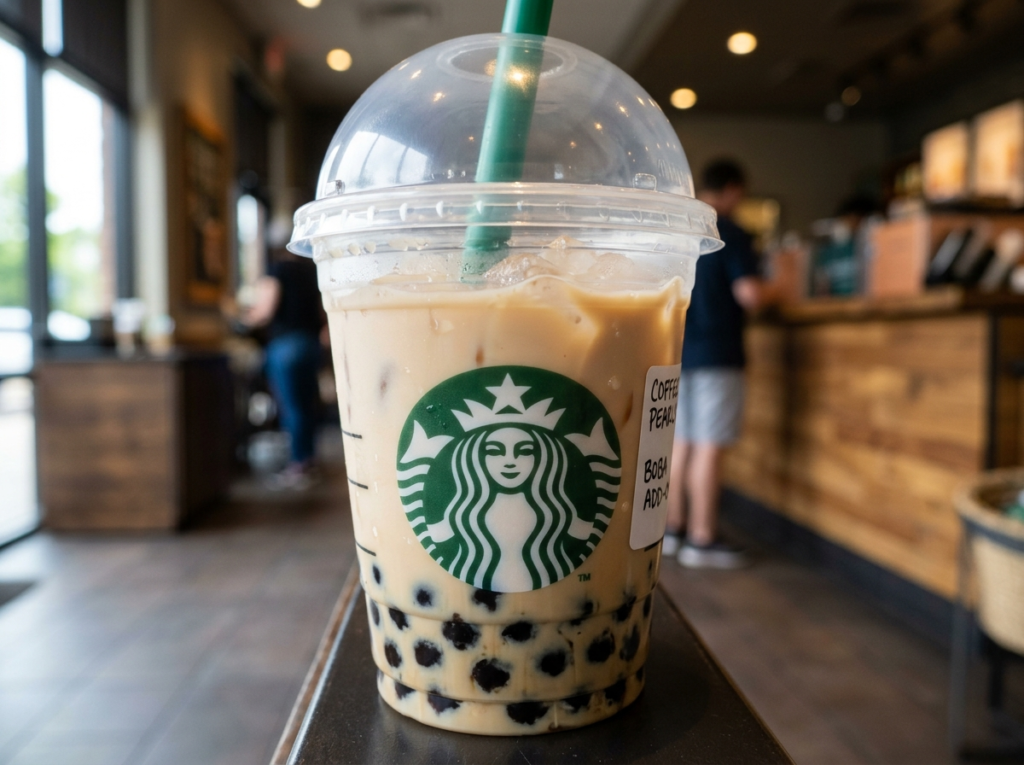
Boba tea shops are popping up on practically every corner these days, and global demand for bubble tea hit roughly $4.08 billion in 2023, with projections pushing well past $5 billion by 2027. So it’s only natural to wonder — can you just walk into the nearest Starbucks and order a cup of boba tea?
The short answer: No, Starbucks doesn’t officially sell boba tea. But that’s not the whole story. There are some creative workarounds, a few boba-inspired Starbucks drinks that come close, and — if you’re really craving those chewy tapioca pearls — you can always make boba at home with surprisingly little effort.
Let’s break all of it down so you know exactly what to expect the next time you’re standing in that Starbucks line.
Why Doesn’t Starbucks Sell Boba?
This question comes up a lot, and honestly, it makes sense. Starbucks already sells iced teas, fruit-flavored drinks, and creamy blended options — adding boba pearls doesn’t seem like a huge stretch, right?
But there are a few solid reasons why Starbucks hasn’t gone there.
Equipment and logistics are a big factor. Traditional boba pearls need to be cooked fresh, kept at the right temperature, and used within a few hours before they harden. Starbucks stores already run a tight operation with espresso machines, blenders, cold brew systems, and all the other gear behind the counter. Adding boba prep stations to over 38,000 locations worldwide isn’t just an “add it to the menu” kind of decision — it’s a massive operational overhaul.
There’s also the brand identity piece. Starbucks has built its reputation around coffee, espresso drinks, and tea-based beverages. Boba is strongly associated with Asian tea culture and dedicated bubble tea chains like Kung Fu Tea, Tiger Sugar, and Gong Cha. Starbucks tends to stay in its lane, at least on the core menu.
And then there’s the supply chain reality. Tapioca pearls come primarily from cassava root, and maintaining consistent quality and freshness across thousands of stores in 80+ countries is no small task. It’s not impossible, but the cost-to-benefit ratio probably hasn’t made sense for Starbucks — at least not yet.
Quick Fact: Starbucks did test “coffee popping pearls” (similar to boba but coffee-flavored) in a few markets around 2021–2022, mainly in Asia. These weren’t traditional tapioca boba — they were more like juice-filled popping balls. The test had mixed results and hasn’t rolled out globally.
What About Starbucks Bubble Tea Options — Do Any Exist?
Here’s where things get interesting. While you won’t find a “Boba Tea” button on the Starbucks menu board, there are a couple of things worth knowing.
Popping Pearls in Select Markets
Some Starbucks locations in Southeast Asia (particularly in countries like Vietnam, Thailand, and the Philippines) have offered drinks with coffee pearls or popping boba as limited-time add-ons. These aren’t the chewy tapioca balls you’d get at a traditional boba shop — they’re smaller, burst in your mouth, and are usually coffee or fruit-flavored.
If you’re traveling through Asia, it’s worth asking your local Starbucks if they carry any boba-like add-ons. But if you’re in the U.S., Canada, UK, or Australia? Don’t count on it.
The Secret Menu Angle
You’ve probably seen TikTok videos or Instagram posts showing “Starbucks boba drinks.” Most of these fall into the Starbucks secret menu category — meaning they’re custom orders that customers have created, not official Starbucks offerings.
These drinks typically try to mimic the flavor profile of popular boba teas (think taro, matcha, brown sugar) using ingredients Starbucks already has. But they won’t include actual boba pearls. You’re getting the taste, not the texture.
Pro Tip: If you want to try a “boba-style” drink at Starbucks, be specific with your order. Baristas won’t know what you mean if you just say “give me the boba drink from TikTok.” Have the exact recipe ready — customizations, syrups, milk choices, everything.
Starbucks Drinks That Feel Like Boba Tea
Okay, so you can’t get real boba at Starbucks. But you can order drinks that scratch that same itch — creamy, sweet, tea-based, and refreshing. Here are some solid options.
Iced Chai Tea Latte
If you love classic milk tea boba, this is your closest Starbucks match. The chai spices give it warmth, the milk makes it creamy, and over ice it hits that same refreshing note. Ask for vanilla syrup if you want it sweeter, or swap to oat milk for a richer texture.
Starbucks Refreshers
The Starbucks Refreshers line — Strawberry Açaí, Mango Dragonfruit, and the fan-favorite Pink Drink — gives you that fruity, light vibe you’d get from a fruit-based boba tea. They’re colorful, not too heavy, and have just enough caffeine to perk you up. No tapioca pearls, obviously, but the flavor world is similar.
Matcha Crème Frappuccino
Matcha boba is one of the most popular orders at any bubble tea shop. Starbucks’ Matcha Crème Frappuccino won’t have the pearls, but it nails the creamy matcha flavor. You can customize it with coconut milk and a pump of vanilla to get closer to that authentic boba shop taste.
Iced Passion Tango Tea with Lemonade
This one’s for people who love fruit tea boba — the tart, herbal flavor of the Passion Tango blend mixed with lemonade creates something genuinely refreshing. It’s caffeine-free too, which might matter if you’re watching your intake.
If you’re exploring other non-coffee drinks at Starbucks, you’ll find even more options that lean into the tea and fruit territory where boba traditionally lives.
How to Make Boba at Home (It’s Easier Than You Think)
Here’s the move that a lot of boba lovers eventually make: just DIY it. Making boba at home sounds intimidating, but it’s genuinely straightforward once you do it a couple of times. And the best part? You control the sweetness, the flavor, and the chewiness.
Making Tapioca Pearls from Scratch
You only need two ingredients for basic DIY boba pearls: tapioca starch and water. That’s it. If you want the classic dark color and caramel-like sweetness, add brown sugar or black sugar to the mix.
Here’s the basic process:
Bring about ½ cup of water and ¼ cup of brown sugar to a boil in a small saucepan. Once it’s bubbling, remove from heat and stir in ¾ cup of tapioca starch, a little at a time. The mixture will start forming a dough — it’ll be sticky at first, but keep kneading until it’s smooth and pliable. Roll the dough into thin ropes, then cut small pieces and roll each one into a ball between your palms. They should be roughly pea-sized.
To cook them, drop the pearls into a pot of boiling water. They’ll sink at first, then float — once they float, cook for another 15–20 minutes on medium heat. Drain them and immediately toss them in a brown sugar syrup (equal parts brown sugar and water, heated until dissolved) to keep them soft and sweet.
Warning: Homemade boba pearls don’t keep well. They start hardening within 4–6 hours. Make only what you plan to use that day.
Quick-Cook Store-Bought Boba
If making pearls from scratch feels like too much work, grab a pack of instant tapioca pearls from an Asian grocery store or order them online. Brands like WuFuYuan and Boba Direct sell them in bags — you just boil them for 5 minutes, let them soak for another 5, and they’re ready. Much faster, and the texture is honestly very close to what you get at boba shops.
For a deeper look at the different types of pearls you might encounter, check out this comparison of honey boba vs crystal boba — the texture and flavor differences between them are bigger than most people expect.
Building Your Boba Drink at Home
Once you’ve got your pearls ready, the fun part starts. You can literally build any boba drink you want.
For a classic milk tea, brew a strong cup of black tea (Assam or Ceylon works best), let it cool, add milk or creamer, sweeten to taste, pour over ice, and drop in your boba pearls. Done.
For a brown sugar boba latte, drizzle that brown sugar syrup along the inside of a glass, add ice, pour in cold milk, and top with a shot of espresso or strong coffee if you want the caffeine kick. The tiger-stripe look you see on Instagram happens naturally when the syrup streaks against the glass.
Want something fruity? Blend mango or strawberry with ice and a splash of juice, pour into a glass over your pearls, and you’ve got a fruit boba drink that rivals anything from a shop.
Did You Know? The average boba tea from a shop contains between 300–500 calories, mostly from sugar and full-fat creamer. Making boba at home lets you cut that significantly — you can use unsweetened almond milk, reduce the sugar, or skip the syrup soak entirely for a lighter version.
Why the Boba Craze Hasn’t Hit Mainstream Coffee Chains (Yet)
It’s worth asking: if boba is this popular, why hasn’t any major U.S. coffee chain added it to the permanent menu?
Part of the answer lies in how different boba preparation is from standard coffee-shop operations. Coffee chains are built around speed — you pull a shot, steam some milk, and the drink is ready in 60 seconds. Boba adds complexity. The pearls need to be prepared in batches, stored properly, and portioned out for each drink. It adds time to each order, and in a drive-through environment where every second counts, that’s a real problem.
There’s also a quality concern. Anyone who’s had stale boba knows the experience — hard, flavorless little balls that ruin the drink. Maintaining pearl quality across thousands of locations, with varying staff training levels, is risky for a brand like Starbucks that obsesses over consistency.
That said, the market pressure isn’t going away. Dedicated boba chains are expanding aggressively in the U.S., and younger consumers (Gen Z in particular) have made boba a lifestyle staple. Starbucks is smart enough to read the room.
The company’s experiments with popping pearls in Asia suggest they’re at least thinking about it. If they find a product format that works within their existing workflow — maybe a shelf-stable pearl that doesn’t need cooking, or a popping boba that ships easily — you could see something boba-adjacent on U.S. menus within the next few years.
Starbucks Boba Tea: What Other Countries Get That You Don’t
One frustrating reality for U.S.-based boba fans: Starbucks menus vary dramatically by country. What’s available in Tokyo or Bangkok might never show up in New York or London.
In Japan, Starbucks has offered drinks with tapioca-like pearls in the past, alongside unique flavors like sakura and hojicha that pair beautifully with boba-style textures. In China, where the bubble tea market is enormous (estimated at over $10 billion annually), Starbucks has experimented more aggressively with tea-forward drinks that borrow from boba culture.
Some Starbucks Reserve locations — the more upscale, experimental Starbucks stores — have occasionally featured drinks with add-ins that feel boba-inspired. If you’re near a Reserve Roastery (there are only a handful globally), it’s worth checking their rotating menu.
For most of us, though, the reality remains: your local Starbucks isn’t serving boba, and that probably won’t change overnight.
Your Best Boba Alternatives Beyond Starbucks
If you’re dead set on getting boba from a chain and Starbucks isn’t delivering, here are your other options.
Kung Fu Tea is one of the biggest boba chains in the U.S. with over 350 locations. Their classic milk tea with tapioca pearls is reliably good, and they’ve got a massive customization menu.
Tiger Sugar is the go-to if you’re after that Instagram-worthy brown sugar boba. They started in Taiwan and have expanded into major U.S. cities. The tiger-stripe presentation alone is worth the visit.
Gong Cha offers a wide range of toppings beyond just tapioca — aloe, pudding, coconut jelly, and more. They let you choose your sugar and ice level, which is something most coffee chains don’t offer.
Local boba shops are often the best option, honestly. They tend to cook their pearls in smaller batches (which means fresher texture), and many of them have creative flavor combinations you won’t find at chain stores.
If you’re curious about the caffeine content in your drinks — whether it’s a Starbucks Refresher or a boba milk tea — understanding how different beverages compare can help you make smarter choices. Take a look at how Starbucks drinks rank by caffeine to see where your favorites land, or compare that against low-calorie Starbucks drinks if you’re keeping an eye on both.
FAQ
Does Starbucks have boba or tapioca pearls on its U.S. menu?
No. As of 2025, Starbucks does not offer traditional tapioca boba pearls at any of its U.S. locations. Some stores in Asia have tested popping pearls or coffee pearls as limited-time add-ons, but these haven’t made it to the standard U.S. menu.
Can I bring my own boba to Starbucks and add it to my drink?
Technically, nobody’s going to stop you. Some boba fans do exactly this — they cook boba at home, bring it in a small container, and add it to their Starbucks drink after ordering. It’s a popular hack, though it works best with iced drinks where the pearls can settle at the bottom and you can sip them through a wide straw you bring yourself (Starbucks straws are too narrow for boba).
What’s the easiest way to make boba at home without special equipment?
All you really need is a pot, tapioca starch, water, and brown sugar. The pearls come together like a simple dough, and you boil them just like pasta. No special equipment required. If you don’t want to make pearls from scratch, instant tapioca pearls from an Asian grocery store cook in about 5 minutes and taste great.
Is Starbucks likely to add boba to its menu in the future?
There’s no official announcement, but the signs suggest Starbucks is aware of the demand. Their experiments with popping pearls in Asian markets show they’re testing the concept. Whether that translates to a global rollout depends on whether they can solve the freshness and logistics challenges that come with tapioca pearls. It’s possible, but don’t hold your breath for 2025.
Which Starbucks drink tastes most like boba tea?
The Iced Chai Tea Latte with vanilla syrup is probably the closest match to a classic milk tea boba. For fruit boba vibes, the Mango Dragonfruit Refresher or the Pink Drink captures that light, fruity sweetness. And the Matcha Crème Frappuccino is a solid stand-in for matcha boba if you’re into that flavor profile.
Your Next Move
So here’s where things stand: Starbucks doesn’t sell boba, and it probably won’t anytime soon — at least not in most countries. But you’ve got plenty of options. You can order boba-inspired drinks from the Starbucks menu that capture similar flavors. You can hit up a dedicated boba chain for the real deal. Or you can make boba at home for a fraction of the price and customize it exactly the way you like.
If you’ve never tried making tapioca pearls yourself, start with the store-bought instant kind. They’re forgiving, they cook fast, and once you’ve nailed the basic milk tea formula, you’ll wonder why you ever paid $7 for a cup of boba in the first place.
The boba world is wide open — Starbucks just isn’t your gateway into it. And honestly? That might not be a bad thing.