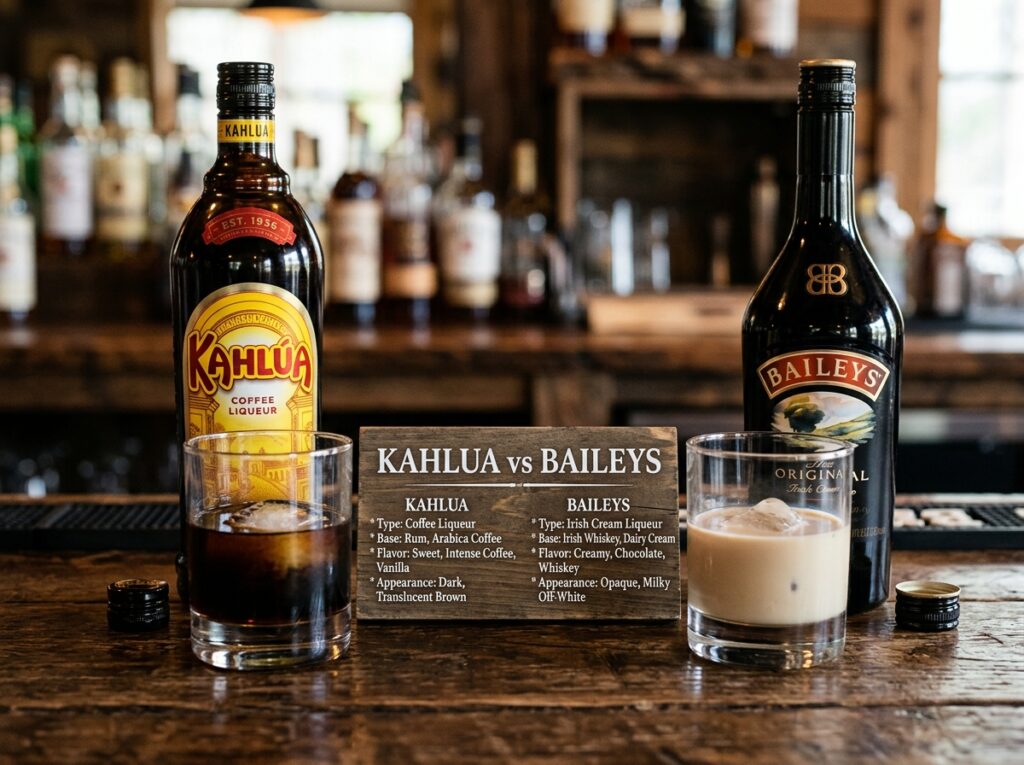
Here’s a fun little fact — Baileys Irish Cream sells roughly 2,300 glasses every single minute around the world. Kahlúa? It shows up in more cocktail recipes than almost any other liqueur on the planet. Both of these bottles sit behind nearly every bar you’ll ever walk into, yet a surprising number of people aren’t sure what actually separates them.
Maybe you’re standing in the liquor store right now, staring at both bottles, trying to figure out which one to grab. Or maybe someone recommended a cocktail and you’re wondering if you can swap one for the other. Either way, you’re in the right place.
The Kahlua vs Baileys difference really comes down to what each one is made from, how they taste, how strong they are, and what you can do with them. They’re both liqueurs, sure. But they belong to two completely different families — and once you understand that, picking between them (or using both together) becomes a whole lot easier.
Let’s break it all down.
What Exactly Is Kahlúa?
Kahlúa is a coffee liqueur that was born in Veracruz, Mexico back in 1936. The name comes from the Nahuatl language of the Acolhua people, and loosely translates to “House of the Acolhua people.” Pedro Domecq originally produced it, though today it’s owned by Pernod Ricard.
The recipe is built around Arabica coffee beans grown in Veracruz, rum, sugar, and vanilla. That combination gives it a dark brown color and a thick, syrupy sweetness that immediately reminds you of strong coffee with sugar stirred in. If you’ve ever had an Espresso Martini or a White Russian — you’ve tasted Kahlúa, whether you realized it or not.
What makes it a “coffee liqueur” specifically? It belongs to a category of spirits where coffee is the dominant flavor. The base spirit is rum, and the coffee and sugar are added during production. Think of it like this: if regular coffee and rum had a sweet, dessert-loving child, that would be Kahlúa.
If you’re curious about how much caffeine Kahlúa actually contains, the answer might surprise you — it’s there, but it’s much less than a regular cup of coffee.
What Exactly Is Baileys?
Baileys Irish Cream hit the market in 1974, making it younger than Kahlúa by almost four decades. It was created in Dublin, Ireland by Gilbeys of Ireland (now part of Diageo), and it was actually the world’s first Irish cream liqueur. Every other Irish cream you see on shelves today? Baileys started that whole category.
The recipe blends Irish whiskey with fresh dairy cream, cocoa, and vanilla. The cream comes from Irish dairy farms — Baileys uses roughly 200 million liters of fresh milk from about 40,000 Irish cows every year. That’s not marketing fluff. The cream is a real, perishable dairy product, which is why Baileys has a shelf life (unlike many other spirits).
So while Kahlúa is a coffee liqueur, Baileys is an Irish cream liqueur. The difference between Irish cream and coffee liqueur is fundamental — one is built around coffee, the other around cream and whiskey. They’re about as different as chocolate cake and cheesecake. Both are desserts, both are sweet, but the experience of eating each one is nothing alike.
Kahlua vs Baileys Taste: How Do They Actually Compare?
This is usually the first thing people want to know, and honestly, it’s where the two bottles couldn’t be more different.
Kahlúa tastes like sweetened coffee with a warm, slightly boozy undercurrent. You get roasted coffee beans up front, followed by vanilla and caramel notes, and a gentle rum warmth on the finish. It’s rich and sweet, but the coffee flavor dominates everything. If you took a sip blindfolded, your brain would immediately say “coffee.”
Baileys is a completely different sensory experience. It’s creamy, smooth, and almost milkshake-like in texture. The flavor profile leans toward chocolate, vanilla, and toffee, with the Irish whiskey providing a mild, warming finish rather than a harsh boozy kick. Your first impression is “cream” — sweet, velvety, and indulgent.
Here’s a simple way to think about the Kahlua vs Baileys taste difference: Kahlúa is like a liquid dessert coffee, while Baileys is like a liquid dessert itself. One makes you think of a cozy café, the other makes you think of melted ice cream with a grown-up twist.
One thing they do share? Both are noticeably sweet. Neither one is going to appeal to someone who strictly drinks dry wines or neat whiskey. These are dessert liqueurs through and through.
Baileys vs Kahlua Alcohol Content: Which One Is Stronger?
Alcohol content is another area where these two differ, and it’s worth paying attention to — especially if you’re mixing drinks and want to know what you’re working with.
Kahlúa sits at 20% ABV (alcohol by volume), which translates to 40 proof. That’s fairly standard for a coffee liqueur. It’s stronger than beer or wine, but noticeably lighter than straight spirits like vodka or rum (which typically run 40% ABV). If you’re interested in a more detailed look at Kahlúa’s alcohol content and how it stacks up against other liqueurs, that’s worth a read.
Baileys comes in at 17% ABV, or 34 proof. That’s slightly lower than Kahlúa, which makes sense when you think about it — all that dairy cream dilutes the whiskey base somewhat.
The 3% difference between them isn’t huge on paper, but it can matter over the course of an evening, especially in cocktails where you’re using generous pours. Two or three Baileys-heavy drinks will hit a little differently than the same number of Kahlúa-heavy drinks.
Pro Tip: Because Baileys has lower alcohol content AND contains dairy, it tends to feel “easier” to drink in large quantities. That smoothness can be deceptive. Don’t let the milkshake taste fool you — it’s still alcohol.
The Base Spirit Question: Rum vs Whiskey
This is something a lot of comparison articles gloss over, but it’s actually a pretty big deal for your taste experience.
Kahlúa uses rum as its base spirit. Rum is made from sugarcane, and it brings a natural sweetness and warmth that complements coffee beautifully. The rum in Kahlúa isn’t meant to stand out — it’s more of a supporting player that adds body and a gentle heat without overpowering the coffee and vanilla.
Baileys uses Irish whiskey as its base. Irish whiskey is triple-distilled, which makes it exceptionally smooth compared to Scotch or bourbon. That smoothness is critical because it needs to blend seamlessly with dairy cream without creating any harsh edges. The whiskey flavor in Baileys is subtle — you know it’s there because of the warmth, but it doesn’t taste like you’re drinking whiskey.
Why does this matter? Because the base spirit affects how each liqueur interacts with mixers. Rum-based Kahlúa plays nicely with vodka, milk, and espresso. Whiskey-based Baileys pairs well with coffee, hot chocolate, and other cream-based drinks. Swap them recklessly in recipes and you might end up with a drink that doesn’t quite work.
How to Use Each One: Cocktails, Coffee, and Beyond
Here’s where things get practical. You’ve got a bottle (or you’re about to buy one) — what do you actually do with it?
Kahlúa’s Best Uses
Kahlúa is a cocktail workhorse. Some of the most famous drinks in the world rely on it.
The White Russian — Kahlúa, vodka, and cream — became iconic partly thanks to “The Big Lebowski.” The Espresso Martini, which has been having a massive resurgence since 2022, uses Kahlúa as its sweetening backbone. The Mudslide, the B-52, the Black Russian — all Kahlúa territory.
Beyond cocktails, Kahlúa works beautifully in baking. Tiramisu often calls for it. Brownies, chocolate cakes, and coffee-flavored frostings all get a lift from a splash. You can even pour it over vanilla ice cream for the laziest (and most satisfying) dessert imaginable.
And yes, people add it directly to coffee. If you enjoy flavored coffee but want something more interesting than a syrup, a shot of Kahlúa in your morning brew (well, maybe your weekend brew) turns an ordinary cup into something special. Speaking of coffee-based drinks, if you’re curious about how Kahlúa and milk work together including the caffeine side of things, that’s a surprisingly popular combination worth trying.
Baileys’ Best Uses
Baileys shines in slightly different territory. It’s the queen of after-dinner drinks — you sip it on its own, over ice, or in a snifter after a meal.
Baileys in hot coffee is practically a national pastime in Ireland. It turns a regular cup of joe into a creamy, warming treat that works perfectly on cold evenings. Hot chocolate with Baileys? Even better.
For cocktails, the Baileys Martini and Mudslide (yes, both liqueurs appear in a classic Mudslide) are popular choices. Baileys also goes into shooters like the Blow Job and Slippery Nipple, where its cream base adds texture.
In the kitchen, Baileys finds its way into cheesecakes, truffles, fudge, and even homemade ice cream. The cream component means it adds both flavor and a silky richness that Kahlúa can’t replicate.
Kahlua Baileys Mix: Can You Use Them Together?
Absolutely — and this is where things get really fun.
A Kahlua Baileys mix is one of the best-kept secrets in home bartending. The coffee notes from Kahlúa and the cream from Baileys complement each other like peanut butter and jelly. You’re essentially creating a creamy coffee cocktail with layers of flavor that neither bottle can deliver alone.
The simplest version? Equal parts Kahlúa and Baileys over ice. That’s it. You’ll end up with something that tastes like the world’s most indulgent iced coffee.
Want to take it further? The B-52 shot layers Kahlúa on the bottom, Baileys in the middle, and Grand Marnier on top. It’s a classic layered shooter that looks impressive and tastes like a liquid dessert.
The Mudslide blends both liqueurs with vodka and cream (or ice cream, if you’re making the frozen version). It’s basically an adult milkshake, and it’s dangerously easy to drink.
Quick Recipe — The Lazy Sunday:
Pour one part Kahlúa and one part Baileys into a glass of cold brew coffee. Add ice. Stir. You now have the best iced coffee of your life, and it took you about 15 seconds.
If you enjoy cold brew and you’re into the idea of coffee-based beverages, you might also want to explore some of the best drinks at Dunkin’ for more coffee inspiration — minus the alcohol, of course.
Shelf Life and Storage: A Critical Difference
Here’s something that catches a lot of people off guard.
Kahlúa lasts a long time — roughly 4 years from the production date if unopened, and about 18 months to 2 years after opening if stored properly. The high sugar content acts as a preservative, and there’s no dairy to spoil. You can keep it in a cool, dark cabinet and it’ll be fine for ages. Wondering about the details? Here’s a deeper look at whether Kahlúa goes bad and how to tell.
Baileys is a different story. Because it contains real dairy cream, it has an expiration date — typically about 2 years from the manufacture date, whether opened or not. Once you open the bottle, you should ideally use it within 6 months. And while you don’t technically need to refrigerate it (the alcohol preserves the cream to some extent), keeping it cold extends its quality.
Warning: If your Baileys smells sour, looks chunky, or has separated in a way that doesn’t fix itself with shaking — throw it out. Expired dairy cream is not something you want to mess with, no matter how much whiskey is mixed in.
This shelf life difference is actually a deciding factor for some people. If you only drink liqueur occasionally, Kahlúa is the more practical purchase because it won’t go bad sitting in your cabinet for months.
Price and Value: What Are You Paying For?
Both Kahlúa and Baileys sit in a similar price range, typically between $20–$30 USD for a standard 750ml bottle, depending on where you live and where you shop. Neither one is going to break the bank.
Kahlúa sometimes edges slightly cheaper, but the difference is usually just a few dollars. Both brands also offer flavored variants — Kahlúa has versions like Kahlúa Especial (a higher-proof, less sweet version with a stronger coffee flavor) and Kahlúa Mint Mocha. Baileys offers Baileys Almande (a dairy-free almond milk version), Baileys Salted Caramel, Baileys Strawberries & Cream, and several others.
If you’re looking for the best value in terms of versatility, Kahlúa might have a slight edge. It works in more cocktail recipes, lasts longer on the shelf, and plays well with a wider variety of mixers. But Baileys wins if what you really want is a standalone sipper or a cream-based dessert ingredient.
A Quick Side-by-Side Look
Sometimes it helps to see everything in one place. Here’s how Kahlúa and Baileys stack up across the key categories:
Origin: Kahlúa comes from Mexico (1936); Baileys comes from Ireland (1974).
Category: Kahlúa is a coffee liqueur; Baileys is an Irish cream liqueur.
Base spirit: Kahlúa uses rum; Baileys uses Irish whiskey.
Key flavors: Kahlúa brings coffee, vanilla, and caramel. Baileys brings cream, chocolate, and toffee.
Alcohol content: Kahlúa is 20% ABV; Baileys is 17% ABV.
Texture: Kahlúa is syrupy and smooth; Baileys is thick and creamy.
Shelf life after opening: Kahlúa lasts 18–24 months; Baileys should be used within 6 months.
Contains dairy: Kahlúa does not; Baileys does.
Calories (per 1 oz): Kahlúa has about 91 calories; Baileys has about 102 calories.
That last point — calories — matters more than people think. If you’re watching your intake, those numbers add up fast, especially in cream-heavy cocktails. For comparison, that’s actually more per ounce than many energy drinks people worry about.
Which One Should You Buy?
This is the real question, right?
Go with Kahlúa if you love coffee, you’re into cocktail-making, you want something with a longer shelf life, or you’re buying for a party where you’ll be mixing drinks. Kahlúa is the more versatile option for bartending and baking, and it plays well with both milk-based and spirit-based cocktails.
Go with Baileys if you want something you can sip on its own, you love creamy dessert flavors, or you mainly plan to add it to coffee or hot chocolate. Baileys is the more “ready-to-enjoy” option — pour it over ice and you’re done.
Buy both if you want to make Mudslides, B-52s, or any cocktail that benefits from the coffee-meets-cream combination. Honestly, having both on your shelf gives you the most flexibility. And since neither bottle is particularly expensive, the investment isn’t major.
One thing to consider: if anyone in your household is lactose intolerant or has a dairy allergy, Baileys is obviously off the table (unless you grab the Almande version). Kahlúa is naturally dairy-free.
FAQ
Can I substitute Kahlúa for Baileys in a recipe?
Not directly, no. They taste completely different and have different textures. Kahlúa is thin and coffee-forward; Baileys is thick and creamy. Swapping one for the other in a cocktail recipe will give you a very different drink. In baking, Kahlúa adds a coffee flavor while Baileys adds a creamy richness — they’re not interchangeable. You can sometimes use both in the same recipe, but treating them as substitutes for each other won’t give you good results.
Does Kahlúa or Baileys have more caffeine?
Kahlúa contains a small amount of caffeine because it’s made with real coffee beans — roughly 5 mg per 1.5 oz serving, which is far less than a regular cup of coffee. Baileys contains almost no caffeine. If caffeine sensitivity is a concern for you, neither one will affect you the way a Starbucks drink ranked by caffeine would. The caffeine in both is genuinely minimal.
Is it safe to mix Kahlúa and Baileys together?
Yes, completely safe, and honestly delicious. Many classic cocktails combine both — the Mudslide and B-52 are probably the most well-known examples. The coffee flavor from Kahlúa and the cream from Baileys are natural partners. Just be mindful that mixing two liqueurs means the sugar and calorie content adds up quickly.
Can vegans drink Kahlúa or Baileys?
Kahlúa’s original version is considered vegan-friendly (no animal products in the ingredients). Baileys Original contains dairy cream, so it’s not vegan. Baileys Almande, which uses almond milk instead of dairy, is the vegan-friendly option from the Baileys lineup.
How should I store them after opening?
Keep Kahlúa in a cool, dark place with the cap tightly sealed. A pantry or liquor cabinet works fine — no refrigeration needed. Baileys should be stored in a cool place too, but refrigerating it after opening is a smart move. Always check the expiration date on Baileys, and don’t push it past 6 months after opening.
Your Next Move
Now you know exactly what sets Kahlúa and Baileys apart — from their ingredients and flavor profiles to their alcohol content, shelf life, and best uses. They’re both fantastic liqueurs, just built for different occasions and different tastes.
If you’re still on the fence, here’s my honest suggestion: start with whichever one matches how you’ll actually use it most. Coffee lover who likes mixing drinks? Kahlúa. Want something smooth to sip after dinner or stir into your evening coffee? Baileys. Planning a cocktail night with friends? Grab both and make Mudslides. You won’t regret it.
And if you do pick up Kahlúa, don’t forget to try it in cold brew with a splash of cream. It’s one of those combinations that, once you try it, you’ll wonder how you ever lived without it.