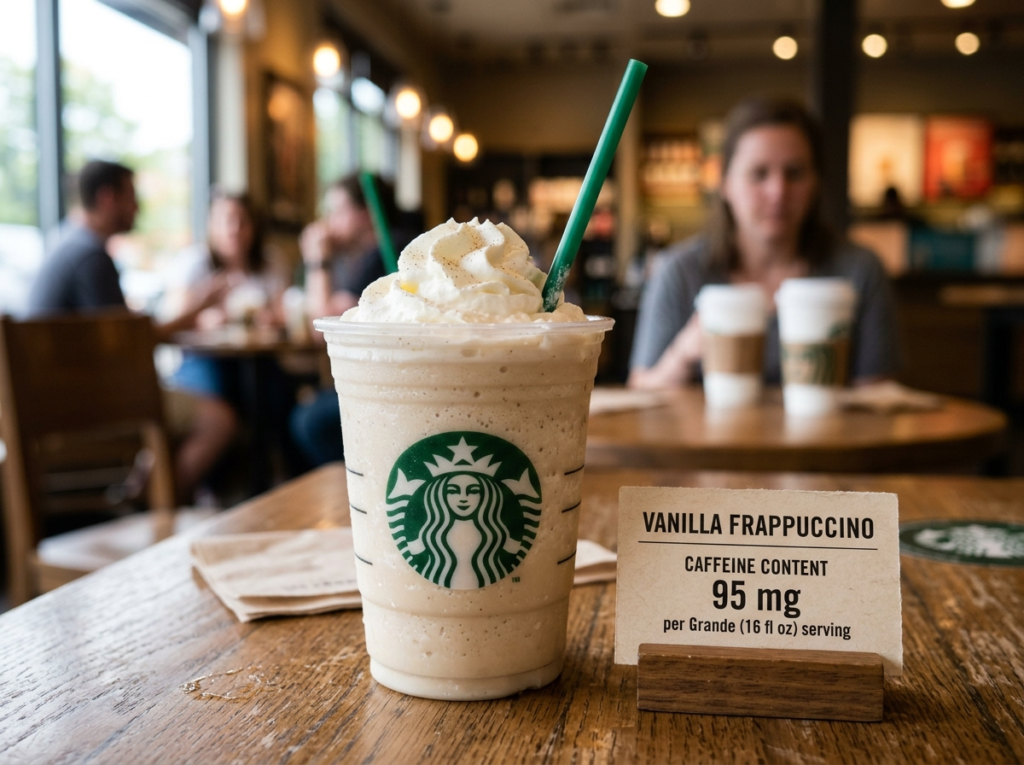
A Grande Vanilla Frappuccino from Starbucks packs about 95 mg of caffeine — roughly the same as a standard cup of brewed coffee. That might surprise you if you’ve always thought of Frappuccinos as glorified milkshakes with barely any kick. Or maybe you’re on the other end, worried it’s loaded with enough caffeine to keep you up all night.
Either way, you’re here because you want a clear answer, and that’s exactly what you’ll get. We’ll break down the vanilla Frappuccino caffeine content across every size, compare it with other popular Frappuccino flavors like the caramel and mocha, and talk about what to order if you want a Frappuccino that’s completely caffeine free.
What Exactly Is a Vanilla Frappuccino?
Before we get into the caffeine numbers, let’s make sure we’re talking about the same drink. Starbucks makes two very different things that both carry the “Vanilla Frappuccino” name, and they don’t have the same caffeine content.
The Starbucks in-store Vanilla Bean Crème Frappuccino is a crème-based blended drink. It’s made with vanilla bean powder, milk, ice, and crème Frappuccino syrup. There’s no coffee in it at all. Zero. So it has no caffeine (or technically, a negligible trace amount).
The Coffee Vanilla Frappuccino — which is what most people mean when they say “Vanilla Frappuccino” — is a coffee-based blended drink. It uses Frappuccino roast (Starbucks’ proprietary coffee designed for cold drinks), milk, ice, vanilla syrup, and whipped cream on top. This one definitely has caffeine.
That distinction matters a lot. If you grabbed a bottled Starbucks Vanilla Frappuccino from a convenience store, that’s a different product entirely with its own caffeine level. We’ll cover that too.
Vanilla Frappuccino Caffeine by Size
The caffeine in your Starbucks Frappuccino caffeine content depends almost entirely on how much Frappuccino roast goes into your drink. Here’s the breakdown for the coffee-based Vanilla Frappuccino at Starbucks:
Tall (12 oz): approximately 65 mg of caffeine
Grande (16 oz): approximately 95 mg of caffeine
Venti (24 oz): approximately 125 mg of caffeine
These numbers come from Starbucks’ own published nutritional data. Keep in mind there can be slight variations depending on how your barista prepares the drink — an extra pump of Frappuccino roast here or there can shift things by 5–10 mg.
For reference, the FDA considers 400 mg of caffeine per day as generally safe for most healthy adults. So even a Venti Vanilla Frappuccino uses up less than a third of that daily limit.
Quick Fact: The Frappuccino roast Starbucks uses isn’t the same as the espresso in your latte or the pike place drip coffee. It’s an instant-style coffee specifically formulated to dissolve in cold liquids without turning bitter. That’s partly why the caffeine content is moderate rather than high.
How Does It Compare to Other Frappuccino Flavors?
This is where things get interesting. Not all Starbucks Frappuccinos carry the same caffeine punch, and some people pick their flavor without realizing the caffeine difference can be significant.
Let’s look at the Grande (16 oz) size across the most popular options:
The Caramel Frappuccino caffeine content sits right at about 90–100 mg — essentially the same as the Vanilla. Both are coffee-based, both use the same Frappuccino roast as their caffeine source. The only real difference is the caramel syrup and drizzle instead of vanilla syrup. Your caffeine intake won’t change much by switching between these two.
The Mocha Frappuccino caffeine content is slightly higher, coming in around 100–110 mg for a Grande. Why the bump? Because mocha sauce contains a small amount of cocoa, and cocoa naturally carries caffeine. It’s not a huge difference — maybe 10–15 mg more than the Vanilla — but it’s there.
Now here’s the one that stands out. The Java Chip Frappuccino caffeine content lands around 105–110 mg for a Grande. It gets its caffeine from two sources: the Frappuccino roast coffee AND the java chips (chocolate chips blended into the drink). Those chips contain cocoa, which adds that extra bit of caffeine on top of the coffee base.
Pro Tip: If you want the least caffeine from a coffee-based Frappuccino, stick with the Vanilla or Caramel. If you want the most without ordering extra shots, go with something chocolate-based like the Java Chip or Mocha.
And then there’s a completely different category — the crème-based Frappuccinos. Drinks like the Vanilla Bean Crème, Strawberry Crème, and White Chocolate Crème Frappuccino don’t use Frappuccino roast at all. They’re essentially non-coffee drinks at Starbucks that happen to be blended and frozen. Their caffeine content? Practically zero, unless cocoa-based ingredients add a tiny trace.
Bottled Vanilla Frappuccino — A Different Story
You’ve probably seen those glass Starbucks Frappuccino bottles in the refrigerated section at grocery stores, gas stations, and Target. The bottled version is a pre-made, shelf-stable product, and its caffeine content doesn’t match what you’d get at a Starbucks store.
A 13.7 oz bottled Starbucks Vanilla Frappuccino contains about 75 mg of caffeine. The older 9.5 oz bottles carry roughly 65 mg.
That’s a bit less than the in-store Grande, which makes sense. The bottled version is a standardized product manufactured in a factory, while the in-store drink is hand-assembled by a barista with fresh Frappuccino roast. The concentration of coffee in the bottled version is slightly lower, and it leans heavier on milk and sugar for taste.
If you’re keeping close tabs on your daily caffeine — maybe because you’re sensitive to it, pregnant, or managing anxiety — the bottled version gives you a bit more predictability. You know exactly what you’re getting every time. With the in-store version, there’s always a tiny margin of variation.
Is There a Caffeine-Free Frappuccino Option?
Yes, and this is great news if you love the Frappuccino texture and experience but don’t want any caffeine at all.
Starbucks’ entire Crème Frappuccino line is essentially Frappuccino caffeine free (or as close to zero as you can get). These drinks skip the coffee roast entirely and rely on flavored syrups, milk, and ice for their taste.
Your best caffeine-free picks include the Vanilla Bean Crème Frappuccino, the Strawberry Crème Frappuccino, the Caramel Ribbon Crunch Crème Frappuccino, and the White Chocolate Crème Frappuccino. If you want to keep it low calorie, ask for nonfat milk and skip the whipped cream — it won’t affect the caffeine, but your waistline will thank you.
One small caveat: if a crème Frappuccino contains chocolate or cocoa (like the Chocolate Cookie Crumble Crème), you’ll get a trace amount of caffeine from the cocoa. We’re talking about 5–15 mg, which is minimal, but not technically zero.
Did You Know? You can also ask your barista to make any coffee-based Frappuccino as a crème version instead. Just say “Can I get this without the coffee?” They’ll skip the Frappuccino roast and make it crème-based. You’ll lose the coffee flavor, obviously, but you’ll keep the vanilla (or caramel, or whatever flavor you chose) and end up with a caffeine-free drink.
How Vanilla Frappuccino Caffeine Stacks Up Against Other Drinks
Numbers in isolation don’t mean much. You need context. So here’s how the caffeine in a Grande Vanilla Frappuccino (95 mg) compares to some other drinks you might reach for on a regular day.
A Grande Starbucks Pike Place brewed coffee has about 310 mg of caffeine. That’s more than three times what the Frappuccino gives you. If you’ve been drinking drip coffee all your life and switch to a Vanilla Frap, you’ll feel the difference — less jittery energy, smoother ride.
A single shot of Starbucks espresso contains roughly 75 mg. So your Grande Vanilla Frap has a bit more caffeine than one espresso shot but less than two. Most lattes and cappuccinos at Starbucks use two shots for a Grande, putting them around 150 mg — noticeably more than the Frappuccino. If you’re curious about how cappuccinos compare to regular coffee in terms of caffeine, that’s worth a read too.
A standard 16 oz can of Monster Energy contains about 160 mg of caffeine — roughly 70% more than a Grande Vanilla Frap. You can check out the full Monster caffeine breakdown here if you’re comparing your afternoon options.
A 12 oz can of Coca-Cola has about 34 mg, and Pepsi sits around 38 mg for the same size. So the Frappuccino carries roughly 2.5 to 3 times the caffeine of a can of cola.
A Starbucks Refresher? Those land between 35–45 mg for a Grande, depending on the flavor. They use green coffee extract instead of brewed coffee, which gives a lighter caffeine lift. If you want to explore that category, here’s a closer look at Starbucks Refresher caffeine content.
The takeaway here is simple: the Vanilla Frappuccino sits in the moderate range. It’s not a caffeine bomb, but it’s not a soft drink either. It lands right in that middle ground where most people feel a gentle boost without the crash.
What Affects the Caffeine in Your Frappuccino?
Your Vanilla Frappuccino’s caffeine can shift based on a few factors you might not think about.
Size is the obvious one. Going from Tall to Venti nearly doubles the caffeine (65 mg to 125 mg). If you’re trying to limit your intake, ordering a Tall instead of a Grande saves you about 30 mg without sacrificing the entire experience.
Extra espresso shots change everything. Some people ask for an affogato-style Frappuccino with a shot of espresso poured on top. Each added shot tosses in an extra 75 mg. A Grande Vanilla Frap with one extra shot jumps from 95 mg to around 170 mg. Two extra shots? You’re at 245 mg — now you’re in serious coffee territory.
The type of milk doesn’t affect caffeine. Whether you choose whole milk, oat milk, almond milk, or nonfat, your caffeine stays the same. Milk contributes calories, fat, and texture. Caffeine comes entirely from the Frappuccino roast and any chocolate ingredients.
Customizations with chocolate matter. Adding mocha drizzle, java chips, or chocolate sauce introduces trace amounts of caffeine through cocoa content. It’s small — maybe 5–10 mg — but if you’re stacking multiple chocolate add-ons, it adds up.
Decaf isn’t really an option here. Unlike espresso-based drinks where you can ask for decaf shots, Frappuccino roast doesn’t come in a decaf version at most Starbucks locations. If you want a truly low-caffeine or caffeine-free Frappuccino, your best bet is to go crème-based and skip the coffee entirely.
When Should You Think Twice About the Caffeine?
For most healthy adults, 95 mg of caffeine from a Grande Vanilla Frappuccino isn’t something to worry about. But certain groups should pay closer attention.
If you’re pregnant or breastfeeding, the American College of Obstetricians and Gynecologists recommends staying under 200 mg per day. A Grande Vanilla Frap takes up nearly half that limit in one drink. A Tall would be a smarter choice, or you could switch to the caffeine-free Vanilla Bean Crème version.
If you’re caffeine-sensitive, even 65 mg (a Tall) might cause jitters, a racing heart, or trouble sleeping — especially if you drink it after 2 PM. Caffeine’s half-life is about 5–6 hours, meaning half the caffeine from a 3 PM Frappuccino is still circulating in your system at 8 or 9 PM.
For kids and teenagers, the high sugar content of a Frappuccino is honestly a bigger concern than the caffeine for most parents. But caffeine guidelines from the American Academy of Pediatrics suggest kids under 12 should avoid caffeine, and teens should stay under 100 mg daily. A Tall Vanilla Frap (65 mg) fits within teen limits, but the Vanilla Bean Crème version is a safer all-around choice for younger kids.
The Sugar Situation (Because It Matters)
We can’t talk honestly about Vanilla Frappuccino caffeine without mentioning what comes along with it. A Grande Vanilla Frappuccino contains roughly 69 grams of sugar and about 400 calories. That’s more sugar than you’ll find in two regular Snickers bars.
The caffeine might be moderate, but the sugar is anything but. If you’re drinking this daily, the caffeine is the least of your health concerns.
You can cut it down by asking for fewer pumps of vanilla syrup (standard is 4 for a Grande — try 2), requesting nonfat milk, and skipping the whipped cream. You’ll shave off about 100 calories and a good chunk of sugar without losing the vanilla coffee flavor. You can also explore other lower-calorie Starbucks options if you’re watching your daily intake.
Ordering Tips for Your Perfect Caffeine Level
Here’s a quick guide depending on what you’re looking for:
Want moderate caffeine (standard)? Order the regular Vanilla Frappuccino in whatever size you prefer. Don’t add or change anything. You’ll get 65–125 mg depending on size.
Want more caffeine? Ask for an extra shot of espresso (or two). Each shot adds roughly 75 mg. You can also ask for extra Frappuccino roast pumps.
Want less caffeine? Order a Tall instead of a Grande. Or ask for half the standard Frappuccino roast — baristas call this a “half-caf” Frap, and most will know what you mean.
Want zero caffeine? Order the Vanilla Bean Crème Frappuccino instead. Same vanilla vibes, no coffee whatsoever. Or check out the full list of non-coffee Starbucks drinks for more ideas.
Want to compare caffeine across the menu? Take a look at this ranking of Starbucks drinks by caffeine — it puts everything in perspective and helps you order smarter.
Frequently Asked Questions
Does a Vanilla Frappuccino have more caffeine than a latte?
No. A Grande Vanilla Frappuccino has about 95 mg of caffeine, while a Grande Vanilla Latte has about 150 mg (from two espresso shots). The Frappuccino uses Frappuccino roast instead of espresso, which delivers less caffeine per serving. If you’re looking for a lower-caffeine option between the two, the Frappuccino is actually the lighter choice.
Is the Vanilla Bean Frappuccino caffeine free?
The Vanilla Bean Crème Frappuccino is essentially caffeine free. It’s a crème-based drink made without any coffee. You might find an almost negligible trace amount (under 2 mg) from processing, but for all practical purposes, it contains zero caffeine. It’s a great pick for kids or anyone avoiding caffeine entirely.
How much caffeine is in a bottled Starbucks Vanilla Frappuccino?
A 13.7 oz bottled Starbucks Vanilla Frappuccino has about 75 mg of caffeine. The older, smaller 9.5 oz bottles contain around 65 mg. Both versions have slightly less caffeine than the in-store Grande because the bottled formula uses a standardized coffee concentration.
Can I get a decaf Vanilla Frappuccino at Starbucks?
Not exactly. Starbucks doesn’t offer a decaf version of their Frappuccino roast. Your best workaround is to ask for a crème-based Frappuccino with vanilla syrup (making it caffeine-free) or ask the barista to use decaf espresso shots instead of Frappuccino roast. The taste will be slightly different, but you’ll get a very similar drink with minimal caffeine.
Which Frappuccino has the most caffeine?
Among standard menu Frappuccinos, the Espresso Frappuccino and Caramel Cocoa Cluster Frappuccino tend to have the highest caffeine. The Java Chip Frappuccino caffeine content also runs a bit higher than average because of the cocoa in the chips. But honestly, the biggest caffeine variable is whether you add extra espresso shots — that’s what really moves the needle.
Your Next Move
The Vanilla Frappuccino sits in a comfortable caffeine sweet spot — enough to give you a gentle afternoon lift, but not so much that you’ll regret it at bedtime. At 95 mg for a Grande, it’s less than a regular cup of Starbucks drip coffee and far less than most energy drinks.
If caffeine is something you actively manage — because of sensitivity, pregnancy, or just personal preference — you now have the exact numbers and the right ordering hacks to get precisely the amount you want. And if you don’t care about caffeine at all and just want the tastiest frozen drink? Well, at least now you know what’s in it.
Next time you’re standing in that Starbucks line, you won’t have to guess. You’ll know exactly what you’re ordering and why.