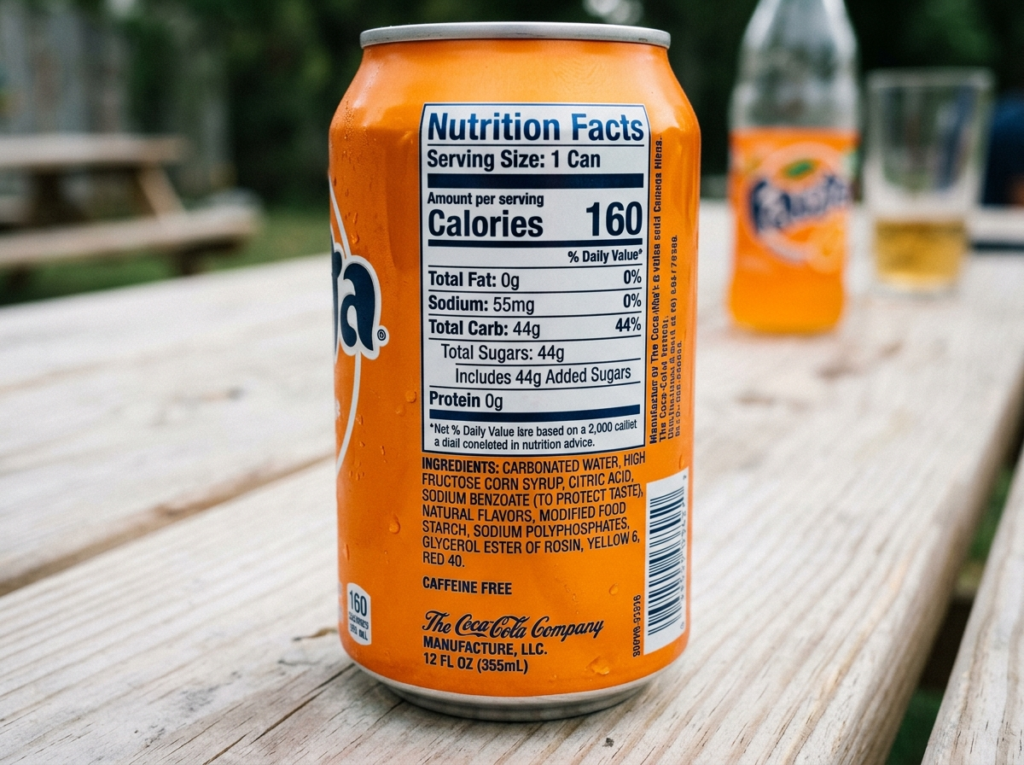
Roughly 95% of Americans drink at least one caffeinated beverage every day. So when you’re reaching for a cold can of Fanta on a hot afternoon, it’s perfectly natural to wonder — does Fanta have caffeine? Maybe you’re trying to cut back on caffeine, or you’re picking up a drink for your kid, or you’re just curious about what’s actually inside that bright orange can.
Here’s the short answer: No, Fanta doesn’t have caffeine. Zero milligrams. Not even a trace. But there’s more to the story than just a one-word answer. The Fanta ingredients list has a few things worth knowing about, especially when it comes to sugar content, artificial additives, and how it compares to other popular sodas. Let’s break it all down.
What Exactly Is Fanta?
Before we get into caffeine and ingredients, a quick backstory. Fanta is a fruit-flavored soda brand owned by The Coca-Cola Company. It was originally created in Germany during the 1940s and has since expanded into one of the most popular soft drink brands worldwide. Today, Fanta is sold in over 190 countries and comes in more than 100 different flavors.
The most popular variety in the United States? Fanta Orange. That’s the one most people picture when they think of the brand — that iconic bright orange color and sweet citrus flavor. But you’ll also find Fanta Grape, Fanta Strawberry, Fanta Pineapple, and plenty of others depending on where you live.
What makes Fanta stand out from colas like Coca-Cola or Pepsi is that it’s a fruit-flavored soda, not a cola. And that distinction actually matters when we’re talking about caffeine.
Does Fanta Have Caffeine? The Direct Answer
Fanta is completely caffeine free. Every single flavor — Orange, Grape, Strawberry, Pineapple, Berry, you name it — contains 0 mg of caffeine. This isn’t just for one specific variety. Across the board, Fanta products don’t include caffeine as an ingredient.
You can verify this yourself. Check the nutrition label on any Fanta can or bottle. You won’t find caffeine listed anywhere. The Coca-Cola Company also confirms this on their official product pages.
So why doesn’t Fanta have caffeine? It comes down to what type of soda it is. Caffeine is a natural component of kola nut extract, which is traditionally used in cola-flavored drinks like Coca-Cola and Pepsi. Since Fanta is a fruit-flavored soda and doesn’t use kola nut, there’s no natural reason for caffeine to be there. And unlike some other sodas, Coca-Cola doesn’t add caffeine artificially to the Fanta formula either.
This makes Fanta a solid choice if you’re specifically looking for a caffeine-free soda option. Parents buying drinks for kids, pregnant women watching their caffeine intake, or anyone who’s sensitive to caffeine can drink Fanta without worrying about that particular stimulant.
Quick Fact: Not all fruit-flavored sodas are caffeine free. Some citrus sodas like Mountain Dew and Sun Drop actually contain significant amounts of caffeine — around 54 mg and 64 mg per 12 oz can, respectively. So being a fruit soda doesn’t automatically mean it’s caffeine free. Fanta just happens to be one that is.
Fanta Ingredients: What’s Actually in Your Can?
Now that we’ve settled the caffeine question, let’s look at what Fanta does contain. Knowing the full Fanta ingredients list gives you a better picture of what you’re drinking.
Here are the main ingredients in a standard Fanta Orange (US version):
Carbonated water makes up the base of the drink. High fructose corn syrup acts as the primary sweetener. Citric acid adds tartness and acts as a preservative. Sodium benzoate is another preservative that keeps the drink shelf-stable. Natural flavors provide the orange taste profile. Modified food starch works as an emulsifier. And those bold colors? They come from Red 40 and Yellow 6 — two artificial food dyes.
Worth noting: the Fanta formula actually varies from country to country. In many European countries, Fanta Orange contains real orange juice (usually around 5–12%) and uses natural colorings instead of artificial dyes. The UK version, for example, uses carrot and pumpkin extracts for color. The US version does not contain any actual fruit juice.
That difference surprises a lot of people, and it’s something worth being aware of if you’ve ever had Fanta abroad and noticed it tasted different. It probably did taste different — because the recipe literally isn’t the same.
Fanta Sugar Content: Here’s Where It Gets Interesting
Caffeine might not be a concern with Fanta, but sugar is a different story. If you’re health-conscious, this is the section you’ll want to pay attention to.
A standard 12 oz (355 ml) can of Fanta Orange in the US contains approximately 44 grams of sugar. That’s about 11 teaspoons of sugar in a single can. To put that in perspective, the American Heart Association recommends that men consume no more than 36 grams of added sugar per day, and women no more than 25 grams.
So one can of Fanta already pushes you past the daily recommended limit — before you’ve eaten anything else.
Here’s how the Fanta sugar content stacks up against some other popular sodas per 12 oz serving:
Fanta Orange has about 44g of sugar and 160 calories. Coca-Cola Classic comes in at roughly 39g of sugar and 140 calories. Pepsi is similar at 41g of sugar and 150 calories. Sprite contains around 38g of sugar and 140 calories. If you’re curious about whether Sprite contains caffeine, the answer is also no — but its sugar content is slightly lower than Fanta’s.
Notice something? Fanta Orange actually has more sugar than regular Coca-Cola. Most people don’t realize that. They assume because it’s a fruit-flavored soda, it might be lighter. It’s not. The Fanta sugar content is among the highest of any mainstream soda.
Pro Tip: If you like the Fanta flavor but want to cut sugar, look for Fanta Zero Sugar (also called Fanta Zero in some markets). It uses artificial sweeteners like aspartame and acesulfame potassium instead of sugar, bringing the calorie count down to zero. It’s still caffeine free, too.
How Does Fanta Compare to Other Sodas on Caffeine?
One of the biggest reasons people search for “does Fanta have caffeine” is because they’re comparing options. They want a soda, but they’re trying to avoid caffeine. So let’s see how Fanta stands in the bigger picture.
Caffeine-free sodas include Fanta (all flavors), Sprite, 7UP, Sierra Mist, root beer varieties (most of them), and cream soda. If you’ve ever wondered about caffeine in root beer, most brands are also caffeine free, though Barq’s is a notable exception with about 22 mg per can.
Sodas with caffeine include Coca-Cola (34 mg per 12 oz), Pepsi (38 mg), Diet Coke (46 mg), Dr Pepper (41 mg), and Mountain Dew (54 mg). If you want details on how much caffeine Pepsi has, that link breaks down the full picture. And for those curious about Coke Zero’s caffeine content, yes — it still has caffeine, about 34 mg per can, even though it has zero sugar.
There’s a general pattern here. Most cola-flavored sodas contain caffeine. Most fruit-flavored and lemon-lime sodas don’t. Fanta falls firmly in the caffeine-free category.
If you want to go beyond soda and look at how much caffeine is in energy drinks, the numbers jump dramatically. A single can of Monster Energy has about 160 mg of caffeine — you can see the full Monster Energy caffeine breakdown here. That’s nearly five times what a Coca-Cola has, and infinitely more than what Fanta has (which is, again, zero).
Is Fanta a Good Choice for Kids?
This is one of the most practical questions parents ask. Kids often want Fanta because of the bright colors and sweet taste. And since it’s caffeine free, it removes one big concern right away. The American Academy of Pediatrics recommends that children under 12 avoid caffeine entirely, so Fanta at least clears that bar.
But here’s the honest truth — caffeine isn’t the only thing to watch for. That 44 grams of sugar in a single can is a lot for a child. The AHA recommends that kids aged 2–18 consume less than 25 grams of added sugar per day. One can of Fanta nearly doubles that limit.
Occasional treat? Sure, most parents aren’t going to lose sleep over a can of Fanta at a birthday party. But as a regular, daily drink? That sugar content adds up fast.
A reasonable middle ground: pour a smaller portion instead of handing over a full can. Or go with Fanta Zero Sugar if your kid doesn’t mind the taste difference.
Fanta Zero Sugar: The Low-Down
Since we’ve mentioned it a few times, let’s give Fanta Zero Sugar its own spotlight.
Fanta Zero Sugar Orange keeps the same general flavor profile as the original but swaps out high fructose corn syrup for artificial sweeteners. It has zero calories, zero sugar, and zero caffeine. The sweeteners typically used are aspartame and acesulfame potassium (Ace-K).
Taste-wise, it’s noticeably different from regular Fanta. Some people find it slightly more tart and less “thick” in mouthfeel. Others say it’s close enough. That’s a personal preference call.
Is it healthier? It depends on your definition. You’re avoiding sugar and calories, which is a clear win if weight management or blood sugar is a concern. But there’s ongoing debate in the nutrition science community about whether long-term consumption of artificial sweeteners carries its own risks. The FDA currently considers both aspartame and Ace-K safe for general consumption within recommended daily limits. The World Health Organization in 2023 did caution against using non-sugar sweeteners for weight control, suggesting the evidence for long-term benefits is limited.
So the answer isn’t black and white. But if the question is purely “does Fanta Zero Sugar have caffeine?” — the answer is a simple no.
Why Do People Think Fanta Might Have Caffeine?
This is a fair question. If Fanta doesn’t have caffeine, why do so many people search for it?
A few reasons come to mind. First, Fanta is made by The Coca-Cola Company, and many people associate Coca-Cola products with caffeine. It’s a natural assumption. If the parent company’s flagship product has caffeine, maybe the others do too? But that’s not how it works. Coca-Cola owns dozens of brands, and many of them — Sprite, Minute Maid, Dasani, Fanta — are caffeine free.
Second, there’s genuine confusion about which sodas have caffeine and which don’t. It’s not immediately obvious. Mountain Dew is a lemon-lime-citrus soda and it has caffeine. Sunkist Orange soda has 19 mg of caffeine per 12 oz can. So not all orange sodas are caffeine free — Fanta just happens to be.
That Sunkist detail catches people off guard. You’d assume two orange sodas would be similar, but Sunkist actually adds caffeine to its formula while Fanta doesn’t. Always check the label if you’re not sure.
Third, some people are checking because they’re caffeine-sensitive or have medical conditions (like anxiety, heart arrhythmia, or pregnancy) where caffeine intake matters. For them, it’s not idle curiosity — they genuinely need to know before they drink it. And the good news is, Fanta is safe on the caffeine front.
What About Fanta Flavors Outside the US?
The Fanta lineup varies significantly by country, and so can the ingredients. But here’s the reassuring part: no matter which country or flavor you’re looking at, Fanta products are consistently caffeine free worldwide.
The differences lie elsewhere. As mentioned earlier, European versions of Fanta Orange tend to include actual orange juice and natural colorings. Some Asian markets have unique flavors like Fanta Melon or Fanta Peach. In Brazil, you’ll find Fanta Guaraná — and this is one to note. Guaraná is a plant that naturally contains caffeine (even more than coffee beans, by weight). But Fanta Guaraná, based on publicly available information from Coca-Cola Brazil, doesn’t list caffeine in its nutritional info. That said, if you’re very sensitive to caffeine, it might be worth double-checking the label on any guaraná-flavored product, since the plant itself is a natural caffeine source.
For the vast majority of Fanta varieties you’ll encounter — Orange, Grape, Strawberry, Pineapple, Berry, Mango, Peach, Apple — caffeine is simply not part of the recipe.
Better Alternatives If You Want Flavor Without the Sugar
Let’s say you love the idea of a caffeine-free, fruity drink, but that sugar content is giving you pause. You’ve got options.
Sparkling water with natural fruit flavors — brands like LaCroix, Spindrift, or Bubly give you fizz and fruit taste with zero sugar and zero caffeine. Spindrift actually uses a small amount of real fruit juice, so there’s a hint of sweetness without the sugar overload.
Infused water — drop some orange slices, strawberries, or cucumber into a pitcher. Let it sit in the fridge for a couple of hours. It’s refreshing, has almost no calories, and you control exactly what goes in.
Fanta Zero Sugar — if you really want the Fanta taste specifically, this is your compromise option.
Kombucha — some low-sugar varieties give you a fizzy, slightly sweet drink with probiotic benefits. Just be aware that most kombucha does contain small amounts of caffeine (usually 10–15 mg) because it’s brewed from tea. It’s much less than a coffee, though.
And if you’re a Starbucks fan looking for non-coffee drink options that skip the caffeine, there’s actually a pretty solid list of choices at most locations.
FAQ
Is Fanta caffeine free in all flavors?
Yes. Every Fanta flavor — including Orange, Grape, Strawberry, Pineapple, Berry, and seasonal varieties — is caffeine free. This applies to both regular and zero-sugar versions. The Coca-Cola Company doesn’t add caffeine to any Fanta product.
How much sugar is in a can of Fanta?
A 12 oz can of Fanta Orange contains approximately 44 grams of sugar and 160 calories. That’s slightly more sugar than a can of Coca-Cola Classic (39g). If you want to avoid sugar entirely, Fanta Zero Sugar is available with zero grams of sugar and zero calories.
Is Fanta healthier than Coke?
That depends on what you mean by “healthier.” Fanta has no caffeine, which could be considered a plus if you’re avoiding stimulants. But it actually has more sugar than Coca-Cola Classic — 44g versus 39g per 12 oz can. Neither drink offers significant nutritional value. From a pure sugar and calorie perspective, regular Coke actually comes in slightly lower than Fanta Orange.
Does orange soda have caffeine?
Not all orange sodas are the same. Fanta Orange is caffeine free, but Sunkist Orange contains about 19 mg of caffeine per 12 oz can. Always check the label. Don’t assume that all fruit-flavored sodas skip the caffeine — the brand matters.
Can I drink Fanta while pregnant?
Since Fanta contains no caffeine, it doesn’t raise the specific caffeine-related concerns that doctors often mention during pregnancy. The American College of Obstetricians and Gynecologists recommends limiting caffeine to under 200 mg per day during pregnancy, and Fanta doesn’t contribute to that number at all. That said, the high sugar content is something to be mindful of, especially if you’re managing gestational diabetes or watching weight gain. It’s always best to discuss your diet with your healthcare provider.
Is Fanta Zero Sugar really zero caffeine too?
Yes. Fanta Zero Sugar has zero caffeine, zero sugar, and zero calories. It uses artificial sweeteners (aspartame and acesulfame potassium) instead of sugar. The caffeine-free status carries over from regular Fanta.
Final Thoughts
So, does Fanta have caffeine? Not even a little bit. Across every flavor and every market, Fanta remains a caffeine-free soda. That’s great news if you’re avoiding caffeine for health, personal preference, or because you’re shopping for younger family members.
Where Fanta does demand your attention is on the sugar side. With 44 grams per can, it’s one of the sweetest mainstream sodas out there. If that bothers you, Fanta Zero Sugar offers the same basic taste without the sugar or calories.
Next time you’re standing in front of the drink cooler, you can grab that Fanta with confidence — at least when it comes to caffeine. And if you’re curious about which drinks do pack a caffeine punch, check out this breakdown of the energy drinks with the most caffeine. The numbers might shock you.