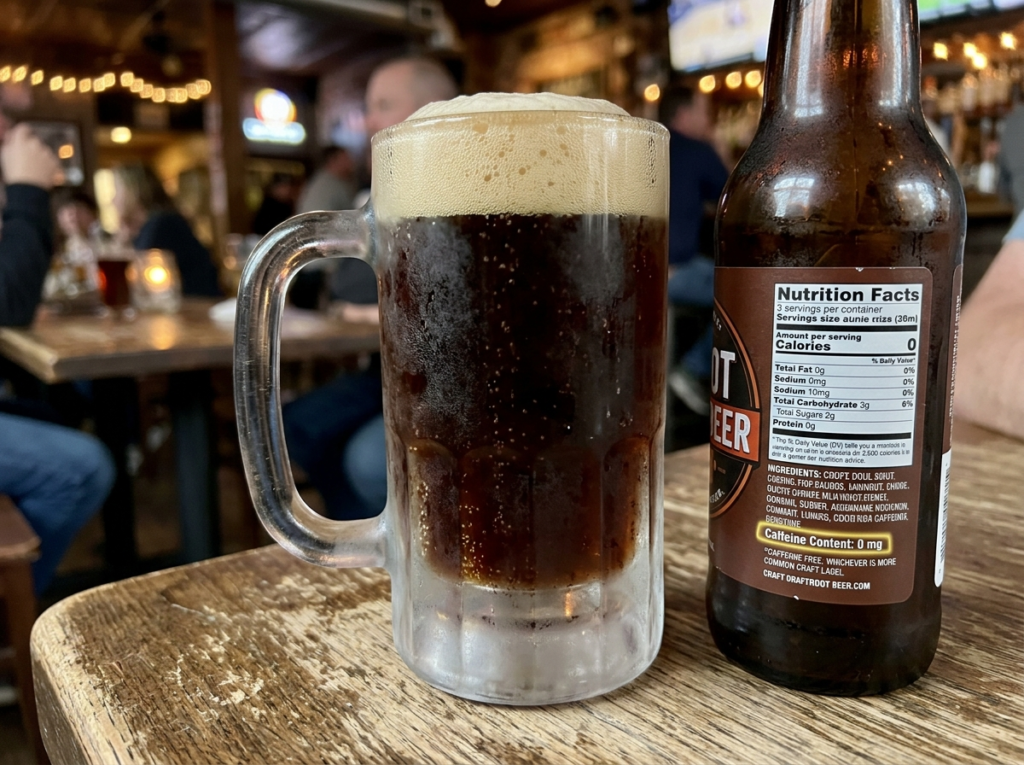
Most people grab a root beer thinking it’s completely caffeine-free. And honestly, for most brands, that’s true. But here’s where it gets tricky — not every root beer skips the caffeine. One of the most popular brands in America, Barq’s, actually contains caffeine, and it catches a lot of people off guard.
So if you’re someone who avoids caffeine for health reasons, or you’re picking up a soda for your kid, or you just want to know exactly what’s in your drink, this matters more than you might think. Let’s break down which root beers have caffeine, which ones don’t, what’s actually inside your root beer, and how it stacks up against other sodas you probably drink every week.
What Exactly Is Root Beer Made Of?
Before we talk caffeine numbers, it helps to understand what goes into root beer in the first place. The root beer ingredients list has changed a lot since the drink was first created in the 1800s.
Traditional root beer was brewed using sassafras root bark, which gave it that distinctive earthy, slightly minty flavor. People used to make it at home, almost like a tea-based fermented drink. But in 1960, the FDA banned safrole — a compound found in sassafras — after studies linked it to liver damage in lab animals. That changed everything.
Modern commercial root beers use a blend of artificial and natural flavorings to mimic that classic taste. A typical can might include carbonated water, high fructose corn syrup or cane sugar, caramel color, natural and artificial flavors (often vanilla, anise, wintergreen, and licorice), citric acid, and sodium benzoate as a preservative.
Notice what’s not on that list? Tea leaves, coffee extract, kola nuts — the usual caffeine sources you’d find in colas. That’s exactly why most root beers are naturally caffeine-free. There’s simply no botanical reason for caffeine to be there. When a brand does contain caffeine, it’s been deliberately added during production.
Is Root Beer Caffeinated? The Short Answer
For the vast majority of root beer brands — no. Root beer is not caffeinated. If you pick up a can of A&W, Mug, Dad’s, or IBC from your local grocery store, you’re drinking zero milligrams of caffeine.
But there’s one big exception that keeps this question alive on Google: Barq’s.
Barq’s root beer — made by The Coca-Cola Company — contains about 22 mg of caffeine per 12-ounce can. That’s not a huge amount (a cup of coffee has around 95 mg), but it’s definitely not zero. And if you’re caffeine-sensitive, pregnant, or giving it to a child, that 22 mg is worth knowing about.
Here’s a detail many people miss: Barq’s diet version (Diet Barq’s) is actually caffeine-free in most markets. So the regular version has caffeine, but the diet one doesn’t. It’s one of those quirks that doesn’t make intuitive sense, but that’s how it’s formulated.
Quick Fact: Barq’s has used the tagline “Barq’s has bite” for decades. Some fans believe the “bite” refers partly to the caffeine kick, though the company has never officially confirmed that.
Caffeine in Root Beer: Brand-by-Brand Comparison
Let’s look at how the most popular root beer brands compare. All values are based on a standard 12-ounce serving.
Barq’s Root Beer — 22 mg of caffeine. This is the outlier. Owned by Coca-Cola, it’s the only mainstream root beer brand that adds caffeine to its regular formula.
A&W Root Beer — 0 mg. A&W root beer caffeine content is zero across all its regular and diet versions. A&W has been around since 1919, and it’s always been a caffeine-free formula. If you’re looking for a worry-free option for kids or for yourself, A&W is a safe pick.
Mug Root Beer — 0 mg. Made by PepsiCo, Mug keeps things simple with no caffeine at all.
Dad’s Root Beer — 0 mg. One of the oldest root beer brands in the U.S. (dating back to 1937), and completely caffeine-free.
IBC Root Beer — 0 mg. Known for its glass bottles and old-school branding, IBC also stays in the caffeine-free lane.
Stewart’s Root Beer — 0 mg. Another nostalgic favorite with no caffeine.
Virgil’s Root Beer — 0 mg. A craft root beer option that uses natural ingredients and no caffeine.
The pattern is pretty clear. Unless you’re specifically drinking Barq’s regular, your root beer almost certainly has no caffeine. The fact that Barq’s adds caffeine is really the exception that created the whole “is root beer caffeinated?” question in the first place.
How Does Root Beer’s Caffeine Compare to Other Drinks?
Putting root beer’s caffeine content in context helps you see where it actually sits. Because even Barq’s — the only caffeinated mainstream root beer — is pretty low on the caffeine spectrum compared to what most people drink daily.
A 12-ounce can of Barq’s gives you 22 mg. Compare that to a same-sized Coca-Cola at about 34 mg, or a Pepsi at roughly 38 mg. Mountain Dew hits around 54 mg per can. And a standard 8-ounce cup of brewed coffee? That’s sitting at around 95 mg — more than four times the caffeine in a Barq’s.
If you’re curious about how Pepsi’s caffeine content compares more closely, it’s worth a separate look. And if you’ve ever wondered whether Sprite has any caffeine, the answer might put your mind at ease — it’s another zero-caffeine soda, just like most root beers.
Energy drinks are on a completely different level. A single 16-ounce can of Monster Energy packs about 160 mg of caffeine. You can read more about Monster Energy’s caffeine content if you want the full breakdown, but the point is this — root beer, even the caffeinated kind, is barely a blip compared to energy drinks or coffee.
So if someone hands you a Barq’s and you’re worried about caffeine, relax. You’d need to drink about four and a half cans of Barq’s to match what’s in a single cup of coffee. That said, if you’re trying to stay completely caffeine-free — maybe you’re on medication that interacts with it, or you get jittery from even small amounts — those 22 mg still matter.
Why Does Barq’s Have Caffeine When Others Don’t?
This is the million-dollar question, and the answer is pretty straightforward. Barq’s root beer caffeine isn’t there because of any natural ingredient in the recipe — it’s intentionally added.
The original Barq’s formula was created by Edward Barq in 1898 in Biloxi, Mississippi. From early on, the brand positioned itself as a root beer with a bit more edge. Adding caffeine was a deliberate choice to give the drink a slightly different character than its competitors. That subtle stimulant effect — the “bite” — became part of the brand identity.
Coca-Cola acquired Barq’s in 1995, and they’ve kept the caffeine in the formula. It’s worth noting that Coca-Cola doesn’t add caffeine to their other root beer products (if they make any). It’s specifically a Barq’s thing.
Pro Tip: If you love Barq’s flavor but want to skip the caffeine, look for Diet Barq’s. In most regions, the diet version is formulated without caffeine. Always double-check the label though, because formulations can vary slightly by market.
Root Beer and Kids: Should Parents Worry?
One of the biggest reasons people search for caffeine in root beer is because they’re buying it for their children. Root beer floats, birthday parties, backyard barbecues — root beer and kids go together like peanut butter and jelly. So the caffeine question is completely valid.
The American Academy of Pediatrics doesn’t recommend caffeine for children under 12, and suggests that adolescents limit their intake to no more than 100 mg per day. Given that most root beer brands contain zero caffeine, there’s genuinely nothing to worry about with brands like A&W, Mug, or Dad’s.
Even with Barq’s, the 22 mg per can is relatively low. But if your child is young or particularly sensitive to stimulants, you might just want to pick a different brand to be safe. It’s one of those situations where reading the label takes five seconds and saves you from unnecessary concern.
And honestly, the bigger health consideration with any root beer isn’t caffeine — it’s sugar. A 12-ounce can of A&W root beer contains about 45 grams of sugar. That’s over 11 teaspoons. Caffeine-free or not, that sugar load is what most pediatricians and nutritionists would flag first.
Caffeine-Free Sodas: What Are Your Options Beyond Root Beer?
If you’re actively trying to avoid caffeine in your soft drinks, root beer is actually one of your best bets. Most root beer brands, most lemon-lime sodas (like Sprite and 7-Up), and many fruit-flavored sodas are naturally caffeine-free.
Fanta is another popular option that skips the caffeine. You can check the details on whether Fanta has caffeine — spoiler: it doesn’t. Same story with Hi-C and its caffeine status.
On the flip side, if you’re someone who wants caffeine but doesn’t love coffee, there are plenty of options. Colas are the obvious choice. Coke Zero’s caffeine content is pretty comparable to regular Coke, so don’t assume “zero” means zero caffeine — it just means zero calories and zero sugar.
The takeaway here is simple: most root beers give you all the flavor and fizz without any caffeine. You just need to be mindful of Barq’s if caffeine is something you’re trying to avoid entirely.
Does Root Beer Have Any Health Benefits?
Let’s be real — root beer is a soda. It’s not a health food. But there are a few interesting things worth knowing.
Traditional root beer ingredients like sassafras, sarsaparilla, and wintergreen were originally used in folk medicine. Native Americans and early colonists used sassafras tea for everything from fever to joint pain. Sarsaparilla was marketed as a “blood purifier” in the 1800s. Whether any of these claims hold up to modern science is a different conversation, but the roots of root beer (pun intended) are genuinely tied to herbal medicine.
Modern root beer, though, is mostly artificial flavoring and sugar. You’re not getting meaningful amounts of any herbal compound from a commercial can. What you are getting is a carbonated drink that happens to be caffeine-free (mostly), which makes it a better nighttime soda choice than cola if you’re worried about sleep disruption.
Some craft root beers — like Virgil’s or certain microbrewery versions — use real herbs and spices in their recipes. If the herbal aspect interests you, those are worth exploring. Just keep your expectations realistic. Drinking root beer for health benefits is like eating chocolate cake because cocoa has antioxidants. Technically true, but you’re missing the bigger picture.
How to Check If Your Root Beer Has Caffeine
The simplest way? Read the label. Since 2007, the FDA has required that caffeine be listed as an ingredient on food and beverage labels if it’s been added. So if caffeine was deliberately put into your root beer (like with Barq’s), it’ll show up on the ingredients list.
There’s a catch, though. If caffeine occurs naturally in an ingredient — like kola nut extract or guarana — it might not be separately called out. This is rare for root beer, but it can happen with some specialty or craft brands that experiment with ingredients.
Here’s a quick checklist for checking any root beer:
- Read the ingredients panel — look specifically for the word “caffeine”
- Check the nutrition facts — some brands voluntarily list caffeine content in milligrams
- Look at the brand’s website — most major brands publish full nutritional information online
- When in doubt, contact the manufacturer — a quick email or phone call gets you a definitive answer
Warning: Don’t assume that “diet” automatically means “no caffeine,” or that “regular” automatically means “has caffeine.” It varies by brand. Diet Barq’s is caffeine-free, while regular Barq’s has caffeine. But with A&W, both the regular and diet versions are caffeine-free. There’s no universal rule — you have to check each one.
Root Beer vs. Craft Root Beer: Any Caffeine Differences?
The craft soda market has exploded in recent years. Small batch root beers from local breweries and specialty brands have become popular at farmer’s markets, specialty grocery stores, and online retailers.
Most craft root beers follow the same caffeine-free tradition as mainstream brands. Brewers like Virgil’s, Sprecher, and Boylan all make their root beers without caffeine. Many of them actually lean harder into natural ingredients — real vanilla, anise, wintergreen oil, honey instead of high fructose corn syrup — which gives them a richer flavor profile without adding any stimulants.
That said, a handful of craft brands have experimented with caffeinated root beer as a niche product. These are usually marketed specifically as “caffeinated root beer” or “root beer energy drink” hybrids. They’re not common, and you’re unlikely to accidentally buy one, but they do exist. Always check the label on any craft or small-batch root beer you haven’t tried before.
If you’re interested in how craft and specialty drinks handle caffeine differently, you might enjoy reading about the caffeine content in Starbucks refreshers — another category where people often assume “no caffeine” and get surprised.
What About Root Beer Float? Does That Change the Caffeine?
A classic root beer float — root beer poured over vanilla ice cream — is one of life’s simple pleasures. And from a caffeine standpoint, it’s straightforward. The ice cream adds zero caffeine (unless it’s coffee-flavored ice cream, which would be a very unusual float). So the float has exactly as much caffeine as whichever root beer you used.
A&W root beer float? Zero caffeine. Barq’s root beer float? About 22 mg from the root beer. That’s it. No hidden caffeine surprises from the ice cream component.
Now, if you’re at a restaurant or ice cream shop and they make the float for you, you might not know which brand of root beer they use. Don’t hesitate to ask. Most servers won’t know the caffeine content off the top of their head, but they can tell you the brand, and that’s all you need to figure it out.
Alcoholic Root Beer: A Different Caffeine Conversation
Hard root beers — like Not Your Father’s Root Beer, Coney Island Hard Root Beer, or Small Town Brewery’s versions — have become a whole separate category. These are alcoholic beverages that taste like root beer, typically ranging from 5% to 10% ABV.
Most hard root beers don’t contain caffeine. They’re brewed or flavored to taste like root beer, and the alcohol content is the main differentiator from regular root beer. But just like with craft sodas, you should always check. Some limited-edition or specialty hard root beers might include unique ingredients.
If you’re curious about caffeine in other popular alcoholic beverages, there’s some interesting info about Twisted Tea and whether it contains caffeine that’s worth a read. Same category of questions, same importance of label-checking.
FAQ
Does A&W Root Beer have caffeine?
No. A&W root beer caffeine content is zero milligrams in both the regular and diet versions. A&W has always been a caffeine-free brand, making it a safe choice for kids, pregnant women, and anyone avoiding caffeine for medical or personal reasons.
How much caffeine is in Barq’s Root Beer?
Barq’s root beer caffeine content is approximately 22 mg per 12-ounce can. That’s roughly a quarter of what you’d find in a similar-sized cola and about a fifth of what’s in an average cup of coffee. Diet Barq’s, interestingly, is caffeine-free in most U.S. markets.
Why is root beer usually caffeine-free?
Root beer’s traditional recipe is based on herbs, bark, and spices — none of which naturally contain caffeine. Unlike colas (which historically used kola nut, a caffeine source), root beer has no botanical reason to contain caffeine. When caffeine is present (as in Barq’s), it’s been deliberately added during manufacturing.
Is root beer safe for kids?
Most root beers are caffeine-free and perfectly fine for children to enjoy occasionally. The primary health consideration is sugar content, not caffeine. A typical 12-ounce can of root beer contains around 40–45 grams of sugar. If you want to be completely safe from caffeine, choose brands like A&W, Mug, or Dad’s, and skip Barq’s regular version.
Can I drink root beer before bed without it affecting my sleep?
If you choose a caffeine-free brand (which is most of them), root beer won’t affect your sleep from a caffeine standpoint. The sugar content could potentially cause a brief energy spike, but caffeine-wise, you’re in the clear. Just avoid Barq’s regular if you’re drinking it close to bedtime and you’re sensitive to caffeine.
Your Root Beer, Your Choice
Root beer sits in a unique spot in the soda world. It’s one of the few soft drink categories where caffeine-free is the default rather than the exception. Whether you’re picking one up for a backyard barbecue, mixing a float for your kids, or just craving that vanilla-and-spice flavor on a hot afternoon, you can almost always count on it being caffeine-free.
The one name you need to remember is Barq’s. It’s the outlier with 22 mg of caffeine per can. Every other major brand — A&W, Mug, Dad’s, IBC, Stewart’s — gives you zero caffeine.
Get in the habit of glancing at the label, especially with craft or unfamiliar brands. It takes two seconds and removes all the guesswork. And if caffeine is something you actively track in your diet, knowing exactly where root beer falls on the spectrum puts you in control of what you’re putting in your body. That’s never a bad thing.