Ask someone what their favourite coffee tastes like and you will usually get a shrug, or a single word: strong, smooth, bitter. Then hand that same person a bag with tasting notes on the label, blackcurrant, dark chocolate, orange zest, and watch their face change. Where do roasters find these descriptions? Are they inventing poetry, or is there something real in the cup that the rest of us are missing?
Mostly, it is real, and mostly, you can learn to taste it. Coffee tasting is not a talent handed out to a chosen few. It is a practice, built on paying attention, comparing coffees side by side, and slowly assembling a vocabulary for what your senses already notice.
Why You Probably Taste More Than You Think
Here is the first reassurance: if you can tell a ripe peach from an unripe one, or notice that one loaf of bread tastes nuttier than another, your palate is already equipped. Coffee tasting feels mysterious because the flavours arrive all at once, in a hot, dark liquid, with no visible clues. Take away the mystery and what remains is pattern recognition.
It also helps to know that nobody tastes exactly what you taste. Taste bud density and responsiveness vary from person to person, and genetics influence how intensely some people perceive bitterness. Roughly a quarter of people carry a variation that makes them less sensitive to certain bitter compounds, which is one reason a coffee one friend calls punishingly bitter can taste pleasant to another. Neither of you is wrong.
Then there is the quiet fact that most of what we call flavour is actually smell. Taste buds handle only a handful of basics: sweet, sour, salty, bitter, and savoury. Everything else, the difference between blueberry and blackberry, between cinnamon and clove, arrives through aroma, much of it retronasally, drifting up from the back of your mouth into your nasal passages as you swallow or exhale. That is why a blocked nose flattens coffee into hot bitterness, and why the slurping used in professional tastings exists at all.
The Vocabulary: Start Broad, Then Narrow
The coffee world’s shared language comes from the flavour wheel, first published by the Specialty Coffee Association in the 1990s and revised in 2016 with World Coffee Research. It is a set of concentric rings: broad families on the inside, like fruity, floral, sweet, nutty, and roasted, narrowing outward to specific notes like blackberry, jasmine, honey, or hazelnut. It is a map, not an exam, and the right way to use it is from the inside out.
Begin with the broadest question: does this coffee lean fruity, floral, sweet, nutty, or roasted? Only once you have an answer should you ask the narrower one. Fruity might become berry-like, then blackberry. Sweet might become caramel-like, then honey. Trying to jump straight to “dried apricot with a hint of bergamot” on your first tasting is like trying to name a bird species before you can tell a sparrow from a finch.
A practical starter vocabulary needs only a few words in each dimension. For aroma, think floral, fruity, nutty, chocolatey, caramelly, spicy. For acidity, think soft, crisp, juicy, or sharp. For sweetness, honey-like, caramel-like, or fruit-like. For body, light, silky, creamy, or syrupy. For the finish, clean, short, lingering, sweet, or dry. That handful of words will carry you through your first dozen comparisons, and the gaps in it will tell you exactly what to learn next.
The Five Things to Notice in Every Cup
Professional tasters evaluate a coffee across a few dimensions, and they are worth borrowing even if you never score anything. The first is aroma, what you smell before and during the sip. Smell the dry grounds, smell the brewed coffee, and notice how the aroma changes as the cup cools.
The second is flavour itself, the overall impression once aroma and basic tastes combine. This is where the wheel earns its keep. Let the coffee sit on your tongue for a couple of seconds before swallowing, and notice what arrives first, what follows, and what lingers.
The third is acidity, the bright, lively quality that gives coffee its sparkle. Good acidity feels juicy and crisp, like biting into a fresh apple. It is not sourness. Sourness feels sharp, hollow, and unfinished, and it usually signals under-extraction or a defect rather than a character trait. Learning to tell the two apart is one of the most useful skills a coffee drinker can develop, because it stops you blaming a bright, well-made coffee for being sour.
The fourth is body, the physical weight of the coffee in your mouth. A light-bodied coffee feels tea-like and delicate. A full-bodied one coats the mouth and feels almost syrupy. Body is about texture, not flavour, and it is heavily influenced by brewing method: a paper filter strips out oils and lightens body, which is why a clean pour-over like a Chemex can make the same coffee feel very different from a French press.
The fifth is aftertaste, the finish. Swallow, wait, and pay attention to what remains. A clean finish fades pleasantly. A lingering finish keeps offering flavour for half a minute or more. A dry or bitter finish can reveal roast character or over-extraction that the sip itself hid. Some notes only show up here, so the finish deserves the same attention as the first sip.
Tasting at Home Without Any Special Gear
You do not need a cupping lab to taste properly. The simplest home method is a mug tasting: weigh out coffee and hot water in the same ratio you would use for a French press, stir, let the grounds settle, and taste from a spoon as the mug cools. A French press works just as well, as long as you press gently and taste at several temperatures rather than drinking it all hot.
The method matters less than the discipline. Use the same dose and water temperature for each coffee, taste them side by side, and taste each one more than once. A coffee near boiling is a different experience from the same coffee at drinking temperature, and different again when it has cooled toward lukewarm. Sweetness often becomes clearer as bitterness subsides with cooling.
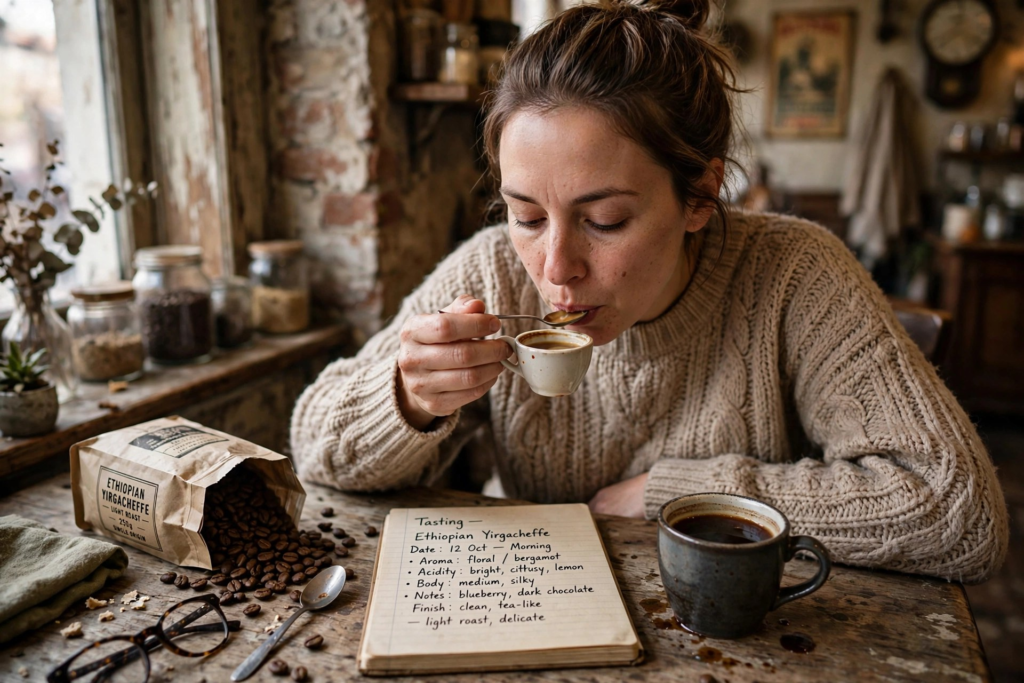
Set up a small ritual. Pour two coffees you want to compare. Smell both before tasting either. Taste the first, then the second, then the first again. Write one line per coffee: bright or soft, light or full, clean or lingering finish. One honest line, repeated over weeks, builds a better palate than a page of guesswork written once.
Training Your Palate Between Cups
Your flavour memory is built from everything you eat and smell, not just coffee. The fastest way to improve it is to taste reference foods deliberately. Eat a square of dark chocolate and pay attention to its bitterness and cocoa character. Smell jasmine tea. Taste a spoonful of honey, then a piece of dried apricot, then a handful of toasted hazelnuts. Each becomes a mental anchor, so that when a coffee reminds you of something, you have a name for it.
Comparison is the other great teacher. Taste a washed coffee next to a natural-processed one from the same region, and the difference processing makes becomes obvious in a way no article can convey. Taste the same coffee brewed two ways, and you learn what the brewer contributes. Taste a light roast next to a dark roast of a similar bean, and you feel how roasting trades delicate sweetness and floral notes for caramel, chocolate, and roast character.
It also pays to keep notes, however rough. A line like “Ethiopia, washed: floral, lemon acidity, light body, clean finish” is worth more a month later than a perfect memory of a cup you never wrote down. After ten or twenty such lines, patterns emerge. You discover you prefer washed coffees, or fruit-forward naturals, or low-acid full-bodied cups. Those preferences are far more useful than any score, because they tell you what to buy next.
Reading the Bag Like a Taster
Once you have tasted a few coffees deliberately, the notes on a bag start to make sense. They are not ingredients; nobody added blackcurrant to your Ethiopian coffee. They are the roaster’s tasting notes, translated through the flavour wheel, describing compounds created by the bean’s origin, its processing, and its roast. You may not taste every note listed, and that is normal. Your palate, your water, and your brewer all shift the result.
The Point of It All
Coffee tasting has a reputation for pretension, and some of that is earned. But at its core it is a simple pleasure: paying real attention to something you already enjoy every day. The difference between drinking coffee and tasting it is the difference between hearing music in the background and sitting down to listen.
So the next time you brew a cup, slow down for a minute. Smell it before you sip. Let it cool a little and taste it again. Ask yourself one question, fruity or floral, bright or soft, light or full, and write the answer down. That is the art of coffee tasting, and it starts with your next cup.