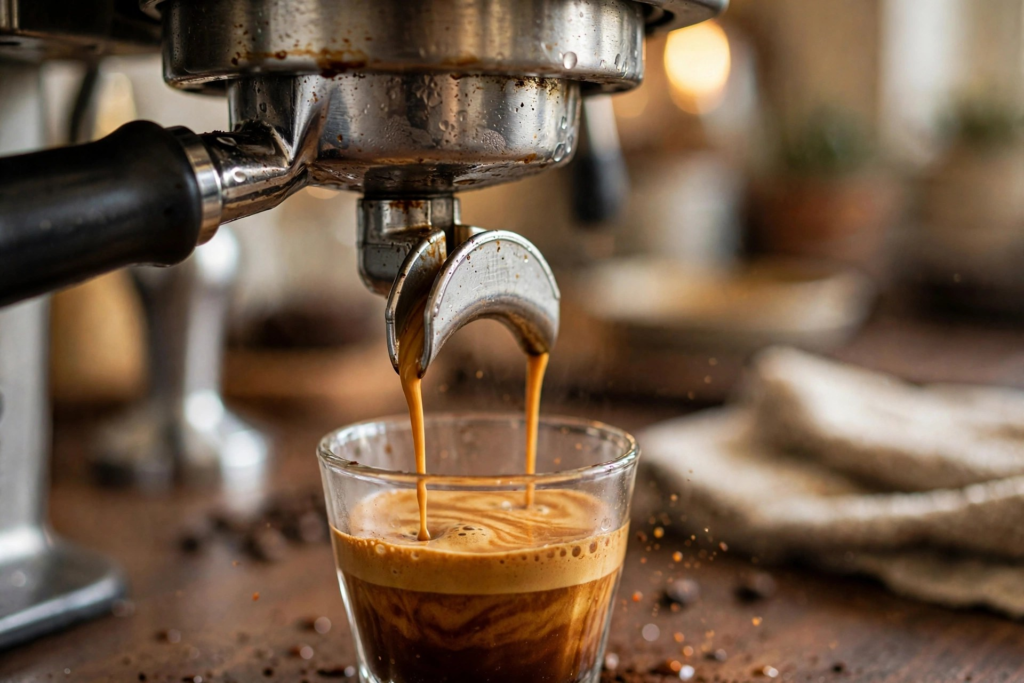
There is a particular silence that falls over a café the moment a good barista starts a shot. The steam wand goes quiet, the grinder stops, and everyone within earshot seems to hold their breath for twenty-five seconds. That silence is not reverence for theatre — it is concentration. An espresso shot is the most exacting thing you will ever brew, and the most rewarding when it lands.
This is a craft worth learning slowly. The old Viennese coffee houses built their reputations on it long before the word “barista” crossed the Atlantic, and nothing fundamental has changed since Luigi Bezzera patented his steam-driven espresso machine in 1901: finely ground coffee, hot water, pressure, and a very short window in which everything must be right. What has changed is how much we understand about what “right” means.
What a Perfect Shot Actually Looks Like
Forget the old rule of thumb about seven grams and an ounce of liquid — that belongs to the era of tiny Italian single shots. Modern specialty practice works almost entirely in doubles, and the numbers are worth learning because they are the language every good barista speaks. Start with a dose of roughly 18 grams of finely ground coffee and aim to pull about 36 grams of liquid espresso — a one-to-two ratio — in 25 to 30 seconds, with the machine’s pump delivering around nine bars of pressure. That is your baseline. Everything else is adjustment.
When it goes well, the shot pours like warm honey from the bottomless or spouted portafilter, starting dark and syrupy and slowly lightening toward the end. On the surface sits the crema — a reddish-gold foam — with the body beneath it and the darker heart at the bottom. A seasoned drinker stirs before tasting, because those layers are not decoration; they are flavour in strata. The crema should smell sweet, almost like caramel. If it looks pale and thin, something upstream needs attention.
Warm Everything Before You Begin
Espresso is unforgiving about temperature, and this is the corner most home brewers cut first. Your machine should heat up for fifteen to twenty minutes before you pull anything — not the five minutes the ready-light suggests. A cold portafilter will strip heat from the shot in seconds and flatten the flavour before it ever reaches the cup.
Run a blank shot of hot water through the group head first. This warms the metal, clears yesterday’s coffee oils, and stabilises the temperature. Warm your demitasse the same way, or simply fill it with hot water while you grind. A shot of espresso is barely two ounces of liquid; it loses heat fast, and a cold cup will punish you for it.
Grind Fine, Grind Fresh
If you take one thing from this guide, let it be this: the grinder matters more than the machine. A mediocre machine paired with a good burr grinder will outperform an expensive machine fed stale, pre-ground coffee every time. Espresso demands a fine, even grind — somewhere around table salt — and the consistency of a proper burr grinder is what makes the water flow through the puck evenly instead of finding shortcuts.
Grind immediately before brewing. Coffee begins losing its volatile aromatics within minutes of grinding, and pre-ground coffee, no matter how fine, cannot be adjusted when the shot runs fast or slow — which is the entire game of dialling in. Freshness of the beans matters too: coffee is at its best between about one and four weeks off the roast. Beans younger than five days can taste gassy and unstable; beans older than a month produce thin, lifeless crema.
Dose, Distribute, and Tamp
Weigh your dose. Eighteen grams for a standard double basket is the usual starting point, though baskets vary — check yours. Consistency here is everything, because you cannot diagnose a shot when the dose changes every time. A small digital scale on the counter is the single cheapest upgrade a home barista can make.
Once the grounds are in the basket, they need to be level before you tamp — an uneven bed locks unevenness into the puck. Tap the portafilter gently against the counter to settle the coffee, sweep a finger across the top, and if you own a distribution tool or a set of fine needles (the Weiss Distribution Technique), break up any clumps you see. Then press the tamper straight down, level and firm, until the puck stops compressing. What matters most is not the legendary thirty pounds of pressure — it is that you tamp level, straight, and the same way every single time. Pressure brewing forgives small errors far more readily than espresso does, so this is where your technique has to be deliberate.
Lock In and Pull
Here is where the seconds start to count, and where haste actually pays. Lock the portafilter into the group head immediately after tamping — a tamped puck left sitting begins absorbing moisture and heat unevenly, and stale seconds show up in the cup. Place your warmed cup underneath, start the pump, and start your timer at the same moment.
Watch the flow the way you would watch a kettle you cannot afford to let boil. The first drops should appear dark and slow, thickening into steady, mouse-tail streams within a few seconds. As the shot progresses, the stream lightens in colour — this is called blonding — and that is your cue that the extraction is nearing its end. For most shots you will stop the pump at 36 grams of liquid, somewhere between 25 and 30 seconds after you started.
Do not let it run long out of curiosity. The compounds that dissolve late in the extraction are bitter and hollow, and every second past your target dilutes what the first twenty seconds built. Ending the shot decisively is a skill; many beginners improve their espresso more by stopping earlier than by anything else.
Reading the Shot and Dialling It In
Taste the shot immediately, while it is hot — espresso’s aromatics fade fast. What you taste tells you what to change, and you should change only one thing at a time. A sour, sharp, or thin shot is almost always under-extracted: grind a touch finer, and it will slow down and sweeten. A bitter, dry, or harsh shot is over-extracted: grind a touch coarser. If the shot chokes and barely drips, the grind is far too fine or the dose too high. If it gushes out in fifteen seconds, go finer.
None of this resolves in a single morning. Every new bag of beans — sometimes every humid afternoon — will want a small adjustment, because grind, humidity, and coffee age all move the target slightly. Keep a notebook by the machine: date, beans, grind setting, dose, yield, time, and a few words on taste. It feels fussy for a week, and then one day you realise you have stopped making bad shots, and you cannot quite say when it happened. That is the whole craft, really — attention, repeated until it becomes instinct.
1 Comment