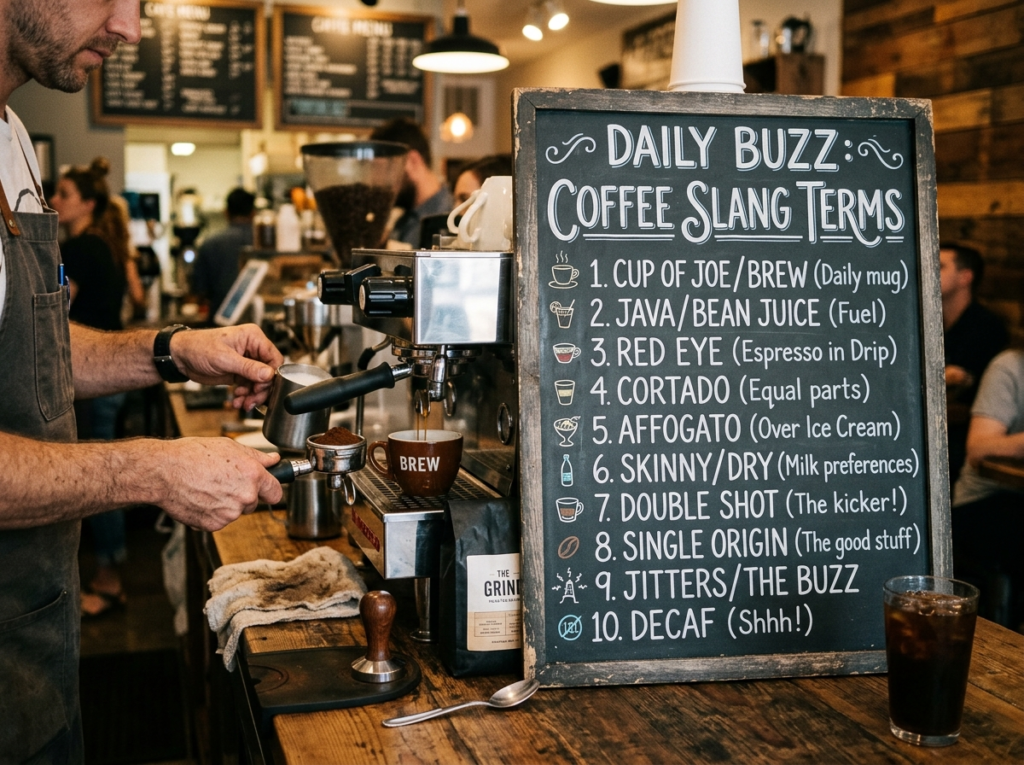
You walk up to a coffee shop counter. The person ahead of you casually says, “I’ll take a red eye with a long pull, extra dry.” The barista doesn’t blink. You, on the other hand, feel like you just walked into a secret society where everyone speaks a language you never learned.
That’s coffee slang for you — a whole vocabulary built around beans, brews, and barista culture. And honestly? Most of it isn’t complicated at all. You just need someone to break it down for you in plain English.
That’s exactly what we’re doing here. Whether you’re a casual coffee drinker who wants to sound a bit more confident at the counter, a new barista trying to keep up with veteran coworkers, or just a curious soul who likes knowing what words mean — this guide covers the coffee slang terms you’ll actually hear in real life. No fluff, no textbook lectures. Just the fun coffee words that make the coffee world feel a little less intimidating and a lot more enjoyable.
Why Coffee Even Has Its Own Slang
Coffee isn’t just a drink. It’s a culture, a ritual, a global obsession that’s been evolving for centuries. And like any deep-rooted culture — think music, sports, or cooking — it’s developed its own language over time.
Some of these terms come from Italian, because espresso culture was essentially born in Italy. Words like “ristretto,” “lungo,” and “macchiato” are straight-up Italian, and they describe very specific things about how espresso is pulled. Other slang words are purely American inventions, born out of diner culture, third-wave coffee shops, or just baristas getting creative behind the counter.
Then there’s the internet era. Social media, TikTok coffee trends, and online communities have added a fresh layer of coffee lingo that didn’t exist even ten years ago. Terms like “dirty chai” or “puppuccino” became mainstream not through barista training manuals, but through viral posts and word-of-mouth.
The point is: coffee shop slang isn’t random. Each term has a reason for existing. And once you know the backstory, the words actually stick in your memory.
Espresso-Based Coffee Slang Terms
Espresso is the backbone of most coffee shop menus. It’s also where a huge chunk of barista terms come from. If you’ve ever stared at a café menu and felt confused by all the Italian-sounding names, this section is for you.
The Pull — What It Actually Means
You’ll hear baristas say they’re “pulling a shot.” This phrase goes back to the early espresso machines in Italy (think 1940s and 1950s), which had a lever you literally pulled down to force hot water through the coffee grounds. Modern machines use pumps, but the term survived. So when someone says “pull me a double,” they mean: make me a double espresso.
A short pull (or ristretto) uses less water, creating a smaller but more concentrated shot. A long pull (or lungo) uses more water, giving you a larger, slightly milder shot. Same amount of coffee grounds — just different water volumes. The flavor difference is real. Ristrettos tend to taste sweeter and richer, while lungos lean a bit more bitter.
Dialing In
This one’s big in specialty coffee circles. Dialing in means adjusting the grind size, dose, and extraction time until you get the perfect shot. It’s not a one-and-done thing — baristas often dial in every morning because factors like humidity, bean freshness, and even the age of the grinder burrs affect the output.
If you ever hear a barista say, “I’m still dialing in this new single origin,” it means they’re tweaking their setup to get that particular coffee tasting its best.
God Shot
This is the holy grail of espresso. A god shot is that rare, perfect pull where everything aligns — the crema is gorgeous, the flavor is balanced, and the mouthfeel is silky. Most baristas will tell you it doesn’t happen every day. Some say they’ve only experienced a handful in their entire career. It’s part skill, part science, and honestly, a little bit of luck.
Crema
Speaking of crema — it’s that thin, golden-brown layer of foam sitting on top of a freshly pulled espresso shot. Crema forms because the high pressure of espresso extraction emulsifies the coffee’s oils and creates tiny CO2 bubbles. A lot of people think thick crema automatically means good espresso. That’s not always true. Over-extracted or very darkly roasted beans can produce loads of crema that actually tastes bitter and ashy. Good crema is more about quality than quantity.
Ordering Lingo You’ll Hear at the Counter
Walk into any busy coffee shop — Starbucks, a local third-wave café, or even a Dunkin’ — and you’ll hear ordering shorthand flying back and forth. Here’s what those quick terms actually mean.
Red Eye, Black Eye, and Dead Eye
These names sound dramatic, and honestly, they kind of are. A red eye is a regular drip coffee with one shot of espresso added. A black eye gets two shots. And a dead eye? Three shots of espresso dumped into your drip coffee.
Why “red eye”? The name supposedly comes from overnight “red-eye” flights, where passengers land exhausted and need maximum caffeine to function. The naming convention is playful but the caffeine hit is very real. If you’re curious about how caffeine levels compare across different drinks, you might be surprised at how a dead eye stacks up.
Wet vs. Dry
These terms usually apply to cappuccinos. A wet cappuccino has more steamed milk and less foam. A dry cappuccino is the opposite — lots of thick, airy foam and very little liquid milk. If you say “bone dry,” you’re telling the barista you want a cappuccino with espresso and foam only — no liquid steamed milk at all.
This distinction matters more than people realize. A wet cappuccino drinks closer to a latte. A bone-dry one is almost like sipping espresso through a cloud. Your preference here says a lot about what you actually enjoy in a coffee drink. If you’ve ever wondered about the real difference between a cappuccino and a regular coffee, these wet/dry variations make it even more nuanced.
Skinny
A skinny drink uses non-fat (skim) milk and sugar-free syrup. You’ll hear this a lot at Starbucks — “skinny vanilla latte,” for example. It’s a calorie-conscious order. If you’re someone who watches their intake but still loves specialty drinks, knowing this term saves you from explaining yourself every time. There are actually quite a few low-calorie options at Starbucks that go beyond just asking for skim milk.
With Room
“With room” means you want the barista to leave some space at the top of your cup — usually about an inch — so you can add cream, milk, or sweetener yourself. It’s one of those small, practical ordering terms that saves everyone time and avoids the awkward moment where your cup overflows when you try to pour half-and-half.
Shot in the Dark
Same concept as a red eye. Some regions and shops use this term instead. It’s a regular coffee with espresso added. The name changes depending on where you are — you might also hear it called a “depth charge” or a “boilermaker” (borrowed from bar culture). Same drink, different names.
Barista Terms Used Behind the Counter
Baristas have their own shorthand that customers rarely hear — or hear but don’t understand. If you’ve worked in a coffee shop or spent time hanging around one, some of these might sound familiar.
Tamping
Tamping is pressing the ground coffee down into the portafilter (that handled metal basket) before pulling an espresso shot. It needs to be firm and level. Uneven tamping creates channeling — where water finds the path of least resistance through the puck, leading to uneven extraction and a sour or bitter shot. Most baristas apply about 30 pounds of pressure, though newer research suggests consistency matters more than exact force.
Channeling
We just touched on this. Channeling happens when water doesn’t flow evenly through the coffee puck. Instead, it carves little channels and rushes through, under-extracting some parts and over-extracting others. The result? A messy, inconsistent shot. It’s something baristas constantly try to avoid, and it’s one reason why proper tamping, distribution, and grind consistency are so important.
Knock Box
That loud banging sound you hear behind the counter? That’s a barista knocking spent coffee grounds (called a “puck”) out of the portafilter and into a knock box — a sturdy container with a rubber bar across the top. You whack the portafilter against it, the puck falls out, and you’re ready for the next shot. Simple tool, satisfying sound.
Latte Art
You probably know this one visually, even if you didn’t know the term. Latte art is the pattern a barista creates by pouring steamed milk into espresso — hearts, rosettas, tulips, swans, and sometimes absurdly detailed portraits. It’s not just for show, though. Proper latte art actually indicates that the milk was steamed correctly (microfoam, not big bubbles) and that the espresso has good crema. Bad milk texture = no clean latte art.
Microfoam
This is the ideal texture of steamed milk for espresso drinks. Microfoam looks glossy and smooth, like wet paint. It has tiny, barely visible bubbles instead of big, frothy ones. Getting microfoam right is genuinely difficult — it takes practice with the steam wand, and the type of milk matters too. Whole milk foams most reliably. Oat milk has become a favorite alternative because it produces decent microfoam, though it behaves differently than dairy.
Bean and Roast Slang
The language around coffee beans themselves is a whole sub-category. You’ll encounter these terms at specialty roasters, in coffee bag descriptions, and on café menus that get a little more detailed than “light, medium, dark.”
Single Origin vs. Blend
A single origin coffee comes from one specific farm, region, or country. It lets you taste the unique characteristics of that particular place — an Ethiopian Yirgacheffe, for example, often has bright, fruity, almost tea-like qualities. A blend mixes beans from different origins to create a balanced, consistent flavor profile. Neither is “better.” Single origins are exciting for their uniqueness; blends are reliable and often designed to taste great with milk.
Third Wave
Third-wave coffee refers to the movement that treats coffee like wine or craft beer — focusing on origin, processing methods, roast profiles, and flavor notes. If your local café lists tasting notes like “stone fruit, dark chocolate, citrus zest” on their menu, they’re firmly in third-wave territory.
The first wave was instant coffee becoming a household staple (think Folgers, Maxwell House). The second wave was the Starbucks era — espresso drinks going mainstream, coffee shops becoming social hangouts. The third wave, which has been growing since the early 2000s, is all about quality, transparency, and treating coffee as an artisan product. Some people now talk about a “fourth wave,” but that term hasn’t fully settled yet.
Cupping
Cupping is the professional method of tasting and evaluating coffee. You coarsely grind the beans, add hot water directly in a cup, let it steep, break the “crust” of grounds on top with a spoon, and then slurp small spoonfuls to evaluate aroma, flavor, acidity, body, and aftertaste. Coffee buyers, roasters, and Q Graders (certified coffee tasters) use cupping to assess quality and decide which beans to purchase. It looks simple but involves a very structured scoring system developed by the Specialty Coffee Association (SCA).
Peaberry
Most coffee cherries contain two flat-sided beans facing each other. A peaberry is a natural mutation where only one rounded bean develops inside the cherry. Peaberries make up roughly 5-10% of a coffee harvest and are often sorted and sold separately because they supposedly roast more evenly (being round rather than flat) and can have a slightly more concentrated flavor. Whether they actually taste “better” is debatable — it’s really a matter of personal preference.
Drink Slang That Sounds Weird But Makes Sense
Some coffee terms sound like they belong in a completely different context. But once you know what they mean, they’re actually pretty logical.
Dirty Chai
A dirty chai is a chai tea latte with a shot of espresso added. The espresso “dirties” the chai. It’s a fan favorite for people who want the spiced warmth of chai with a caffeine boost and a richer, more complex flavor. Order it “double dirty” if you want two shots. Some shops also make a “filthy chai” with three. The naming convention is fun, the drink is genuinely delicious, and it’s one of those orders that makes you feel like an insider.
Flat White
This one causes a lot of confusion. A flat white originated in Australia and New Zealand (both countries claim it, and the debate is ongoing). It’s espresso with steamed milk — similar to a latte, but served in a smaller cup with a higher ratio of coffee to milk, and topped with a thin layer of microfoam rather than a thick cap of froth. The result is a stronger, more espresso-forward drink than a standard latte. If you want to understand how drinks like this differ from a caffè misto or a latte, the milk ratio is really where it all comes down to.
Affogato
Italian for “drowned.” An affogato is a scoop of vanilla gelato or ice cream with a hot espresso shot poured over it. Is it a drink? A dessert? Honestly, it’s both. You eat/drink it quickly before the ice cream fully melts into the coffee. It’s the kind of thing you order at the end of a nice meal, and it never disappoints.
Puppuccino
If you’ve ever seen a dog with a tiny cup of whipped cream at a drive-through, you’ve seen a puppuccino. It’s not on any official menu — it’s a small cup of whipped cream offered (usually free) at places like Starbucks for your furry friend. No coffee, no caffeine, just cream and a very happy dog. There’s a whole guide to the Starbucks Puppuccino if you want to know the etiquette of ordering one.
Breve
A breve (pronounced “BREV-ay”) replaces regular milk with half-and-half. So a breve latte is espresso with steamed half-and-half instead of whole or skim milk. It’s richer, creamier, and significantly more calorie-dense. Think of it as the indulgent option. Some people order it as an occasional treat; others swear by it daily.
Coffee Culture Slang and Fun Coffee Words
Beyond the technical barista terms, there’s a whole layer of casual, cultural slang that coffee lovers use in everyday conversation and online.
Cup of Joe
One of the most iconic coffee nicknames. The origin is debated. One popular theory credits Secretary of the Navy Josephus Daniels, who banned alcohol aboard Navy ships in 1914, making coffee the strongest available drink — hence, “a cup of Joe.” Other linguists think it’s just a genericization of “java” or “jamoke” (a blend of “java” and “mocha”). Whatever the real story, “cup of Joe” has stuck around for over a century, and everyone knows what it means.
Java
Java is both a nickname for coffee and the name of an Indonesian island that was one of the earliest major coffee-producing regions. Dutch colonists started growing coffee on Java in the 17th century, and the island’s name became synonymous with the drink itself. Today, Java still produces coffee, but the slang term has far outgrown its geographic roots.
Mud
Calling coffee “mud” is usually affectionate — or it’s describing a really thick, strong, possibly over-extracted brew. “Pass me some mud” is something you’d hear in a diner, on a construction site, or from your grandpa who’s been drinking the same dark roast since 1978. It’s straightforward, no-nonsense coffee slang.
Bean Juice
The most literal, playful coffee nickname out there. You’ll see “bean juice” a lot on social media, in memes, and on coffee-themed merchandise. It’s not technical. It’s not even clever, really. But it makes people smile, and that counts for something.
Decaf Drinker (as a Gentle Insult)
In certain coffee-obsessed circles, calling someone a “decaf drinker” is a lighthearted way of saying they’re not fully committed or they’re being a bit soft. It’s not serious — just playful coffee culture ribbing. Of course, there’s absolutely nothing wrong with drinking decaf. Some of the best specialty coffees now come in excellent decaf versions, and plenty of real coffee enthusiasts switch to decaf in the afternoon.
Brewing Method Slang
Different brewing methods have spawned their own coffee lingo, and knowing these terms makes you sound like you genuinely understand what’s happening with your coffee.
Pour Over
A pour over is a manual brewing method where you slowly pour hot water over coffee grounds in a filter, and gravity does the rest. Popular pour-over devices include the Hario V60, Chemex, and Kalita Wave. The barista controls the pour rate, water temperature, and timing, which means each cup can be customized. It takes longer than pushing a button on a machine, but pour-over fans swear the clarity and flavor complexity are worth it.
French Press (or Press Pot)
A French press uses a metal mesh filter and steeps ground coffee directly in hot water for about four minutes before you press the plunger down. It produces a full-bodied, slightly gritty cup because the mesh filter lets oils and fine particles through. People who love French press coffee enjoy that thick, robust mouthfeel. People who don’t call it “sludge.” Both opinions are valid.
Cold Brew vs. Iced Coffee
These two get mixed up constantly, but they’re very different. Cold brew is made by steeping coarse coffee grounds in cold or room-temperature water for 12 to 24 hours. It’s smooth, less acidic, and naturally sweeter. Iced coffee is regular hot-brewed coffee that’s been cooled down and poured over ice. It tends to have more brightness and acidity. Cold brew isn’t just “cold coffee.” The extraction process itself is fundamentally different, which changes the chemical composition and flavor profile of the drink.
Cowboy Coffee
Cowboy coffee is about as no-frills as it gets. You boil water, toss in ground coffee, let it steep, and then pour carefully (or strain through your teeth, if you want to be authentic about it). No filter, no fancy equipment. It’s how coffee was made on trail rides and cattle drives, and some outdoor enthusiasts still make it this way while camping. The taste? Strong, gritty, and character-building.
AeroPress
The AeroPress was invented in 2005 by Alan Adler — the same guy who invented the Aerobie flying ring. It’s a small, plastic, manual brewing device that uses air pressure to push water through coffee grounds. It’s portable, nearly indestructible, and incredibly versatile. There’s even a World AeroPress Championship held annually where competitors get wildly creative with their recipes. It’s become a cult favorite among travelers and home brewers.
Starbucks-Specific Coffee Lingo
Starbucks has essentially created its own dialect within coffee culture. Love them or not, their terminology is everywhere, and knowing it saves you time in line.
Their sizing system — Tall (12 oz), Grande (16 oz), Venti (20 oz hot / 24 oz cold), and Trenta (30 oz, cold drinks only) — confuses newcomers regularly. “Tall” is their small. “Grande” is medium. “Venti” means twenty in Italian, referring to the ounce count. If you’ve ever been curious about how other chains handle cup sizes, the differences are interesting.
A Frappuccino is Starbucks’ trademarked blended ice drink. It’s not a universal coffee term — it’s their brand name. You won’t find a “Frappuccino” at a non-Starbucks shop. Other cafés call similar drinks “blended coffee” or “ice blended.” Speaking of which, if you want to know the caffeine content of a Vanilla Frappuccino, it’s lower than most people expect.
The secret menu is another interesting piece of Starbucks lingo. It’s not actually a menu that exists in the store — it’s a collection of custom drink combinations that spread through social media. Baristas aren’t trained on these drinks, so if you order a “Cotton Candy Frappuccino,” you’ll need to know the actual recipe to tell them. There’s a useful overview of popular Starbucks secret menu drinks that breaks this down.
Regional Coffee Slang From Around the World
Coffee is global, and every region adds its own flavor — literally and linguistically — to the conversation.
In Australia, ordering a “long black” gets you hot water with a double espresso poured over it (similar to an Americano, but the espresso goes on top to preserve the crema). A “short black” is a straight espresso. And a “flat white,” as we talked about earlier, is their signature contribution to global coffee culture.
In Italy, you’d never order a “latte” by itself — “latte” just means “milk” in Italian, so you’d get a glass of plain milk. You say “caffè latte” if you want what Americans call a latte. Also, ordering a cappuccino after 11 AM in Italy is considered a faux pas. Italians view it as a breakfast drink, and drinking milky coffee after a meal is seen as unusual.
Turkish coffee isn’t just a brewing style — it’s a whole ritual. Finely ground coffee is simmered in a small pot called a “cezve” (or “ibrik”), often with sugar added during brewing. The grounds settle at the bottom of your cup, and in some traditions, the leftover grounds are even used for fortune-telling (called “tasseography”).
In Ethiopia — widely considered coffee’s birthplace — the coffee ceremony (“Buna Tetu”) is a social event that can last hours. Green beans are roasted on the spot, ground by hand, and brewed in a clay pot called a “jebena.” Being invited to a coffee ceremony is a sign of friendship and respect.
Slang That Describes Coffee Taste
When coffee professionals and enthusiasts describe what they’re tasting, they use specific vocabulary that can sound unusual to outsiders.
Bright means a coffee has noticeable, pleasant acidity — like the tangy zip you get from a citrus fruit. It doesn’t mean sour or unpleasant. Brightness is actually a highly valued quality in specialty coffee, especially in light roasts from East African origins like Kenya and Ethiopia.
Body refers to the weight and texture of coffee in your mouth. A full-bodied coffee feels thick and heavy (think Sumatran or Brazilian). A light-bodied coffee feels more like tea — clean and almost watery. Neither is objectively better; it’s a preference.
Earthy describes flavors that remind you of soil, wood, mushrooms, or wet forest floor. It sounds unappealing, but many people love earthy coffees, especially those from Indonesia. Sumatra Mandheling, for example, is famously earthy and it’s adored by dark-roast fans worldwide.
Fruity is increasingly common in third-wave coffee descriptions. Natural-processed Ethiopian coffees, for instance, can taste like blueberries, strawberries, or stone fruit. If you’re used to traditional dark-roast diner coffee, a fruity light roast can be genuinely surprising. Some people love it immediately. Others need a few cups to adjust.
Clean describes a coffee with a clear, transparent flavor — no muddiness, no lingering off-tastes. It’s the opposite of earthy. Clean coffees let you pick out individual flavor notes easily. Washed-process coffees from Central America tend to be on the cleaner end of the spectrum.
FAQ
What does “86” mean in coffee shop slang?
“86” means something is out of stock or has been cut from the menu for the day. If a barista says, “We’ve 86’d the oat milk,” it means they’ve run out. The term comes from restaurant and bar culture, and its exact origin is debated — some trace it to 1920s New York speakeasies, others to military jargon. Either way, it’s used widely across food and beverage service.
What’s the difference between a macchiato at Starbucks vs. a traditional café?
A traditional macchiato (caffè macchiato) is a shot of espresso “marked” or “stained” with just a tiny dollop of milk foam. It’s a small, strong drink. Starbucks’ version — the Caramel Macchiato, for example — is essentially a vanilla latte with caramel drizzle, served in a large cup. They share a name but are fundamentally different drinks in size, sweetness, and coffee-to-milk ratio.
Why do baristas say “pulling” a shot instead of “making” one?
The term goes back to lever-operated espresso machines from the mid-20th century. Baristas physically pulled a lever to create the pressure needed to force water through the grounds. Modern machines are pump-driven, but the language stuck. It’s one of those coffee traditions that lives on through vocabulary even after the technology changed.
What does “dialed in” mean in coffee slang?
It means the grinder, dose, and extraction settings have been adjusted to produce the best-tasting shot with a particular coffee. Think of it like tuning a guitar — you make small adjustments until everything sounds (or in this case, tastes) right. Baristas typically dial in at the start of each shift because environmental factors and bean freshness change daily.
Is there a difference between coffee slang and barista terms?
There’s overlap, but they’re not identical. Barista terms tend to be technical and job-specific — tamping, channeling, dosing, extraction yield. Coffee slang is broader and includes cultural nicknames (cup of Joe, bean juice), ordering shorthand (red eye, skinny), and casual expressions used by drinkers and professionals alike. Most barista terms are coffee slang, but not all coffee slang is barista-specific.
Your Coffee Vocabulary Cheat Sheet
Here’s the thing about coffee slang terms — you don’t need to memorize every single one. You pick them up naturally. The more you order, the more you visit different shops, the more you experiment with brewing at home, the more these words just become part of how you talk about coffee.
Start with the terms that apply to your actual life. If you order espresso drinks, learn the pull and foam vocabulary. If you brew at home, get familiar with dialing in and extraction language. If you just want to have fun, “bean juice” and “cup of Joe” are always there for you.
Language is one of the things that makes coffee culture so rich and welcoming. Every weird term has a story behind it, every piece of barista shorthand exists because someone needed a faster way to communicate during a morning rush, and every regional nickname carries a little piece of local history.
Next time you’re at the counter, try ordering something using its proper slang. Ask for a red eye, request your cappuccino bone dry, or tell them you want room. You’ll notice the barista’s eyes light up just a little — because you’re speaking their language now.