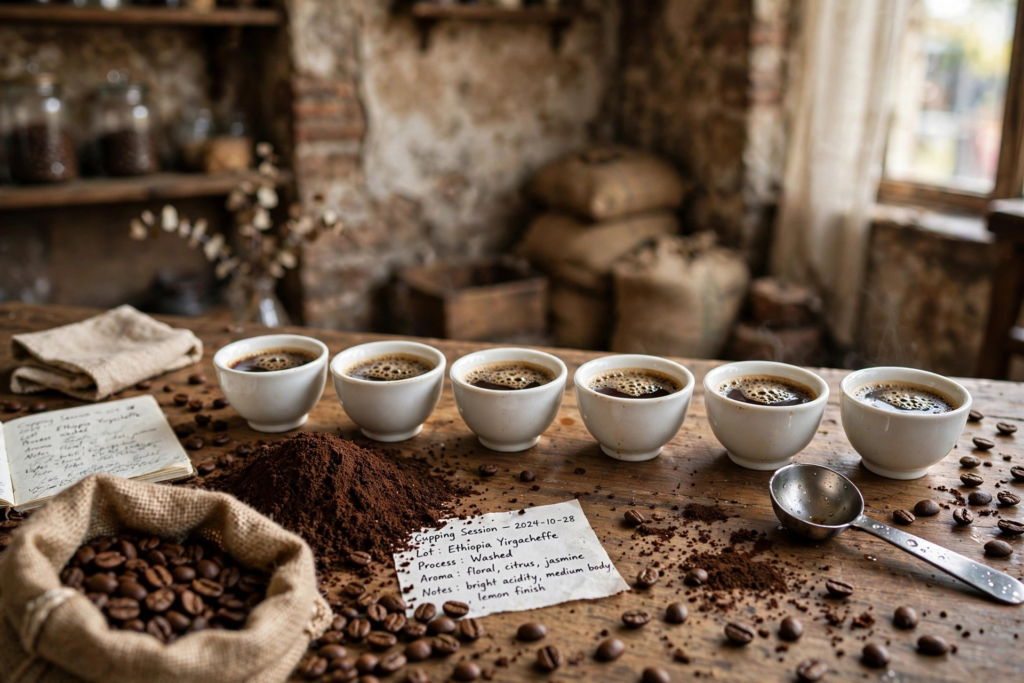
Walk into a roastery on a delivery day and you might catch a strange scene: a long table lined with small bowls of coffee, a row of spoons, and a group of people sniffing, slurping loudly, and scribbling notes. Nobody is drinking a morning cup. They are cupping, and while it looks like a ritual, it is really the coffee trade’s oldest and most honest way of answering a simple question: what does this coffee actually taste like?
Cupping is how roasters choose which lots to buy, how importers check that a shipment matches its sample, and how competition coffees are judged. It is also something anyone can do at a kitchen table with a kettle, a grinder, and a few bowls. You need curiosity and a consistent method.
What Cupping Is, and Why It Works
Every brewing method adds its own fingerprints to a cup. A paper filter strips out oils, a metal filter lets them through, an espresso machine amplifies body and compresses flavour. Cupping removes all of that. Ground coffee steeps directly in hot water, like a French press without the press, so nothing stands between you and the bean. When every sample on the table is prepared exactly the same way, the only thing left to explain the differences is the coffee itself.
That uniformity is the whole point. Change the grind for one sample, or pour cooler water on another, and your comparison falls apart. Cupping is less about fancy technique than about discipline: same dose, same grind, same water, same timing, every bowl.
Roasters and buyers have used versions of this method for well over a century, and the Specialty Coffee Association eventually formalised it into a written protocol so that a buyer in one country and a producer in another can taste the same coffee and agree on what they are tasting. At home, you can relax the lab-coat parts. The core discipline still matters.
What You Need
Keep the kit simple. For each coffee you want to taste, you need two identical small bowls or sturdy cups, each holding roughly 150 to 200 millilitres. Two bowls per coffee is the professional habit: if they disagree, something went wrong in preparation. A kitchen scale, a burr grinder, a kettle, a timer, and a couple of deep spoons complete the setup. Soup spoons work perfectly well in place of proper cupping spoons.
Choose coffees that are freshly roasted, ideally within a couple of weeks of their roast date, and grind them just before you start. A coarse grind, roughly the texture of raw sugar, is right; finer grinds over-extract in a steep and muddy the comparison. Purge a pinch of each new coffee through the grinder before grinding its dose, so the previous coffee does not haunt the next bowl.
Setting Up: Dose, Water, and Timing
The widely used standard ratio is 8.25 grams of coffee per 150 millilitres of water, which works out to about 55 grams per litre. It is stronger than most home brewing ratios, deliberately so: the extra concentration makes small differences between coffees easier to spot. If your bowls hold 200 millilitres, use about 11 grams.
Heat clean, fresh water to around 93 degrees Celsius, just off a rolling boil. Water that is too cool under-extracts and leaves the cup thin and sour; water straight off a violent boil can scorch delicate aromatics.
Fragrance: Smelling the Dry Grounds
Before a drop of water touches the coffee, lean in and smell the dry grounds. This first impression is called fragrance, and it is surprisingly revealing. Fresh coffee smells sweet, nutty, or floral. Stale coffee smells flat, papery, or faintly woody before you have even brewed it. Over-roasted coffee announces itself here too, with a sharp, ashy edge. Write down whatever comes to mind, even if it sounds odd; a note that says “smells like a bakery” is more useful than a blank line.
Pour, Steep, and Break the Crust
Pour the hot water over the grounds, wetting everything evenly, and start the timer. Then leave the bowls alone for four minutes. The grounds will rise and form a crust on the surface, trapping gases and aroma beneath it. Resist the urge to stir.
At four minutes, it is time for the most satisfying part of the whole ritual. Take a spoon, push it gently through the crust toward the back of the bowl, three slow strokes, and lean in close as you do. The aroma that rushes out, the wet aroma, is deeper and more intense than the dry fragrance, and it is your best preview of what the cup will taste like. This is the moment cuppers live for, and it is worth taking your time over.
Once the crust is broken, stir gently so the heavier grounds sink, then skim the surface clean with two spoons. Rinse your spoons in clean hot water between bowls so flavours do not cross over.
The Slurp
Now the loud part. Dip a spoon into the bowl, lift a spoonful, and slurp it with real force, drawing the coffee across your whole palate as a fine spray. It sounds ridiculous, and everyone at a professional cupping sounds ridiculous doing it. The noise has a purpose: aerating the coffee spreads it over your tongue and drives aromatic compounds up into your nasal passages, where most of what we call flavour is actually perceived. A polite sip simply cannot do the same job.
What You Are Looking For
Professional cuppers break a coffee down into a handful of qualities. You do not need to score them formally, but the categories give your palate somewhere to look.
Aroma and flavour. Aroma is what you smell, flavour is what you perceive once the coffee is in your mouth, and the two overlap heavily. Ask yourself what the coffee reminds you of: fruit, flowers, nuts, chocolate, caramel, spice, herbs. Start broad, then narrow. “Fruity” can become “berry-like,” and berry-like can become “blackcurrant” once you have tasted enough coffees to anchor the words.
Acidity. In coffee, acidity does not mean sourness. It means brightness, the crisp quality that makes a Kenyan coffee sparkle or an Ethiopian coffee taste like citrus. A coffee with no acidity tastes flat and dull; one with the wrong kind tastes sour and sharp. The difference is whether the brightness is backed by sweetness and aroma, or standing alone and unpleasant.
Body. Body is the weight and texture of the coffee in your mouth, from light and tea-like to heavy and syrupy. It is driven by dissolved solids and oils rather than flavour, which is why a coffee can feel full-bodied while tasting simple, or feel delicate while tasting complex.
Sweetness and balance. Sweetness in coffee is not sugar; it is the perception of ripe, honeyed, caramel-like character that rounds out the cup. Balance is how well all of these qualities hold together. A coffee with dazzling acidity but no body feels lopsided; one where nothing dominates is balanced, and balance is often what separates a good coffee from a memorable one.
Aftertaste. What lingers after you swallow matters as much as the sip itself. Is the finish clean and sweet, or does it turn dry, bitter, or papery? A long, pleasant finish is one of the most reliable signs of quality, and one of the easiest things for a beginner to notice.
Traditionally, coffees evaluated this way were scored out of 100, with 80 points and above marking the threshold for specialty coffee. The Specialty Coffee Association has since moved to a newer assessment system that separates describing a coffee from judging it, but the old 80-point line still appears on bags and in conversation, and it remains a useful shorthand for quality.
Running Your First Home Cupping
Pick two or three coffees that are different enough to teach you something: a washed Ethiopian next to a natural Brazilian, for instance, or the same origin at two roast levels. Label the bottoms of the bowls, not the rims, so you can taste blind if you like. Keep the room free of strong smells that compete with the coffee.
Work through the stages in order, fragrance, wet aroma, then tasting at hot, warm, and cool temperatures, and jot a line or two at each stage. Do not wait until the end to write things down; the hot-cup impressions will be gone by then. A coffee that seems tight and sharp when hot may open into sweetness as it cools, and faults that hid behind heat sometimes step forward. Compare your notes across the coffees rather than agonising over any single bowl. Tasting is comparative by nature, and differences teach faster than absolutes.
One last piece of advice: say what you taste out loud, even if it sounds strange. Everyone’s palate is wired a little differently, and the person next to you may catch the apricot you missed while you catch the honey they overlooked. Slurp loudly, write honestly, and let the coffee do the talking.
1 Comment