Espresso has a vocabulary problem. Walk into any serious discussion of machines and you’ll be pelted with letters — PID, OPV, HX, SBDU — as though everyone agreed to memorise the manual and nobody handed you a copy. But each term names a real decision the machine makes on your behalf.
This is a guided tour through the machine’s anatomy, grouped the way the shot experiences it: water, coffee, pressure, heat, and care. By the end you’ll know what each part does for the cup — which is the only definition that ever mattered.
The Path of the Water: Boiler to Cup
Everything starts in the boiler, the sealed tank where water is held at brewing or steaming temperature. Boiler material matters: brass and copper conduct heat evenly, while smaller aluminium boilers heat faster but run twitchier. The water leaves under the force of the pump — home machines mostly use vibration pumps, which build pressure in pulses while the shot runs; commercial machines use rotary pumps, which hold it with an eerie, steady calm. Between pump and coffee sits the OPV, the over-pressure valve — a small, adjustable valve that bleeds off excess pressure so the coffee sees no more than about 9 bar. Some owners lighten it to 8 or even 6 bar for delicate, lightly roasted coffees that channel under full pressure.
The water’s final stop before coffee is the group head, the fixture the portafilter locks into. The classic E61 is a heavy chrome-plated brass group kept hot by a constant circulation of boiler water — the “thermosyphon” — which is why E61 machines take so long to warm up and hold temperature so well. Newer saturated groups bolt the brewing chamber directly to the boiler and respond faster. Beneath the group head, the shower screen spreads incoming water evenly over the puck, while the group gasket seals the portafilter so pressurised water goes through the coffee and not around it. A worn gasket is the single most common cause of a leaky lock-in, and it costs a few dollars to replace.
Portafilters and Baskets: Where Coffee Meets Water
The portafilter is the handled device that holds your ground coffee during extraction. The standard commercial size is 58 millimetres, and machines that use it — like the Rancilio Silvia — give you access to the entire universe of aftermarket baskets and tampers. Smaller home machines use 51, 53, or 54 millimetre baskets, which is worth knowing before you buy accessories.
Portafilters come in personalities. The spouted (double-spouted) portafilter is the classic: the stream splits into two, filling two cups at once. The naked or bottomless portafilter has no spouts at all — the espresso drips straight from the basket, so channeling, uneven flow, and blonding are plainly visible. It’s a diagnostic instrument. The pressurized portafilter has a single tiny exit hole that artificially creates back pressure and a foamy pseudo-crema; it’s forgiving of stale coffee and bad grinds — which is why enthusiasts graduate away from it, since it hides the feedback you need to improve.
Inside the portafilter sits the basket, the perforated metal cup the grounds live in. Straight-walled baskets with evenly drilled holes extract more uniformly than tapered or poorly drilled ones. Singles hold roughly 7–9 grams, doubles 14–18, triples around 20–22 — though in practice the double is the workhorse of modern espresso.
How Machines Handle Heat: Boilers, Thermostats, and PIDs
Temperature is the other half of espresso, and machine designs are philosophies of heat. A single boiler, dual use (SBDU) machine uses one boiler for both brewing and steaming — the most affordable architecture, and the reason for rituals like temperature surfing. A heat exchanger (HX) machine keeps its single boiler at steam temperature and flashes brew water through a metal tube inside it; HX machines brew and steam simultaneously but require a cooling flush before brewing. A dual boiler gives each job its own boiler and its own control — the connoisseur’s architecture, at a connoisseur’s price. Cheaper machines use a thermoblock: a block of heated metal that flashes water on demand. Fast to heat, but the least thermally stable of the lot.
The thermostat is the oldest control scheme: a switch that turns the heater on and off with a wide deadband, which is why surfed machines swing through a range of temperatures. The PID — proportional-integral-derivative controller — is the modern answer: a small computer that adjusts the heater in tiny, continuous increments, holding the boiler within a degree of your setpoint. A PID display shows the boiler temperature, not the temperature at the puck — there’s always an offset — but it transforms consistency.
Pressure and the Start of the Shot
Espresso is defined by pressure: 9 bar — roughly nine times atmospheric pressure — is the canonical standard. But the moment before full pressure arrives matters too. Pre-infusion wets the puck gently at low pressure for a few seconds before ramping up, letting the coffee swell evenly and reducing channeling. The fanciest machines let you draw a pressure profile — a programmed curve of pressure over time, gentle at the start, full in the middle, declining at the end.
At the end of the shot, trapped pressure must be released. On machines with a 3-way solenoid valve, flicking the brew switch off vents the water above the puck with a satisfying thunk, leaving a dry, easy-to-knock-out puck. Machines without one leave a soupy puck you’ll need to wait out.
Grind, Dose, Tamp: The Coffee’s Preparation
The machine only does what the puck allows. A burr grinder crushes beans between two revolving burrs, producing a consistent particle size. Consistency is the whole point: uneven particles mean uneven resistance, which means channeling. Blade “grinders” chop randomly and have no place near espresso.
dose is the weight of dry coffee in the basket — typically 18 grams for a modern double, weighed on a scale. From dose and yield comes the brew ratio: 18 grams in, 36 grams out is a 1:2 ratio, the modern default called a normale. A ristretto is a shorter, restricted shot — roughly a 1:1 ratio, intense and syrupy. A lungo is long, 1:3 or beyond, thinner and more bitter as late-extracting compounds join in.
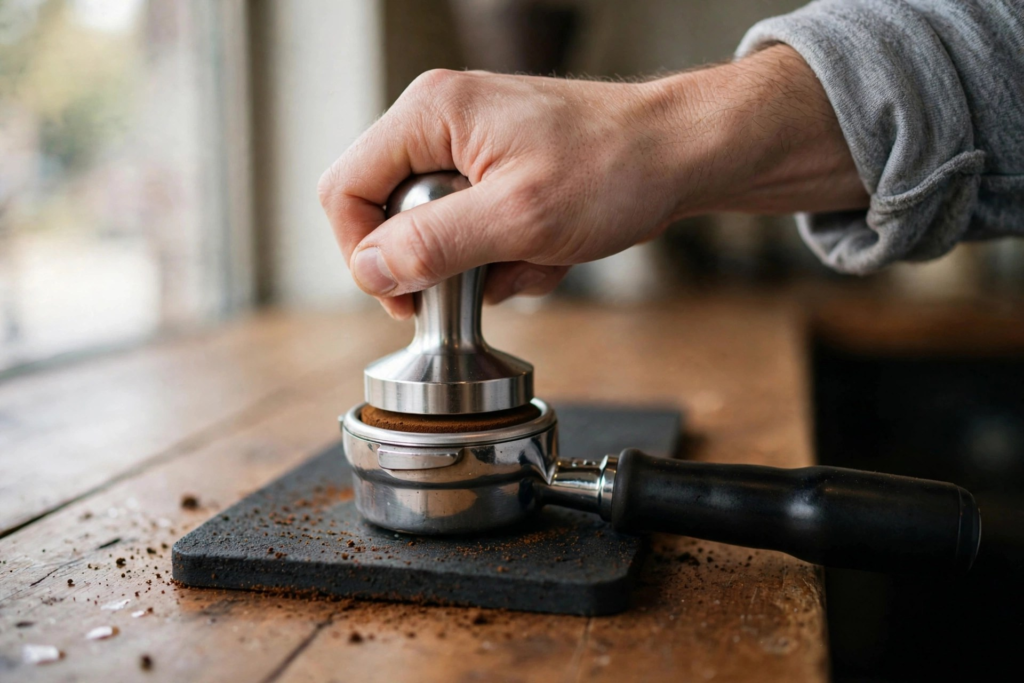
Before the shot, the grounds must be distributed and tamped — pressed into a level, even puck with the tamper. Distribution matters more than force: clumps channel no matter how hard you press. The Weiss Distribution Technique (WDT) — stirring the grounds with fine needles — has become the hobbyist standard for breaking up clumps. Our visual tamping tutorial covers the motion in full, but the short version holds: level, firm, and the same every time beats heroic pressure.
The Language of the Cup
Crema is the reddish-gold foam crowning a well-pulled shot — an emulsion of coffee oils and carbon dioxide created under pressure. Fresh beans make more of it; stale beans make almost none. It’s a rough indicator, not a guarantee. Watch also for blonding, the moment the stream lightens from dark syrup to pale yellow — the shot telling you the bitter tail is arriving. Extraction yield is the geek’s measure: the percentage of the coffee’s mass dissolved into the cup, with 18–22% the widely cited sweet spot.
Steam and Milk
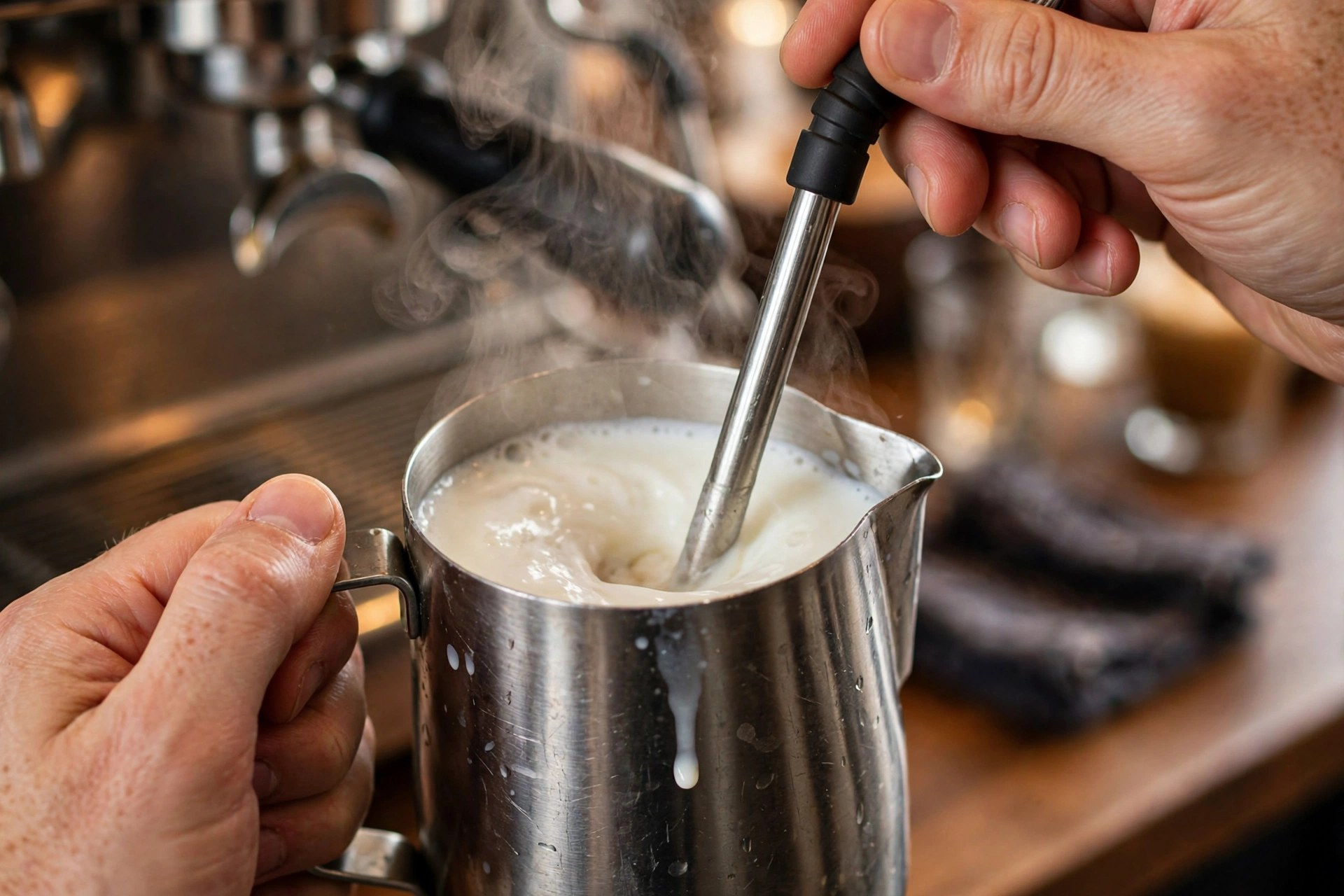
The steam wand releases dry steam for heating and aerating milk. Good technique has two phases — stretching, where the tip sits near the surface and folds air in with a soft hiss, and texturing, where the tip goes deeper and the steam folds that air into glossy microfoam. Microfoam is the goal for lattes and flat whites: milk and air so fully integrated the pitcher pours like wet paint. Big, dry bubbles mean too much air added too fast. Always purge the wand before and after — the first blast is condensation.
Care Terms: Descaling, Backflushing, and the Rest
Espresso machines are chemistry experiments that happen to make coffee, and chemistry leaves residue. Backflushing is the routine of brewing against a blind (hole-less) basket with a pinch of espresso detergent, forcing the cleaning solution back up through the group head to dissolve rancid coffee oils. Descaling runs a descaling solution through the boiler to dissolve mineral scale, the slow killer of heating elements and valves. The best descaling schedule is the one you never need — water filtration, using soft, low-mineral water from the start, prevents scale and is the single cheapest life-extension a machine can get.
Why the Words Matter
None of this vocabulary exists to impress anyone — though it might. It exists because espresso is a system, and you can’t fix a system you can’t name. When a shot runs fast, you need to know whether to blame the grind, the dose, the OPV, or the channeling your naked portafilter is showing you. To see the whole system in motion, our guide to pulling the perfect shot puts every one of these terms to work in a single twenty-five-second ritual.