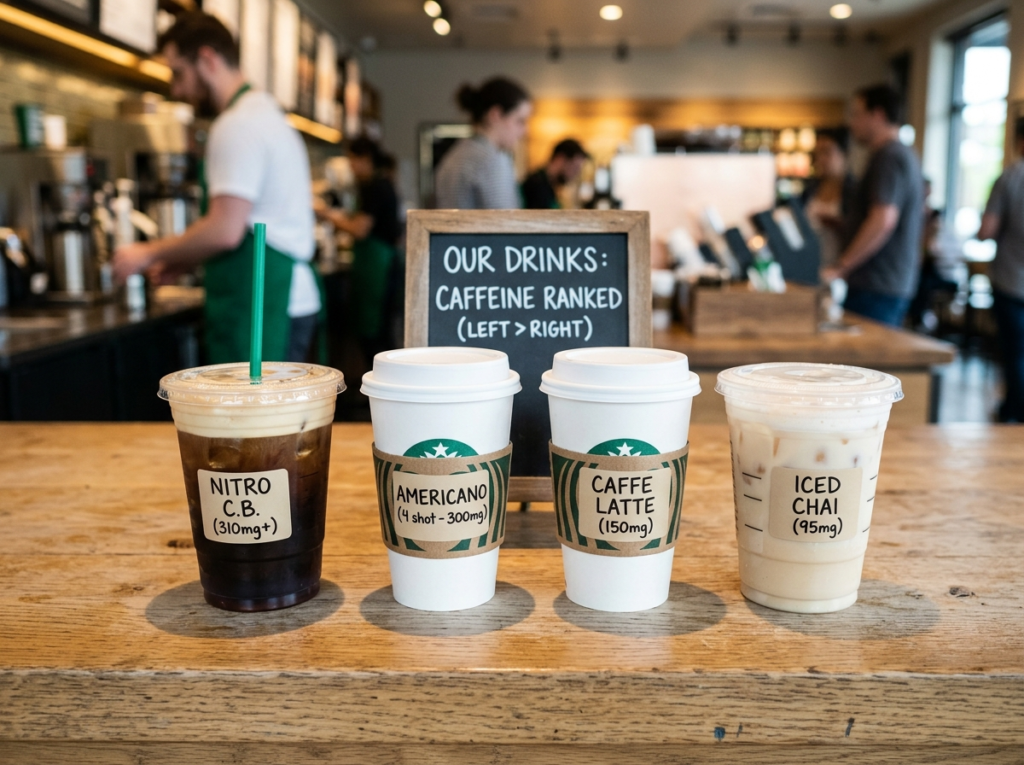
A Venti Blonde Roast at Starbucks packs about 475 mg of caffeine — that’s nearly six cans of Coca-Cola in one cup. Most people walk into Starbucks, order their usual drink, and have zero idea how much caffeine they’re actually consuming. Some think a Frappuccino hits harder than a plain drip coffee. Others assume espresso drinks are always the strongest option on the menu. Both assumptions? Completely wrong.
This Starbucks caffeine chart breaks down the actual caffeine content across the entire menu — from the lightest sips to the most caffeinated Starbucks orders you can place. Whether you need a serious wake-up call or something gentle for an afternoon pick-me-up, you’ll know exactly what you’re getting before you reach the counter.
How Starbucks Caffeine Content Actually Works
Before jumping into the rankings, you need to understand something most people overlook: caffeine at Starbucks doesn’t follow the logic you’d expect.
Your average customer thinks espresso-based drinks are the strongest thing on the menu. Makes sense on the surface — espresso is concentrated, intense, and even smells stronger. But here’s the catch. A single shot of Starbucks espresso contains roughly 75 mg of caffeine. A Grande Latte uses two shots, giving you about 150 mg. Now compare that to a Grande Pike Place brewed coffee sitting at 310 mg. The brewed coffee has more than double the caffeine of your latte.
Why? Because brewed coffee goes through a longer extraction process. Hot water passes through the grounds for several minutes, pulling out significantly more caffeine than the 20-25 second espresso shot. So the “strength” you taste in espresso is really about flavor intensity, not caffeine content.
Size matters too. Starbucks cup sizes change the caffeine game dramatically. A Tall (12 oz) brewed coffee has around 235 mg, while a Venti (20 oz) of the same coffee jumps to 410 mg. But espresso-based drinks don’t scale the same way. A Tall Latte has one shot (75 mg), a Grande has two (150 mg), and a Venti has two shots as well — not three. That surprises a lot of people.
The type of coffee bean also plays a role. Starbucks Blonde Roast beans, despite their lighter flavor profile, actually contain more caffeine than the darker roasts. Lighter roasting preserves more of the bean’s natural caffeine. So that mild-tasting Blonde Roast? It’s quietly the strongest Starbucks drink in the brewed coffee category.
The Highest Caffeine Starbucks Drinks (300+ mg)
If you’re looking for maximum energy and you want the most caffeinated Starbucks order possible, these are the drinks that sit at the top of the chart. All caffeine numbers below are based on Grande (16 oz) size unless stated otherwise.
Blonde Roast Brewed Coffee
Caffeine: ~360 mg (Grande) | ~475 mg (Venti)
This is the reigning champion. The highest caffeine Starbucks drink isn’t some complicated espresso concoction — it’s a simple cup of Blonde Roast drip coffee. No fancy ingredients, no extra charges. Just coffee.
Most people skip right past it on the menu because “blonde” sounds like the lighter, weaker option. And flavor-wise, it is lighter. But lighter roast means more caffeine survived the roasting process. A Venti Blonde Roast gives you almost 475 mg of caffeine, which sits just under the FDA’s recommended daily maximum of 400 mg for most healthy adults. Yes, one cup puts you over the daily suggested limit.
⚠️ Quick Note: If you’re sensitive to caffeine or have any heart-related concerns, a Venti Blonde Roast might be too much in a single sitting. Consider sticking with a Tall.
Pike Place Roast
Caffeine: ~310 mg (Grande) | ~410 mg (Venti)
Pike Place is Starbucks’ signature medium roast and their most popular brewed option. It’s been on the menu since 2008 and remains the default drip coffee at most locations. At 310 mg for a Grande, it still beats almost every espresso-based drink on the menu by a wide margin.
The flavor is balanced — nutty, slightly chocolatey, smooth enough to drink black but forgiving enough for cream and sugar. If you want strong caffeine without going full Blonde Roast, Pike Place is your sweet spot.
Featured Dark Roast
Caffeine: ~260 mg (Grande) | ~340 mg (Venti)
Starbucks rotates its dark roast offerings, but you’ll commonly find options like Sumatra, French Roast, or Italian Roast. Dark roasts have the boldest, smokiest flavor — but as you now know, they carry slightly less caffeine than their lighter counterparts.
Still, 260 mg in a Grande is nothing to dismiss. That’s more caffeine than a Grande Americano, more than most energy drinks on the market, and roughly three times what you’d get from a Monster Energy can.
Starbucks Cold Brew
Caffeine: ~205 mg (Grande) | ~310 mg (Venti)
Cold brew has earned a massive following over the past few years, and its caffeine content is a big reason why. The brewing process — steeping coarsely ground coffee in cold water for about 20 hours — creates a smooth, low-acid drink with a solid caffeine punch.
A Grande Cold Brew lands around 205 mg. Not as high as brewed hot coffee, but significantly more than a standard iced latte. If you order a Venti or add an extra shot, you’re easily crossing 300 mg territory.
Pro Tip: Starbucks’ Nitro Cold Brew only comes in Tall and Grande sizes (no Venti). A Grande Nitro has about 280 mg of caffeine — higher per ounce than regular cold brew because it isn’t diluted with ice.
Strong Espresso-Based Drinks (150–300 mg)
This middle tier is where most of the popular Starbucks menu lives. These are the lattes, macchiatos, and Americanos people order daily. They’re not the strongest, but they’re far from weak.
Caffe Americano
Caffeine: ~225 mg (Grande)
An Americano is espresso diluted with hot water. A Grande uses three shots instead of the usual two, which bumps its caffeine above most other espresso drinks. If you enjoy the taste of espresso but want a full-sized drink, the Americano gives you more caffeine than a latte or cappuccino of the same size.
Wondering how a Caffè Misto compares to a latte? A Misto uses brewed coffee instead of espresso, so it actually packs more caffeine than an Americano — around 310 mg in a Grande since it’s based on Pike Place.
Flat White
Caffeine: ~195 mg (Grande)
The Flat White uses ristretto shots — a shorter, more concentrated espresso pull. A Grande Flat White has three ristretto shots, each containing roughly 65 mg of caffeine. That puts it around 195 mg total.
It’s a creamy, velvety drink with a strong coffee flavor. People who want something richer than a latte but don’t want plain black coffee tend to gravitate here. The caffeine is respectable without being overwhelming.
Standard Latte, Cappuccino, and Mocha
Caffeine: ~150 mg (Grande)
These three classics all share the same espresso base in a Grande size — two shots, giving you about 150 mg of caffeine. The difference between them is all about milk texture and additions.
A latte is smooth steamed milk with espresso. A cappuccino uses more foam. A mocha adds chocolate sauce. But from a caffeine standpoint, they’re identical. The sweetness of a mocha doesn’t change the caffeine at all — a common misconception.
Caramel Macchiato
Caffeine: ~150 mg (Grande)
Same two-shot base as the latte family. The vanilla syrup, caramel drizzle, and milk don’t affect caffeine content. It’s essentially a vanilla latte with caramel on top, served with the espresso poured last. 150 mg in a Grande, same as the others.
Moderate Caffeine Drinks (50–150 mg)
Not everyone needs a caffeine sledgehammer. These mid-range drinks work well for afternoon sipping, for people who are caffeine-sensitive, or for anyone who just doesn’t need 300+ mg at once.
Iced Shaken Espresso Drinks
Caffeine: ~170 mg (Grande, Brown Sugar Oatmilk version)
This is a newer category that’s taken over Starbucks’ menu. The Brown Sugar Oatmilk Shaken Espresso, the Chocolate Almondmilk Shaken Espresso — these drinks use three blonde espresso shots shaken with ice and flavoring. Because they use blonde shots (~85 mg each for a standard shot, but Starbucks uses a slightly different calibration for shaken espressos), a Grande lands around 170 mg.
They taste stronger than a latte because there’s less milk diluting the flavor. They’re also relatively low-calorie compared to other Starbucks options, which is another reason they’ve gotten so popular.
Chai Tea Latte
Caffeine: ~95 mg (Grande)
Starbucks’ Chai Tea Latte uses a concentrated chai syrup that contains black tea extract. At 95 mg for a Grande, it falls roughly in line with a standard cup of black tea. It’s a solid choice if you want some energy without the intensity of coffee.
Worth noting — this is a tea-based drink, so the caffeine hits differently. Many people describe tea caffeine as a slower, more gradual boost compared to coffee’s sharper spike. That’s partly because of L-theanine, an amino acid naturally present in tea that promotes calm focus.
Starbucks Refreshers
Caffeine: ~45 mg (Grande)
Here’s where things often surprise people. Starbucks Refreshers — including the iconic Pink Drink, Strawberry Açaí, and Mango Dragonfruit — do contain caffeine. Not a lot, but it’s there. The caffeine comes from green coffee extract, which is unroasted coffee bean extract.
A Grande Refresher gives you about 45 mg. That’s roughly what you’d find in a can of Diet Coke. If you’re curious about the specific caffeine levels in the Pink Drink or want a deeper breakdown of Refresher caffeine content, those numbers tell a consistent story — light caffeine, not caffeine-free.
Low Caffeine and Caffeine-Free Options (0–50 mg)
Maybe you’re ordering for the evening. Maybe you’re pregnant and limiting intake. Maybe you just don’t want caffeine but still love the Starbucks experience. These options keep you in that safe zone.
Decaf Coffee
Caffeine: ~15-30 mg (Grande)
Decaf isn’t truly zero caffeine. Starbucks’ decaf brewed coffee still contains about 15-30 mg per Grande cup. The decaffeination process removes roughly 97% of caffeine, but a small amount always remains. For most people, that trace amount won’t cause any noticeable effects.
You can also order any espresso-based drink with decaf shots. A Decaf Grande Latte would have around 15 mg total — essentially negligible.
Hot Chocolate
Caffeine: ~25 mg (Grande)
Starbucks hot chocolate contains a small amount of caffeine from the mocha sauce, which is made with cocoa. It’s minimal, but it’s not zero. A Grande has roughly 25 mg — barely noticeable for most adults but worth knowing if you’re ordering for a child.
Herbal Teas (Mint Majesty, Peach Tranquility)
Caffeine: 0 mg
These are your truly caffeine-free options. Herbal teas don’t come from the Camellia sinensis plant (which is where black, green, and white teas get their caffeine). Starbucks’ herbal options like Mint Majesty and Peach Tranquility contain zero caffeine.
Crème Frappuccinos
Caffeine: 0–15 mg (Grande)
Crème-based Frappuccinos don’t use coffee or espresso. The Vanilla Bean Crème Frappuccino, the Strawberry Crème Frappuccino — these are essentially blended milkshakes. Most have zero caffeine unless they include an ingredient like matcha or chocolate that brings a tiny amount along.
If you’re wondering whether Starbucks serves actual milkshakes, the answer is technically no — but Crème Frappuccinos are about as close as it gets.
For anyone who wants to enjoy the Starbucks atmosphere without any caffeine at all, there are also plenty of non-coffee drinks worth trying.
Starbucks Caffeine Chart: Quick Reference
Here’s a clean snapshot of where the most common Starbucks drinks land, all based on Grande (16 oz) size:
Blonde Roast Brewed Coffee — 360 mg
Pike Place Roast — 310 mg
Caffè Misto (with Pike Place) — 310 mg
Nitro Cold Brew (Grande) — 280 mg
Featured Dark Roast — 260 mg
Caffe Americano — 225 mg
Cold Brew Coffee — 205 mg
Flat White — 195 mg
Shaken Espresso Drinks — 170 mg
Latte / Cappuccino / Mocha — 150 mg
Caramel Macchiato — 150 mg
Chai Tea Latte — 95 mg
Matcha Latte (with default recipe) — 80 mg
Green Tea — 25-30 mg
Refreshers (Pink Drink, etc.) — 45 mg
Hot Chocolate — 25 mg
Decaf Brewed Coffee — 15-30 mg
Herbal Tea — 0 mg
Crème Frappuccinos — 0-15 mg
Keep in mind — these are Starbucks’ official approximate numbers. Your actual drink may vary slightly depending on the barista, brew time, and specific beans in rotation that day.
How to Customize Your Caffeine Level
One of the best things about Starbucks is that you’re not locked into the standard menu. You can adjust your caffeine up or down with a few simple modifications.
Want More Caffeine?
Ask for an extra shot. Each additional espresso shot adds about 75 mg. So a Grande Latte with an extra shot goes from 150 mg to 225 mg. You can also ask for blonde espresso shots instead of the standard signature espresso — blonde shots have slightly more caffeine per shot (about 85 mg vs. 75 mg).
Another easy hack: order a Venti brewed coffee instead of a Venti latte. You’ll get 410 mg vs. 150 mg for roughly the same price. That’s a huge difference for the same cup size.
Want Less Caffeine?
Ask for fewer shots. You can get a single-shot latte in any size. You can request half-caf (one regular shot, one decaf). Or you can switch to a Vanilla Frappuccino, which has a surprisingly moderate caffeine level compared to hot espresso drinks.
Ordering a Short size (8 oz) is another underrated move. Most locations don’t display it on the menu board, but you can absolutely order it. A Short brewed coffee has about 155 mg — still solid but much more manageable than a Grande.
Starbucks vs. Other Caffeine Sources
It helps to put Starbucks caffeine numbers into perspective. How does a Grande Pike Place compare to other popular caffeine sources?
A standard 8 oz cup of home-brewed coffee has about 95 mg of caffeine. A Grande Pike Place at 310 mg is essentially three cups of home coffee in one serving. A single can of Red Bull (8.4 oz) has about 80 mg — so a Grande Pike Place is roughly four Red Bulls. Even a Monster Energy can with its 160 mg doesn’t come close to Starbucks’ brewed coffees.
That’s important context. People often treat energy drinks as the “heavy hitter” category for caffeine, but a plain Starbucks drip coffee quietly surpasses most of them. If you’ve ever felt jittery after a large Starbucks order, caffeine content — not sugar, not anxiety — is probably the real reason.
The FDA recommends 400 mg as a general daily limit for healthy adults. A single Venti Blonde Roast exceeds that. So if you’re drinking Starbucks daily, especially larger sizes, tracking your total caffeine intake across the day is worth doing.
What Affects How Caffeine Hits You
Two people can drink the same Grande Pike Place and feel completely different effects. Caffeine metabolism varies based on several real factors.
Body weight plays a role. A 130-pound person will feel 310 mg of caffeine more intensely than a 200-pound person. Genetics matter too — some people carry a variant of the CYP1A2 gene that makes them process caffeine faster. They can drink coffee at 8 PM and sleep fine. Others metabolize caffeine slowly and feel one cup for six to eight hours.
Tolerance is another big factor. If you drink coffee every single day, your adenosine receptors adapt, and you’ll need more caffeine to feel the same “boost.” That’s why some daily Starbucks drinkers barely feel a Grande but occasional drinkers get wired from a Tall.
Food intake changes things too. Drinking coffee on an empty stomach means faster absorption and a sharper caffeine spike. Having it with food slows things down and creates a more gradual effect.
Medications can interact with caffeine. Birth control pills, certain antibiotics (like ciprofloxacin), and some antidepressants can slow caffeine metabolism significantly. If you’re on any medication, it’s worth checking whether caffeine interactions are a factor.
FAQ
What is the strongest Starbucks drink by caffeine?
The strongest standard Starbucks drink is the Venti Blonde Roast brewed coffee at approximately 475 mg of caffeine. Among espresso-based drinks, a Venti Americano with its four shots comes in at about 300 mg. You can push caffeine even higher by adding extra blonde espresso shots to any drink.
Do Frappuccinos have a lot of caffeine?
Not really. Coffee-based Frappuccinos like the Caramel or Mocha Frappuccino contain roughly 95-100 mg of caffeine in a Grande — less than a brewed coffee of the same size. Crème-based Frappuccinos (Vanilla Bean, Strawberry) have little to no caffeine since they don’t contain espresso or coffee.
Does the Pink Drink at Starbucks have caffeine?
Yes. The Pink Drink contains about 45 mg of caffeine in a Grande, sourced from green coffee extract in the Strawberry Açaí base. It’s a low amount — comparable to about half a cup of green tea — but it’s not caffeine-free.
Is Starbucks Blonde Roast stronger than Dark Roast?
In terms of caffeine, yes. Blonde Roast contains more caffeine because lighter roasting preserves more of the bean’s natural caffeine content. A Grande Blonde Roast has about 360 mg compared to roughly 260 mg for a dark roast. The flavor of dark roast is bolder, but the caffeine content is actually lower.
How many shots of espresso are in a Venti Latte at Starbucks?
A Venti hot Latte contains two shots of espresso (about 150 mg of caffeine) — the same number as a Grande. A Venti iced Latte, which uses a larger 24 oz cup, gets three shots (about 225 mg). This is one of the most common surprises on the Starbucks menu.
Your Next Starbucks Order
Now you know exactly where every Starbucks drink falls on the caffeine spectrum. The biggest takeaway? Brewed coffee dominates espresso drinks when it comes to pure caffeine content, and Blonde Roast sits at the very top — not where most people would guess.
Next time you’re standing in that Starbucks line, think about what you actually need. A morning jolt to power through a busy day? Go for the Blonde Roast or Cold Brew. An afternoon treat that won’t keep you up at night? A Refresher or Chai Tea Latte keeps things mellow. And if you’re ordering late in the evening, herbal tea or a Crème Frappuccino lets you enjoy the experience without any caffeine consequences.
Your perfect Starbucks order isn’t just about flavor — it’s about knowing exactly what that cup is doing to your body. And now, you do.