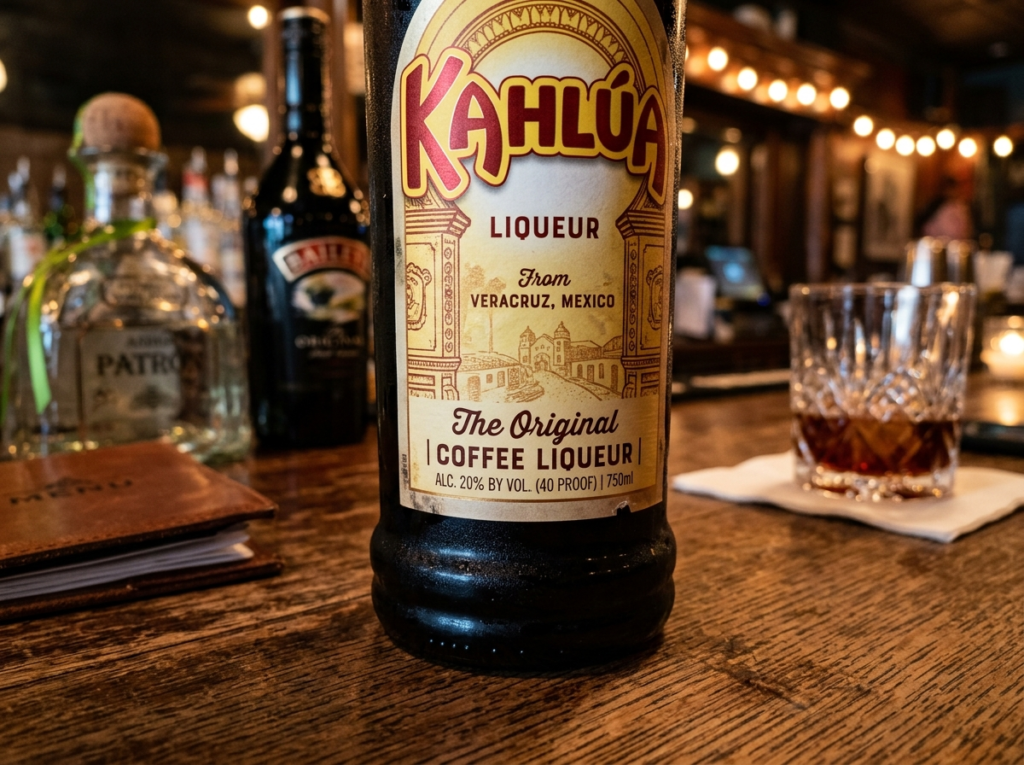
Most people grab a bottle of Kahlua thinking it’s basically coffee with a slight kick. And honestly, that rich, sweet, dessert-like flavor does make it easy to forget you’re drinking alcohol at all. But here’s the thing — Kahlua does contain a real amount of alcohol, and if you’re mixing drinks, pouring it over ice cream, or sipping it straight, you should know exactly what you’re working with.
The Kahlua alcohol content sits at 20% ABV (alcohol by volume), which translates to 40 proof. That’s not as light as you might assume from something that tastes like a coffee milkshake. And it’s not as strong as a bottle of vodka either. It falls right in that middle zone — enough to matter, easy to underestimate.
Let’s break this down properly so you know exactly how strong Kahlua is, how it compares to other drinks, and what that ABV means when you’re actually pouring it into your glass.
What Does 20% ABV Actually Mean for Kahlua?
ABV stands for “alcohol by volume.” It tells you what percentage of the liquid in the bottle is pure alcohol. So when you see that the Kahlua ABV percentage is 20%, it means one-fifth of every pour is alcohol.
To put that in perspective, think about a standard 1.5-ounce shot. If you pour a shot of Kahlua, roughly 0.3 ounces of that is pure alcohol. That’s about half the alcohol you’d get from a shot of vodka or whiskey (which typically clock in at 40% ABV).
Now, that might sound manageable. And for a single serving, it is. The catch? People rarely drink Kahlua the way they drink whiskey. Nobody’s nursing a neat Kahlua and contemplating life. It usually goes into mixed drinks — White Russians, Espresso Martinis, mudslides — where you might pour two or three ounces without blinking. Those cocktails add up faster than you’d expect.
Quick fact: Kahlua’s 20% ABV has actually been the standard since around 2004. Before that, the original formula sat at 26.5% ABV. The company reformulated to create a smoother, more mixable profile. So if your uncle tells you “Kahlua used to hit different back in the day,” he’s not wrong — it literally did.
Kahlua Proof Explained: Why the Number Is 40
You’ll sometimes see alcohol strength listed as “proof” instead of ABV, especially in the United States. The conversion is simple: proof = ABV × 2. Since Kahlua has 20% ABV, the Kahlua proof is 40.
This system dates back centuries — originally, spirits were “proved” by mixing them with gunpowder and lighting it on fire. If it burned, the alcohol was “proved” strong enough. The modern system is much less dramatic but equally useful.
Here’s why this matters practically. If you’re comparing bottles at a liquor store and one label says “40 proof” while another says “20% ABV,” they’re telling you the exact same thing. Don’t let the different numbers confuse you — some brands lean on proof because a higher number looks more impressive on the shelf.
At 40 proof, Kahlua falls into the liqueur category. Most liqueurs range from 30 to 70 proof. So Kahlua sits on the lower-to-middle end of that spectrum, which partly explains why it goes down so easily.
How Strong Is Kahlua Compared to Other Drinks?
Numbers in isolation don’t mean much. You really understand how strong Kahlua is when you stack it against drinks you already know. Here’s how it lines up:
Beer typically ranges from 4% to 6% ABV. Kahlua at 20% is roughly four times stronger than your average beer. One shot of Kahlua packs about the same alcohol as drinking half a standard beer — in a much smaller volume.
Wine usually falls between 12% and 15% ABV. Kahlua is noticeably stronger. A glass of wine and a generous pour of Kahlua aren’t far apart in alcohol content, but the Kahlua tastes sweet enough to make you forget you’re drinking something stronger.
Vodka, rum, and whiskey generally hit 40% ABV (80 proof). Kahlua is exactly half their strength. That’s worth remembering when you’re making cocktails — the Kahlua adds real alcohol, even if you’re pairing it with a stronger spirit.
Baileys Irish Cream comes in at 17% ABV. So Kahlua is slightly stronger than Baileys, despite both being cream/dessert liqueurs that people treat as “light” drinks. If you’re curious about how these two stack up beyond just alcohol content, there’s a detailed comparison of Kahlua vs Baileys that covers flavor, uses, and more.
Twisted Tea, a popular flavored malt beverage, sits at only about 5% ABV. Kahlua is four times stronger. You can read more about Twisted Tea’s alcohol content if you’re comparing different drink options for a gathering.
The takeaway? Kahlua isn’t a “barely alcoholic” drink. It’s a proper liqueur with a meaningful ABV. Treat it that way.
Why People Underestimate Kahlua’s Alcohol Content
There’s a real pattern here, and it trips people up all the time. Kahlua’s flavor profile works against your natural caution.
The sweetness factor. Kahlua contains sugar — quite a bit of it. Sweet drinks mask the alcohol burn that normally signals “hey, slow down.” Your tongue tastes coffee, vanilla, and caramel. It doesn’t detect the 20% ABV hiding underneath. Compare that to sipping bourbon, where the alcohol announces itself on every sip. Your body’s warning system gets bypassed with sweet liqueurs.
The coffee association. Your brain links coffee flavor with alertness, productivity, and morning routines — not with getting tipsy. This psychological association makes it harder to register Kahlua as a “real” alcoholic drink. You might feel alert because of the caffeine in Kahlua (yes, it does contain a small amount of caffeine from real coffee beans), but that alertness doesn’t cancel out the alcohol.
Cocktail dilution illusion. In a White Russian, Kahlua gets mixed with vodka, cream, and ice. The drink tastes like a dessert. But you’re actually combining a 20% ABV liqueur with a 40% ABV spirit. The final cocktail might taste gentle, but it’s carrying serious alcohol.
Pro tip: If you’re watching your intake, count a 1.5-ounce pour of Kahlua as roughly half a standard drink. Two ounces? That’s getting close to a full standard drink. Track accordingly.
Kahlua in Cocktails: How the ABV Adds Up
Let’s get specific about what happens when Kahlua enters popular cocktails. Because understanding the Kahlua alcohol by volume really matters when you’re mixing drinks — especially at home where nobody’s measuring precisely.
White Russian — The classic recipe calls for 1.5 oz vodka, 1 oz Kahlua, and 1 oz heavy cream. Total alcohol? You’re looking at roughly 1.5 standard drinks in a single glass. The cream and sweetness make it dangerously smooth.
Espresso Martini — This typically uses 1.5 oz vodka, 1 oz Kahlua, and a shot of espresso. You’re getting a similar alcohol load to the White Russian, but the espresso adds real caffeine. You’ll feel wide awake and energized while the alcohol is still doing its thing. That’s a combination worth respecting.
Mudslide — Kahlua, Baileys, and vodka blended with ice cream. You’re combining two liqueurs (both with significant ABV) plus a full-strength spirit, all disguised as a milkshake. These can easily pack 2+ standard drinks per serving.
B-52 Shot — Equal parts Kahlua, Baileys, and Grand Marnier, layered in a shot glass. Even in a small 1.5-ounce shot, you’re consuming liqueurs that average around 20-30% ABV each. Not a “weak” shot by any measure.
Kahlua and Milk — The simplest mixed drink. Usually 2 oz Kahlua in a glass of cold milk. This one’s more moderate — about one standard drink. But it tastes so much like chocolate milk that people sometimes pour a second glass without thinking. If you’re curious about the caffeine side of this combination, here’s a closer look at Kahlua and milk caffeine content.
The pattern is clear. Kahlua shows up in dessert-style drinks where people let their guard down. Knowing the ABV helps you enjoy them without overdoing it.
Does Kahlua’s Alcohol Content Vary by Product?
Yes — and this catches people off guard. Kahlua makes several varieties, and they don’t all share the same ABV.
Original Kahlua is the standard at 20% ABV (40 proof). This is the bottle most people know and buy.
Kahlua Especial is a stronger, more coffee-forward version designed for bartenders and cocktail enthusiasts. It comes in at 35% ABV (70 proof) — nearly double the standard. If someone hands you a drink made with Especial and you’re expecting regular Kahlua strength, you’ll be in for a surprise.
Kahlua Flavored Varieties (like Kahlua Mint Mocha, Kahlua Vanilla, or Kahlua Salted Caramel) typically match the original at 20% ABV, though some limited-edition flavors have varied slightly. Always check the label on flavored versions.
Kahlua Ready-to-Drink products (pre-mixed cocktails in cans or bottles) usually come in much lower, around 5-12.5% ABV depending on the specific product and market.
The lesson? Don’t assume every Kahlua product is 20% ABV. Read the label. Especially with Kahlua Especial, where the alcohol content jumps dramatically.
Shelf Life and Storage: Does ABV Affect How Long Kahlua Lasts?
This is a question that comes up constantly, and it’s directly tied to the alcohol content. Kahlua’s 20% ABV is high enough to act as a preservative, but it’s not high enough to keep the liqueur fresh indefinitely.
Full-strength spirits like vodka (40% ABV) can last basically forever once opened. The high alcohol prevents any spoilage. But Kahlua’s lower ABV, combined with its sugar and dairy-adjacent ingredients, means it does have a limited shelf life.
An unopened bottle stays good for about 4 years from production. An opened bottle should ideally be consumed within 18 months. After that, the flavor starts to degrade — the coffee notes go flat, and the sweetness can turn slightly off. It won’t make you sick, but it won’t taste right either.
If you’ve got a bottle sitting in your cabinet and you’re not sure where it stands, there’s a thorough guide on whether Kahlua goes bad that covers all the signs to watch for.
Store your bottle in a cool, dark place with the cap tightly sealed. The fridge isn’t necessary but won’t hurt either. Just don’t leave it on a sunny countertop for months — heat and light are Kahlua’s enemies.
How to Drink Kahlua Responsibly (Without Overthinking It)
You don’t need to treat Kahlua like it’s dangerous. At 20% ABV, it’s a moderate-strength liqueur. But you do need to respect it the same way you’d respect any alcoholic drink.
Measure your pours. Free-pouring Kahlua is where most people get into trouble. That “generous splash” you added to your coffee might be 3 ounces, which is over a full standard drink. A jigger takes two seconds to use.
Pace yourself with dessert cocktails. Drinks like White Russians and mudslides go down fast because they taste like desserts. Treat them like any other cocktail — sip, don’t chug. Have a glass of water between rounds.
Watch out for the caffeine-alcohol combination. Kahlua contains a small amount of caffeine from real coffee beans. When you mix it with espresso (like in an Espresso Martini), you get enough caffeine to feel alert even as the alcohol impairs your judgment. Feeling awake isn’t the same as being sober. If you’re interested in understanding more about how caffeine interacts with your system, you might find it useful to read about how long energy drinks like Red Bull last — the caffeine dynamics are similar.
Know your personal limit. Two ounces of Kahlua is roughly one standard drink. If you normally have a two-drink limit, that means about 4 ounces of Kahlua total for the evening — before counting any other spirits in your cocktails.
Kahlua Alcohol Content in Food and Cooking
Here’s where things shift. Kahlua shows up in a ton of recipes — tiramisu, brownies, ice cream, sauces, and coffee drinks. So what happens to the alcohol content when you cook with it?
Baked goods: Alcohol evaporates during baking, but not completely. After 30 minutes in the oven, roughly 35% of the original alcohol remains. After an hour, about 25% still lingers. A tablespoon of Kahlua in a batch of brownies distributes an incredibly tiny amount of alcohol per serving — practically negligible.
No-bake desserts: Tiramisu, mousse, and similar recipes don’t involve heat. The alcohol stays fully intact. A tiramisu made with a generous pour of Kahlua will contain real, measurable alcohol. Worth noting if you’re serving it to kids or to anyone avoiding alcohol.
Coffee drinks: Adding a shot of Kahlua to hot coffee will cause some alcohol to evaporate from the heat, but not all. The drink will still be alcoholic. If you’re looking for a non-alcoholic coffee treat instead, you might enjoy something like a Vanilla Frappuccino — all the sweet coffee flavor, zero ABV.
Did you know? Professional pastry chefs often prefer Kahlua Especial (35% ABV) for baking because the stronger coffee flavor survives the heat better than the standard version. The higher ABV itself burns off similarly during cooking.
Frequently Asked Questions
What is the exact Kahlua ABV percentage?
Standard Kahlua Original has an ABV of 20%, which equals 40 proof. This has been the standard since the early 2000s when the formula was adjusted from its previous 26.5% ABV. Kahlua Especial, a bartender-focused version, is considerably stronger at 35% ABV (70 proof).
Is Kahlua stronger than beer or wine?
Yes, Kahlua is stronger than both. Most beers fall between 4-6% ABV, and wines typically range from 12-15% ABV. At 20% ABV, Kahlua is roughly three to four times stronger than beer and noticeably stronger than most wines. Don’t let the sweet, dessert-like taste fool you into treating it casually.
Can Kahlua get you drunk?
Absolutely. Kahlua is a real alcoholic beverage with 20% ABV. Drinking several ounces — especially in cocktails mixed with other spirits like vodka — can definitely lead to intoxication. Because it tastes sweet and smooth, people sometimes consume more than they realize. A White Russian, for example, can contain 1.5 standard drinks in a single glass.
How much caffeine is in Kahlua along with the alcohol?
Kahlua contains a small amount of caffeine — roughly 5 mg per 1.5-ounce serving — because it’s made with real Arabica coffee beans. That’s significantly less than a cup of coffee (which has around 95 mg), but it’s not zero. The caffeine doesn’t counteract the alcohol’s effects on your body.
Does Kahlua alcohol content change when mixed with milk or cream?
The total alcohol doesn’t change — you still consume the same amount. But diluting Kahlua with milk or cream lowers the overall ABV of the drink in your glass. A 2 oz pour of Kahlua (20% ABV) mixed into 6 oz of milk creates a drink that’s roughly 5% ABV overall. That’s about the same strength as a beer — but the alcohol quantity you consume is still equivalent to one standard drink.
Your Next Pour
Kahlua at 20% ABV is one of those drinks that deserves more respect than it usually gets. It’s not “barely alcoholic.” It’s not a soft drink with attitude. It’s a proper liqueur with enough alcohol to matter, wrapped in a flavor profile that makes you forget that fact.
Now that you know exactly how strong it is — and how that strength plays out in cocktails, cooking, and mixed drinks — you can enjoy it with your eyes open. Measure your pours, pace your cocktails, and appreciate the coffee-meets-spirit balance for what it is.
If you’ve got a bottle on your shelf right now, maybe tonight’s the night for a properly made White Russian. Just remember: one standard drink is about two ounces of Kahlua. Everything beyond that is a conscious choice — and that’s exactly how good drinking should work.